• We’re currently investigating an issue related to the forum theme and styling that is impacting page layout and visual formatting. The problem has been identified, and we are actively working on a resolution. There is no impact to user data or functionality, this is strictly a front-end display issue. We’ll post an update once the fix has been deployed. Thanks for your patience while we get this sorted.

GTX 680 Versus 7970 GHZ Edition

Page 4 - Seeking answers? Join the AnandTech community: where nearly half-a-million members share solutions and discuss the latest tech.
Why do you type "u" for you ? Are you on your iphone or something?

Anyway, I pretty much agree with his statement. The 7970 wins some games, and the 680 wins others - most review websites really tend to favor bf3 and skyrim which favors nvidia hardware, while other games run a lot better on the 7970 (metro , crysis, alan wake, some others). In terms of overclocking the 7970 has the upper hand here currently. With voltage modification you can reach absurdly high overclocking speeds on water, and I was able to get 1150 on both of my cards with 50% manual fan. So there isn't a clear winner unless you a) don't overclock b) only play bf3 and skyrim.

Since you mention hardocp they did do a max 680 oc vs max 7970 oc in various games and while nvidia games tend to be about even (bf3 , skyrim) other games definitely run faster on tahiti. But there's also other factors that come into play, such as the software benefits of being in the nvidia ecosystem (I really have to give it to nvidia -- their software development for their cards is awesome) and you don't get the oddities that some 7970 users report. Currently i've switched to nvidia for the time being and I really enjoy being in their software ecosystem - but its not a flat out upgrade in some respects. I definitely get slightly lower framerates in a few games, but bf3 and skyrim are just better on nvidia hardware when you take OC'ing out of the picture.

The big problem here is what else does 7970 have going for it? I think the hardware is pretty good, and is great for overclocking, but unless it offers a clear benefit over the 680 I think most people would rather get the 680 or 670. I personally think a 1.5gb 7970 at 380$ or so would be a fantastic idea, but AMD will never do this. So there is no major benefit to getting a 7970 unless you really want to go insane with water cooling.
Yup I was on iphone 😀
[H] recommended 680 for single,sli and even for tri sli configurations over amd's offerings.I don't want to start a Nv vs Amd war here,but 680 is better in almost every metric.U can find benches where 7970 is ahead sure,but for the vast majority of games 680 pulls ahead making it a natural winner.If u typically play those games where 7970 is stronger by all means get a 7970,but for the rest 680 will be a better option.
 
Umm...I do. It makes me extra money, and I've paid for one of my 6950s already.

The current price are pretty crappy. I made some nice cash with my 5870 and 6870 last year (1Q-3Q) but now it's just not worth it when you factor-in the price of electricity, wear/tear on components, and heat produced.
 
I keep seeing the 7970 favored over the GTX 680 for triple monitor setups due to the extra gig or vram. At 5760 x 1080 resolution does the 2 vs 3 gigs affect most games? This review of triple monitor setups, believe it or not, favored the GTX 680 overall.
http://hexus.net/tech/reviews/graphics/37253-three-screen-geforce-gtx-680-vs-radeon-hd-7970/

The issue is that 2GB is not at all future proof for those resolutions. Most triple monitor users started with the 5870 1GB, and have since needed to upgrade because of VRAM limitations. Hence, given very similar performance, most triple monitor users will go for the card with more VRAM, not to mention the superior feature set on the 7970.
 
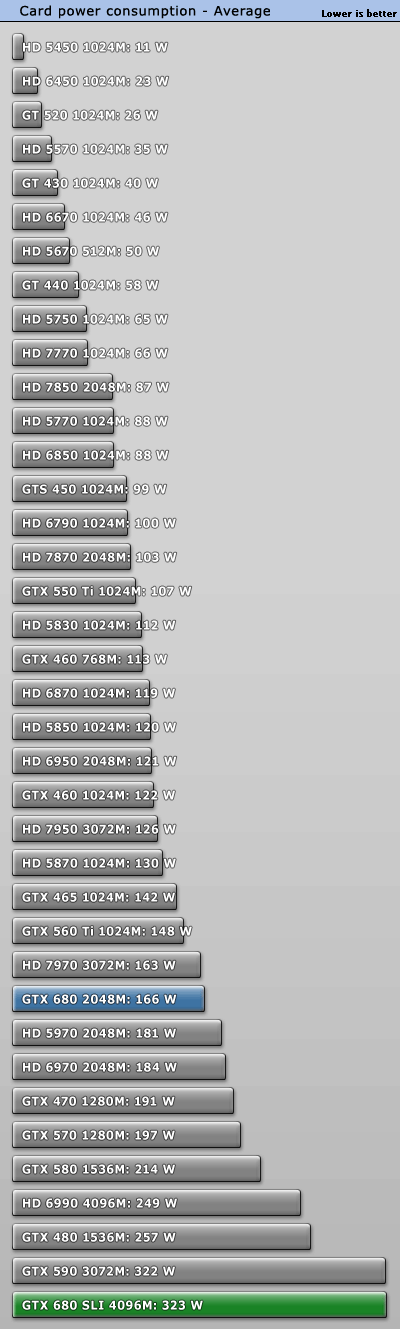
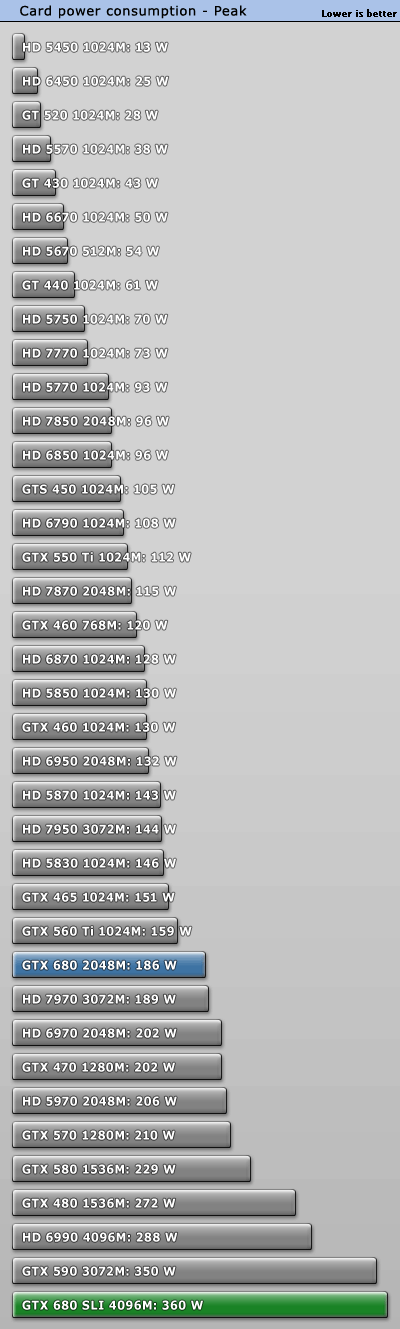
Average power consumption, is what what most people should be paying attention to.


So, a 13% difference in power consumption under typical gaming session. The additional gigabyte of video ram is also accountable for the higher power draw of the 7970.


About 7% difference here.

IMO, power consumption isn't really 670's main selling point. They are minuscule under load and slightly worse at idle. Mixed bag. Once 7970 will have dropped in price, people will be jumping on it.

Power consumption is really important to a lot of people (and AMD as well previously). With a standard 700-750w PSU, most users could easily SLI a pair of 670s or 680s, even overclocked. You would have to keep your 7970s at stock, undervolted to make that happen in many cases, with their max power usage.

FYI - my GPU is pegged at 100% pretty much all the time while playing D3 these days. The important power numbers are at idle (both companies are competitive here) and load. When you game, your GPU is likely mostly loaded unless you are rocking older games, and then its probably close to idle anyways. Same goes for compite tasks; you are idle or load. I don't need that extra heat in my case, around my case, or in my office. If I want the extra heat, it should be because it is much faster, which it is not.
 
Do what the rest of us do. Get a Real Job :whiste: :biggrin:

If money is no object as you imply, wouldn't a watercooled 7970 be the best bet? :sneaky:

Power consumption is really important to a lot of people (and AMD as well previously). With a standard 700-750w PSU, most users could easily SLI a pair of 670s or 680s, even overclocked. You would have to keep your 7970s at stock, undervolted to make that happen in many cases, with their max power usage.

FYI - my GPU is pegged at 100% pretty much all the time while playing D3 these days. The important power numbers are at idle (both companies are competitive here) and load. When you game, your GPU is likely mostly loaded unless you are rocking older games, and then its probably close to idle anyways. Same goes for compite tasks; you are idle or load. I don't need that extra heat in my case, around my case, or in my office. If I want the extra heat, it should be because it is much faster, which it is not.

If you're dropping $800-1000 on graphics cards, I'm pretty sure you could spring for the extra $50 to get a more powerful PSU. The 600 series does better than Tahiti with power consumption but the difference is blown out of proportion IMO.
 
Do what the rest of us do. Get a Real Job :whiste: :biggrin:

As per my edit, it makes me "extra money".

Enough for beers/entertainment/etc. 🙂

Don't be mad cause your nV card is not working FOR you! 😛

The current price are pretty crappy. I made some nice cash with my 5870 and 6870 last year (1Q-3Q) but now it's just not worth it when you factor-in the price of electricity, wear/tear on components, and heat produced.
I still do it because I pay a flat rate on electricity, but I have the whole system (2x6950s) down to about ~300w at load (this is with just the 2 cards crunching) measured with a kill-a-watt...I'm not sure how accurate they are..
 
Last edited:
Yes, I want to know what is a superior feature set.

For multi-monitor users AMD has additional features like task-bar repositioning. You can connect more than three monitors. You can use monitors of different sizes in eyefinity. You also have a number of games using the eyefinity API that will only center the HUD when you use an AMD graphics card. I'm definitely not a fan of the later, but it's an advantage.
 
I keep seeing the 7970 favored over the GTX 680 for triple monitor setups due to the extra gig or vram. At 5760 x 1080 resolution does the 2 vs 3 gigs affect most games? This review of triple monitor setups, believe it or not, favored the GTX 680 overall.
http://hexus.net/tech/reviews/graphics/37253-three-screen-geforce-gtx-680-vs-radeon-hd-7970/

I'm not even going to open that link due to the mass use of canned benchmarks. This is what actual gameplay found out:

http://www.hardocp.com/article/2008/02/11/benchmarking_benchmarks/4

http://www.hardocp.com/article/2012/05/14/geforce_680_670_vs_radeon_7970_7950_gaming_perf/3
(oc vs oc, 2560x1600: 7970 = 680 and both are > 670 which is > 7950)

Even if we postulated that going to higher than 2560x1600 doesn't help the 7970 at all, they are still basically tied when both are max oc'd, and the 7970 is more futureproof with the extra VRAM at Eyefinity resolutions.


For multi-monitor users AMD has additional features like task-bar repositioning. You can connect more than three monitors. You can use monitors of different sizes in eyefinity. You also have a number of games using the eyefinity API that will only center the HUD when you use an AMD graphics card. I'm definitely not a fan of the later, but it's an advantage.

NV can go up to 4 monitors now. Without needing adapters. They also center your taskbar by default so that's probably the only one you need.

You can use different monitor sizes in Eyefinity, true, not rez though IIRC.

I didn't know that about the Eyefinity APIs; do you know where I can find a list?

The biggest multi-mon advantage is one you didn't list, imho: presets and using hotkeys to switch between them in a matter of seconds, rather than having to dive into the driver control panel every time you want to go from one config to another. I use three configs a lot and the hotkeys are great to switch between:

1 monitor centered
3 monitor extended desktop
3 monitor Eyefinity
 
Last edited:
If you're dropping $800-1000 on graphics cards, I'm pretty sure you could spring for the extra $50 to get a more powerful PSU. The 600 series does better than Tahiti with power consumption but the difference is blown out of proportion IMO.
This.

http://forums.anandtech.com/showthread.php?t=2249983

New drivers for 7970 have increased performance apparently though I am skeptical that the gains are that big in real life.
Yeah, I am curious as well. Anybody want to check?
 
I keep seeing the 7970 favored over the GTX 680 for triple monitor setups due to the extra gig or vram. At 5760 x 1080 resolution does the 2 vs 3 gigs affect most games? This review of triple monitor setups, believe it or not, favored the GTX 680 overall.
http://hexus.net/tech/reviews/graphics/37253-three-screen-geforce-gtx-680-vs-radeon-hd-7970/

It's real simple. Some games will work better with the additional bandwidth and/or additional memory buffer the 7970 provides. Others won't. If you do a review choosing games that don't benefit from it, then the results will say it doesn't matter.
 
Power consumption is really important to a lot of people (and AMD as well previously). With a standard 700-750w PSU, most users could easily SLI a pair of 670s or 680s, even overclocked. You would have to keep your 7970s at stock, undervolted to make that happen in many cases, with their max power usage.

FYI - my GPU is pegged at 100% pretty much all the time while playing D3 these days. The important power numbers are at idle (both companies are competitive here) and load. When you game, your GPU is likely mostly loaded unless you are rocking older games, and then its probably close to idle anyways. Same goes for compite tasks; you are idle or load. I don't need that extra heat in my case, around my case, or in my office. If I want the extra heat, it should be because it is much faster, which it is not.

power_average.gif
power_peak.gif


^This is the actual difference in power consumption while gaming. We are talking 3 watts, one way or the other. Now, when you overvolt the 7970 and can't overvolt the 680, then we start seeing those 100W differences that favor the 680 everyone seems to latch onto.

As you say power consumption is important and to "AMD as well previously". All of this "previous" talk started when comparing the 5870 to the 480. Look at the charts above. We're talking differences in excess of 100W, not 3W. Even then though it didn't seem to matter as people bought the 480 anyway.

So, nVidia has managed to design a stripped down gaming chip that is competitive with AMD's full compute capable chip in gaming efficiency comparisons. Good for them. They have definitely made huge improvements since the 480. I think it's really interesting though when people want to continuously drive home the efficiency advantage of GK104 compared to Tahiti. Because, in actuality, it's really not enough of a difference to matter.

  • __________________
    My Rig:
    i7 3930K @ 4.62Ghz (132*35) 1.34v NH-D14 SE2011
    Asus Sabertooth X79 0604 BIOS
    32GB (8x4GB) @ 1365mhz 7-7-7-22 1.5v
    Galaxy GTX 670 1215/1700
    Kingston 120GB III/Intel X-25M/1.5TB Samsung
    Dell 2408wfp

^This is the rig from your sig. An O/C'd X79 (socket 2011) 6c rig with 32gig of RAM is not going to turn into an efficient gaming rig by using a 670 instead of a 7970.

You, of course, are allowed to have any type of rig you want to. You might even do more than game and need 6c/12t and all that RAM. I'm just saying that, for it's intended use, the 670/680 is not going to effect anything, including heat/noise, enough to matter. A 22nm Ivy Bridge set up, or 16gig instead of 32gig of RAM will matter far more.
 
Back
Top