

GTX 670 Drops Tomorrow. Buying One?
Page 8 - Seeking answers? Join the AnandTech community: where nearly half-a-million members share solutions and discuss the latest tech.
You are using an out of date browser. It may not display this or other websites correctly.
You should upgrade or use an alternative browser.
You should upgrade or use an alternative browser.

blastingcap
Diamond Member
- Sep 16, 2010
- 6,654
- 5
- 76
OR $399 GTX670 OC ~ HD7970 reference performance for $550 4 months ago. $150 improvement on the price/performance curve. But HD7970 owners have enjoyed their cards for 4 months. The price of an early adopter is understanding that in 4-6 months something faster or cheaper with similar performance may be released but they get to enjoy the latest and greatest. I think this time though it was more obvious than ever. When HD7950 launched at $450 but only beat GTX580 by 5%, I think most people suspected AMD's is going to have trouble.
It worked out well for AMD that GK100 was unworkable/unprofitable based on current 28nm yields and that NV is capacity constrained. Had it launched on time, it would have been G80 style disaster for AMD for 2 generations trying to catch up. Now they may have 1 full year from HD7900 series launch to work on HD8000 series. That's a lot of time to release a competitive HD8000 series.
If 'big K' GTX685 launched for $549, GTX680 for $399 was GTX670/660Ti, GTX670 for $299 as GTX660, it would have been game over because their entire HD7850-> HD7970 line-up would have been toast.
Given how many 670s there are, it looks like 680 yields were less than stellar, so what makes you think BigK would have had good yields? It likely would not have, and that, coupled with HPC silicon, would have set it back in perf/watt for gaming. So no, it would not have been a G80 situation. And anyway it looks like Tesla will get the first GK110s.
What may happen is that AMD specializes its chips too like NV did with its high-end-HPC/midrange GTX6x0/lower-end GTX 660 approach. That way the top dog can be less energy efficient and have HPC; the midrange parts can be like Gtx 6x0 and Pitcairn (less HPC); and the low end can take whatever is left of the discrete graphics card market. In other words, if you scale Pitcairn up a bit, or strip out the HPC stuff from Tahiti, it should make it competitive with GTX6x0 on perf/watt again and perhaps beat it. People forget that part of the reason why Tahiti eats more power than 6x0 is due to the extra 1GB VRAM. So the delta is even smaller than you think, hence why an upscaled Pitcairn on an improved 22nm process could probably beat a gtx680 and potentially beat it on perf/watt.

exar333
Diamond Member
- Feb 7, 2004
- 8,518
- 8
- 91
Given how many 670s there are, it looks like 680 yields were less than stellar, so what makes you think BigK would have had good yields? It likely would not have, and that, coupled with HPC silicon, would have set it back in perf/watt for gaming. So no, it would not have been a G80 situation. And anyway it looks like Tesla will get the first GK110s.
What may happen is that AMD specializes its chips too like NV did with its high-end-HPC/midrange GTX6x0/lower-end GTX 660 approach. That way the top dog can be less energy efficient and have HPC; the midrange parts can be like Gtx 6x0 and Pitcairn (less HPC); and the low end can take whatever is left of the discrete graphics card market. In other words, if you scale Pitcairn up a bit, or strip out the HPC stuff from Tahiti, it should make it competitive with GTX6x0 on perf/watt again and perhaps beat it. People forget that part of the reason why Tahiti eats more power than 6x0 is due to the extra 1GB VRAM. So the delta is even smaller than you think, hence why an upscaled Pitcairn on an improved 22nm process could probably beat a gtx680 and potentially beat it on perf/watt.
Odd that the 4GB 680 uses less power than the 2GB version with same clocks.
http://www.guru3d.com/article/palit-geforce-gtx-680-4gb-jetstream-review/4
More misinformation...
blastingcap
Diamond Member
- Sep 16, 2010
- 6,654
- 5
- 76
Odd that the 4GB 680 uses less power than the 2GB version with same clocks.
http://www.guru3d.com/article/palit-geforce-gtx-680-4gb-jetstream-review/4
More misinformation...
You do realize that different PCBs and configurations of boards and bins of chips will draw different amounts of power, right? If you have the exact same GPU and PCB and everything else, and added more VRAM, then you will have higher energy consumption. If you are trying to argue otherwise, then why doesn't NV design a 1TB VRAM video card, which would make the entire video card draw NEGATIVE wattage? NV would make $trillions of dollars and put the electric company out of business by selling their invention to replace our existing electric power plants. Lmao.
But hey you never responded to my calling you out on your deceptive statements about the HardOCP and TR reviews, trying to claim the 670 is faster at 5760x1200 and ignoring what HardOCP actually said about VRAM limits. So I guess this kind of behavior from you is not necessarily surprising.

RussianSensation
Elite Member
- Sep 5, 2003
- 19,458
- 765
- 126
Given how many 670s there are, it looks like 680 yields were less than stellar, so what makes you think BigK would have had good yields?
I was saying if GK100 was profitable (i.e., had good yields and volume) then it would have been a G80 situation. Since NV couldn't launch GK100 in large volumes in consume space, obviously this isn't happening any time soon.
People forget that part of the reason why Tahiti eats more power than 6x0 is due to the extra 1GB VRAM.
The power consumption difference between 1GB and 2GB GTX560Ti/HD6950 was minimal. I think there is more to it than just 1GB of VRAM that's contributing to HD7970's power consumption. For example, HD7970 needs 1.25V to get to 1250mhz while 670/680 cards get here on 1.175V-1.19V.
So the delta is even smaller than you think, hence why an upscaled Pitcairn on an improved 22nm process could probably beat a gtx680 and potentially beat it on perf/watt.
NV would also benefit from 22nm shrink though. So it's a moot point.
Right now 1344 SP GTX670 is 25% faster than Pitcairn.
The delta between GCN and Kepler architecture is huge. Kepler only needs 1536 SPs, 32 ROPs and 256-bit memory bus over 192GB/sec bandwidth to keep up with a 2048 SP, 32 ROPs, 384-bit 264 GB/sec GCN 7970 card. Forget about GPGPU for a second and look at the underlying GPU specs. It would take very large IPC increase or 2560 SPs, 48 ROPs for HD8000 series to be able to go against GTX780. As an architecture Kepler, Kepler is about a half to a full generation ahead. It's obviously when NV's GTX560Ti successor (GTX670) ~ HD7970. Also, it's evident in the actual specs of the cards. AMD needs a lot more raw specs to match NV's card.
NV's 680 card is just as fast as 7970 despite way less shaders and way less memory bandwidth. Not to mention Kepler is way faster in tessellation and bi-linear texture filtering. It's going to be interesting to see if AMD brings 48 ROPs for HD8000 series since they keep leaving pixel performance on the table time and time again and it hurts them. What's the point of gobbles of memory bandwidth and shaders when Pitcairn has more pixel shading power than HD7970? (32000 MPixels/sec vs. 29600 MPixels/sec)
I think you are overstating how great Pitcairn is. GCN architecture is LESS efficient than VLIW4 (i.e., HD6950/6970) is for games. The only reason it looks more efficient is because of 28nm node. It operates at 1000 mhz vs. 880mhz for HD6970 and is only 7-8% faster than HD6970. If HD6970 was shrunk to 28nm and its tessellation performance doubled, it would have SMOKED it for games even if it was still using VLIW-4. Pitcairn is great mostly because of the 28nm shrink. Take a look what happens in a game with tessellation:
HD7850 CF ~ GTX670 OC:
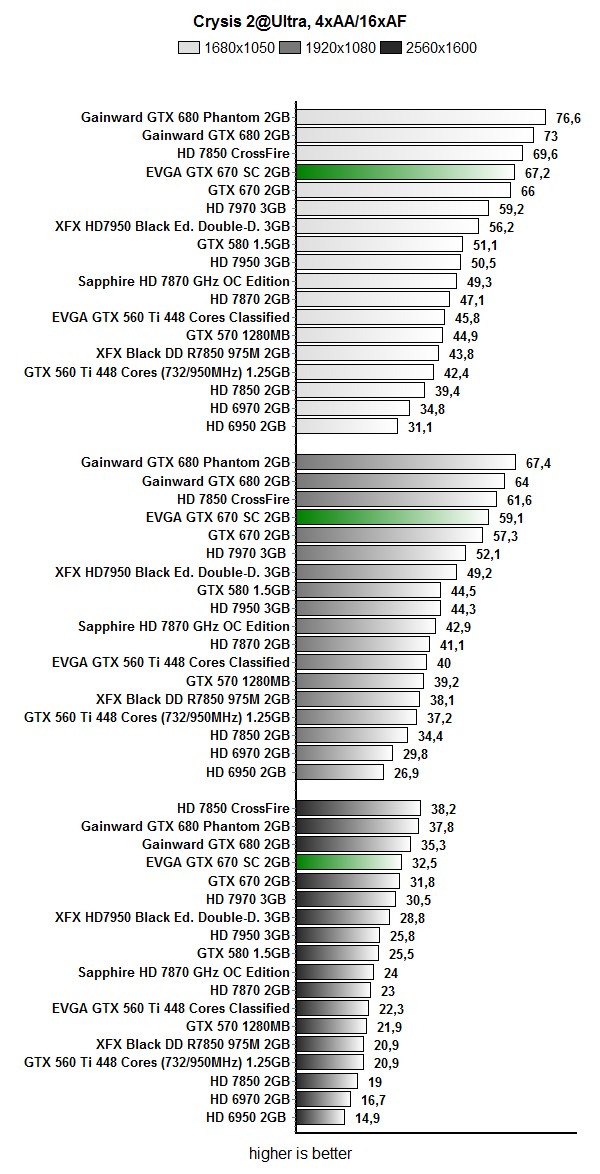
If you lift the hood, GCN is still behind Kepler architecture in tessellation and texture performance. While texture performance is a non-issue right now since current games still have low quality textures and GTX670/680/7970 are similarly "slow" (~ 30 fps) at very high resolutions, Kepler wins in most tessellated games (Batman AC, Lost Planet 2, Hawks 2, Crysis 2, Civ5). That bodes well for future products based on this architecture. AMD will probably have to go GCN 2.0 Enhanced while NV can just roll over Kepler to GTX700 series chips.
When a lot of us have said it took AMD a 28n node shirk + a new architecture with HD7950 to barely beat a 40nm Fermi, this is what we meant - GCN is 1st generation compute architecture from AMD. AMD delivered a well balanced card but keep in mind that their primary target market of $300-500 GPUs are gamers, not heterogeneous computing professionals who spend $3-5K on GPUs. Fermi was criticized for this but it was able to pull through with GTX460 1GB/768mb and sell a lot of Tesla cards. Also, the fact that GTX560/560Ti/GTX570 and 580 launched soon after 470/480s helped. AMD can do the same if it launches faster clocked 7950/7970 cards. AMD has its own GTX460 = HD7850 so they are fine for now.
Last edited:
Rvenger, I wish you were correct but sportmanship between AMD and Nvidia? That's like saying sportsmanship between the Steelers and Raiders in the 70s! ( I grew up in Western Pa and those were knock down drag out football games.)
Haha, I don't think the Steelers and Raiders can be compared in such a manner. Actually.. I think we figured out that I live close to your hometown in the Beaver County area.
blastingcap
Diamond Member
- Sep 16, 2010
- 6,654
- 5
- 76
I was saying if GK100 was profitable (i.e., had good yields and volume) then it would have been a G80 situation. Since NV couldn't launch GK100 in large volumes in consume space, obviously this isn't happening any time soon.
This I agree with. The rest, we shall see if AMD tweaks their GCN arch like NV did with Fermi, when it comes times for the refresh (HD7975 or whatever).
Also, on an unrelated topic, apparently BSN is reporting that Tesla is not GK110 but is actually almost the same as GTX690 which I find difficult to believe considering that DP will be kind of pathetic. But they're saying some Tesla customers don't care about DP.

flexy
Diamond Member
- Sep 28, 2001
- 8,464
- 155
- 106
I was soooooooooooooo going for a 7850 but the 670 now made me decide otherwise.
Although i am kind of hesitant to spend close to €400 for new card. You guys in the states are better off since $380 is *significantly* less than €380...but i just cant bring myself to pass on that card. It has of course better performance than the 7850 and (regardless what people say) Nvidia drivers ARE somewhat better than ATI and the CCC crap, then CUDA etc..etc.. And as it looks the EVGA one looks pretty good.
EDIT: I stay corrected, the EVGA looks actually like ***t, i might get a Gigabyte. to be honest, not that it matters but the EVGA is the ugliest piece of PC equipment i have ever seen and the cooler doesn't "look" that great either.
Although i am kind of hesitant to spend close to €400 for new card. You guys in the states are better off since $380 is *significantly* less than €380...but i just cant bring myself to pass on that card. It has of course better performance than the 7850 and (regardless what people say) Nvidia drivers ARE somewhat better than ATI and the CCC crap, then CUDA etc..etc.. And as it looks the EVGA one looks pretty good.
EDIT: I stay corrected, the EVGA looks actually like ***t, i might get a Gigabyte. to be honest, not that it matters but the EVGA is the ugliest piece of PC equipment i have ever seen and the cooler doesn't "look" that great either.
Last edited:
flexy
Diamond Member
- Sep 28, 2001
- 8,464
- 155
- 106
AMD took a jab at NV today, questioning their Kepler availability.
"We urge you to focus on maxed settings at 2560x1600 or higher resolution in your reviews."
Because the 0.0001% of people who run such resolutions are really..uhm..relevant?

RussianSensation
Elite Member
- Sep 5, 2003
- 19,458
- 765
- 126
But they're saying some Tesla customers don't care about DP.
Well remember how many people presumed that GK104 would tank in Folding@Home?
Looks like some GPGPU programs do not benefit from DP performance.

Still, I find it hard to believe that DP is not important since NV purposely/artificially limited it on G80, GT200B and Fermi cards vs. their Tesla counter-parts. I don't buy Tesla cards, so I can't say what scientific/financial/engineering/computation fluid dynamics programs benefit from DP exactly nowadays. I just know AMD mops the floor with NV in Collatz Conjecture, MilkyWay, bitcoin mining and some other DC projects
Last edited:
blastingcap
Diamond Member
- Sep 16, 2010
- 6,654
- 5
- 76
who knows what they want exactly nowadays.
Yeah DP is probably not important to some Tesla buyers. Anyhow, here is the rumor I was referring to:
http://www.brightsideofnews.com/new...esla-card3b-8gb-ecc-gddr52c-weak-dp-rate.aspx
RussianSensation
Elite Member
- Sep 5, 2003
- 19,458
- 765
- 126
Yeah DP is probably not important to some Tesla buyers. Anyhow, here is the rumor I was referring to:
http://www.brightsideofnews.com/new...esla-card3b-8gb-ecc-gddr52c-weak-dp-rate.aspx
2 Things:
1) "Every [GTX690 aka Tesla C3000] GPU is paired with 4GB GDDR5 memory for a grand total of 8GB, a world record for a GPU."
^ So NV released a unicorn 4GB GTX690 for $1K but will sell the C3000 for $3k+? They shouldn't have even bothered with 690 until 7990 showed up. Unloading 690s for $3k vs. $1k. hmm....
2) "Thus, you can expect a seven-billion transistor Tesla card with 3072 CUDA cores, 512-bit memory interface, 8GB GDDR5 with over 300GB/s of video memory bandwidth (shared between two GPUs), as great looking and expensive high-end heatsink and increased cooling capabilities."
^ So now we went from a rumoured 2304 SP GK110 to 3072 SP 512-bit GK110? For real?

Last edited:

- Oct 11, 2011
- 2,865
- 0
- 0

bunnyfubbles
Lifer
- Sep 3, 2001
- 12,248
- 3
- 0
2 Things:
1) "Every [GTX690 aka Tesla C3000] GPU is paired with 4GB GDDR5 memory for a grand total of 8GB, a world record for a GPU."
^ So NV released a unicorn 4GB GTX690 for $1K but will sell the C3000 for $3k+? They shouldn't have even bothered with 690 until 7990 showed up. Unloading 690s for $3k vs. $1k. hmm....
2) "Thus, you can expect a seven-billion transistor Tesla card with 3072 CUDA cores, 512-bit memory interface, 8GB GDDR5 with over 300GB/s of video memory bandwidth (shared between two GPUs), as great looking and expensive high-end heatsink and increased cooling capabilities."
^ So now we went from a rumoured 2304 SP GK110 to 3072 SP 512-bit GK110? For real?
no, C3000 is just a Tesla version of GTX690, ie two GK104s with double the memory, not a monolithic monster GPU.
TRENDING THREADS
-
 Discussion Zen 5 Speculation (EPYC Turin and Strix Point/Granite Ridge - Ryzen 9000)
- Started by DisEnchantment
- Replies: 25K
-
Discussion Intel Meteor, Arrow, Lunar & Panther Lakes + WCL Discussion Threads
- Started by Tigerick
- Replies: 23K
-
 Discussion Intel current and future Lakes & Rapids thread
- Started by TheF34RChannel
- Replies: 23K
-

-


AnandTech is part of Future plc, an international media group and leading digital publisher. Visit our corporate site.
© Future Publishing Limited Quay House, The Ambury, Bath BA1 1UA. All rights reserved. England and Wales company registration number 2008885.
 Facebook
 Twitter