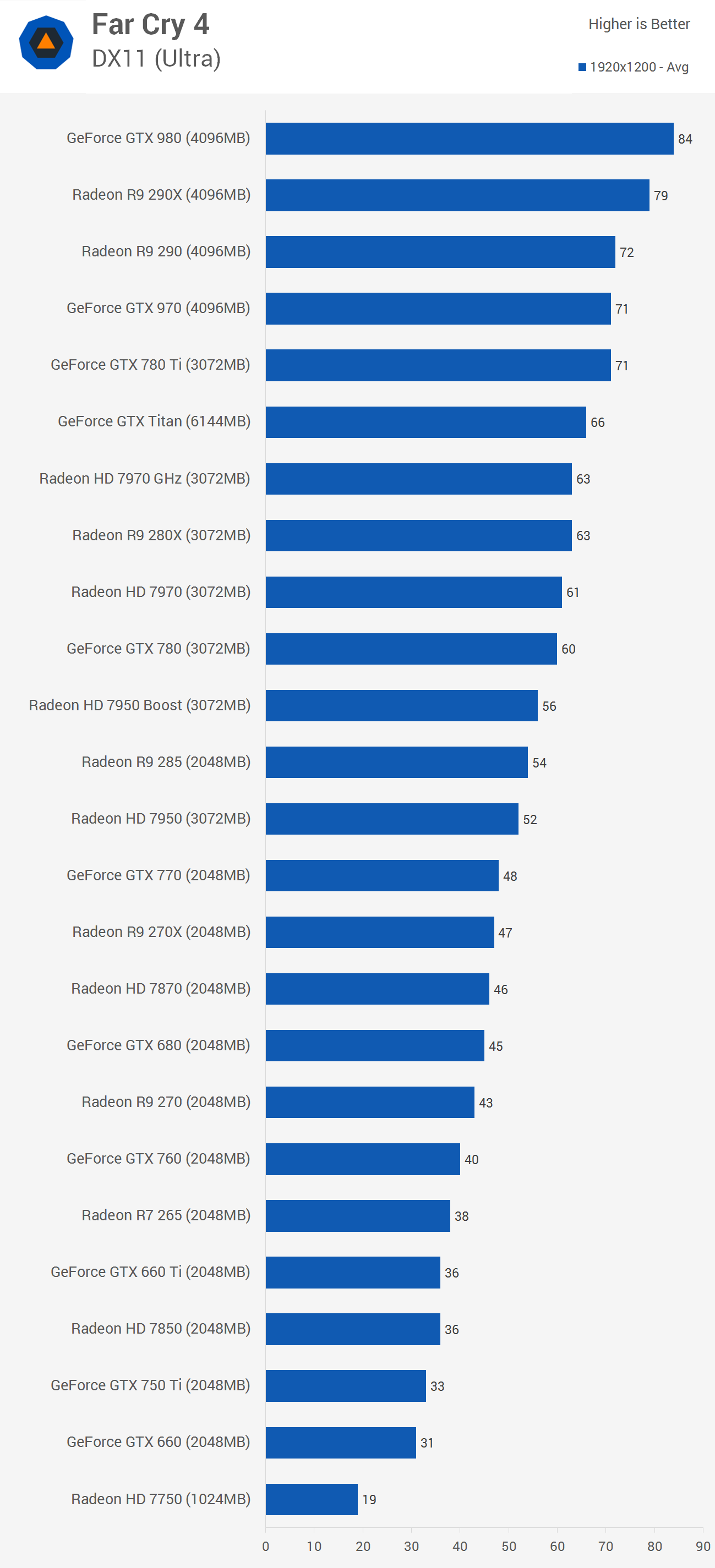
FC4 alone doesn't paint a picture as being an outlier for Kepler's recent poor form. Just take a look at 970/980 launch reviews and then recent reviews and see where 780Ti/Titan/780/680/770 land. Clearly in modern games they are underperforming. Considering NV has a history of strong driver team/support, are we supposed to believe the 280X can approach Titan/780 performance because AMD found some miracle performance nearly 3 years after Tahiti's launch? I am not buying that.
There have been way too many games now where 280X is on the heels of a 780 and 680/770 are getting a pounding. That tells me FC4 is not an outlier. If anything, 780 and the Titan should have aged better against the 280X/7970Ghz due to superior tessellation performance and a lot of AAA games being GW titles. Instead on TPU, 780 is barely faster than a 7970Ghz in the latest reviews. I remember people and even HardOCP stating that a Titan was nearly as fast as 7970 XF in games. Now that's just wishful thinking as the Titan is only 21% faster than 7970Ghz at 1440p, and shockingly enough the 780 is just 13% faster, with 780Ti just 2.4% faster than a reference throttling 290X!!!
Ok, I realize that 780/780Ti and Titan have massive overclocking headroom. However, their current stock performance is disappointing given their crazy high launch prices:
http://www.techpowerup.com/mobile/reviews/Gigabyte/GeForce_GTX_980_G1_Gaming/27.html
NV's voltage locking for overclocking and VRAM gimped SKUs (570/580/670/680/770) all hint that NV doesn't really want to design cards to last. I think it's fair to say in hindsight that 7970/7970Ghz was a much better product overall than the 680. GK104 won the popularity battle but Tahiti XT won the war. Had I purchase 680 2GB SLI, I would have been forced to upgrade already.
---
As far as 285 goes, while as an overall product, it's a fail imo, as a testbed for color fill-rate, memory bandwidth efficiency, and tessallation performance improvements, it's has addressed 3 major areas of weakness for GCN. Because these 3 aspects are improved, AMD can focus on Shaders/ALUs, TMUs, cache/IPC, HBM and power efficiency. It's a lot easier for the 300 series team to tackle a new GPU since they have to focus on less areas for improvement.