You might be thinking of a safe deposit box. Most people think of banks as safe deposit boxes.
Money in the bank is not "your" money. It is an unsecured loan to the bank. The bank then lends that money to other people for things like credit cards and mortgages. This is called risk arbitrage or interest rate arbitrage.
http://www.investopedia.com/terms/b/bank-deposits.asp
This is why things like bank runs and bail-ins happen. The bank can't give your money back because they don't have it. They lent it to someone and have not yet been paid back. This is why default rates are an excellent indicator of future bank failures.
But discouraging people from putting money in the bank de-capitalizes the banks. Since we use a fractional reserve banking system, a system where banks can lend more money than they actually have, every $1 not in the bank is effectively the same as taking $10 worth of loans out of the economy. As much as we all hate banks and bankers, banks are a critically important part of an economy. They provide mortgages, they provide business loans, and they provide consumer credit. Imagine how much the economy would contract if all credit cards in the country immediately stopped working, and people could only buy things with cash. Our whole economy would crash.
Instead of trying to destroy our banking system, we should strengthen it. Slowly raise the interest rates. Pay people to keep their money in the banks. This allows banks to make loans, money starts moving again, and the economy recovers.
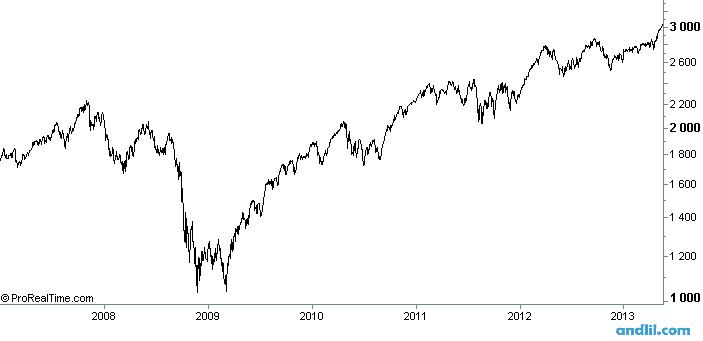
Right now we're doing the exact opposite of this. American banks have negative real interest rates, so there's no reason to hold money in the bank. Where else can people put their savings? Obviously, the stock market. Oh, hey, look at that, the stock market is at an all time high because
it contains all of the money that would normally be in banks (mostly the retirement funds of baby boomers). Does bidding stocks up to ridiculously high prices increase consumer credit? No. Does the stock market provide mortgages or startup capital for businesses? No. It just sits there. It does nothing. The money in the stock market is effectively in a coffee can.
An obvious question is where money in the stock market goes. Every transaction has a buyer and a seller. If the buyers are old people who have been forced to buy stocks just to protect themselves against inflation, who is the seller? Rich people. Do you think rich people spend that money in the US? Some of it, yes, but most of it will go into treasury bonds, and they will wait for the market to crash so they can buy their shares back. You can even see this right now in the bond market. The yield curve is flattening, and the 10 year yield has been dropping since January (meaning rich people are bidding up the price of bonds). After the stock market crashes, retail investors will run to bonds, rich people will sell their bonds for more than they paid, and they'll use that money to buy the stocks people are selling for half price.
Overall, the low interest rates lead to cycles where rich people get richer and everyone else gets poorer.
America is not a closed system. Most products are imported from countries like China and India, so consumer spending slowly leads out of the country. If we want money to stay in the country and be used for
capital goods instead of
consumer goods, we would need to raise interest rates and tell people to put their money in the bank.








 Facebook
 Twitter