France to form new government

Page 7 - Seeking answers? Join the AnandTech community: where nearly half-a-million members share solutions and discuss the latest tech.

fskimospy

Elite Member
Mar 10, 2006
88,221
55,760
136
Then you don't understand basic accounting principles. Money in a savings account is an asset for you, and a liability to the bank who holds it. Unless you literally are keeping currency in a coffee can or safe deposit box, saving money does not take it out of circulation.

Putting money in a bank does not create a net liability or a net asset for anyone. You lose $100 in cash and gain a $100 marker to call in on the bank. The bank gets $100 in cash and loses a $100 liability to you. This is basic accounting as well as common sense.

A liquidity trap exists when people prefer to hold cash over doing anything else with it. With a functionally infinite preference for cash, spending and investment do not increase despite large increases in the money supply. The money might as well be in a coffee can.

EDIT: Not sure what any of this has to do with the fact that you earlier claimed that we would all spend our money and then we'd all be broke together, which is clearly false.
 
Last edited:

Jhhnn

IN MEMORIAM
Nov 11, 1999
62,365
14,686
136
Putting money in a bank does not create a net liability or a net asset for anyone. You lose $100 in cash and gain a $100 marker to call in on the bank. The bank gets $100 in cash and loses a $100 liability to you. This is basic accounting as well as common sense.

A liquidity trap exists when people prefer to hold cash over doing anything else with it. With a functionally infinite preference for cash, spending and investment do not increase despite large increases in the money supply. The money might as well be in a coffee can.

EDIT: Not sure what any of this has to do with the fact that you earlier claimed that we would all spend our money and then we'd all be broke together, which is clearly false.

Correct. The FRB is trying to push on a string, but they're the only people doing much of anything right at all. They know monetary policy can't solve the problem, but they'll be damned if they'll let it make things worse as in the early stages of the Great Depression. They & the bailout are the only reasons this isn't a lot worse.
 

Spungo

Diamond Member
Jul 22, 2012
3,217
2
81
Putting money in a bank does not create a net liability or a net asset for anyone. You lose $100 in cash and gain a $100 marker to call in on the bank. The bank gets $100 in cash and loses a $100 liability to you. This is basic accounting as well as common sense.
You might be thinking of a safe deposit box. Most people think of banks as safe deposit boxes.

Money in the bank is not "your" money. It is an unsecured loan to the bank. The bank then lends that money to other people for things like credit cards and mortgages. This is called risk arbitrage or interest rate arbitrage.

http://www.investopedia.com/terms/b/bank-deposits.asp
investopedia said:
The "deposit" itself is a liability owed by the bank to the depositor (the person or entity that made the deposit), and refers to this liability rather than to the actual funds that are deposited.

This is why things like bank runs and bail-ins happen. The bank can't give your money back because they don't have it. They lent it to someone and have not yet been paid back. This is why default rates are an excellent indicator of future bank failures.


A liquidity trap exists when people prefer to hold cash over doing anything else with it. With a functionally infinite preference for cash, spending and investment do not increase despite large increases in the money supply. The money might as well be in a coffee can.
But discouraging people from putting money in the bank de-capitalizes the banks. Since we use a fractional reserve banking system, a system where banks can lend more money than they actually have, every $1 not in the bank is effectively the same as taking $10 worth of loans out of the economy. As much as we all hate banks and bankers, banks are a critically important part of an economy. They provide mortgages, they provide business loans, and they provide consumer credit. Imagine how much the economy would contract if all credit cards in the country immediately stopped working, and people could only buy things with cash. Our whole economy would crash.
Instead of trying to destroy our banking system, we should strengthen it. Slowly raise the interest rates. Pay people to keep their money in the banks. This allows banks to make loans, money starts moving again, and the economy recovers.

Right now we're doing the exact opposite of this. American banks have negative real interest rates, so there's no reason to hold money in the bank. Where else can people put their savings? Obviously, the stock market. Oh, hey, look at that, the stock market is at an all time high because it contains all of the money that would normally be in banks (mostly the retirement funds of baby boomers). Does bidding stocks up to ridiculously high prices increase consumer credit? No. Does the stock market provide mortgages or startup capital for businesses? No. It just sits there. It does nothing. The money in the stock market is effectively in a coffee can.

An obvious question is where money in the stock market goes. Every transaction has a buyer and a seller. If the buyers are old people who have been forced to buy stocks just to protect themselves against inflation, who is the seller? Rich people. Do you think rich people spend that money in the US? Some of it, yes, but most of it will go into treasury bonds, and they will wait for the market to crash so they can buy their shares back. You can even see this right now in the bond market. The yield curve is flattening, and the 10 year yield has been dropping since January (meaning rich people are bidding up the price of bonds). After the stock market crashes, retail investors will run to bonds, rich people will sell their bonds for more than they paid, and they'll use that money to buy the stocks people are selling for half price.

Overall, the low interest rates lead to cycles where rich people get richer and everyone else gets poorer.


EDIT: Not sure what any of this has to do with the fact that you earlier claimed that we would all spend our money and then we'd all be broke together, which is clearly false.
America is not a closed system. Most products are imported from countries like China and India, so consumer spending slowly leads out of the country. If we want money to stay in the country and be used for capital goods instead of consumer goods, we would need to raise interest rates and tell people to put their money in the bank.

 

Jhhnn

IN MEMORIAM
Nov 11, 1999
62,365
14,686
136
You might be thinking of a safe deposit box. Most people think of banks as safe deposit boxes.

Money in the bank is not "your" money. It is an unsecured loan to the bank. The bank then lends that money to other people for things like credit cards and mortgages. This is called risk arbitrage or interest rate arbitrage.

http://www.investopedia.com/terms/b/bank-deposits.asp


This is why things like bank runs and bail-ins happen. The bank can't give your money back because they don't have it. They lent it to someone and have not yet been paid back. This is why default rates are an excellent indicator of future bank failures.


But discouraging people from putting money in the bank de-capitalizes the banks. Since we use a fractional reserve banking system, a system where banks can lend more money than they actually have, every $1 not in the bank is effectively the same as taking $10 worth of loans out of the economy. As much as we all hate banks and bankers, banks are a critically important part of an economy. They provide mortgages, they provide business loans, and they provide consumer credit. Imagine how much the economy would contract if all credit cards in the country immediately stopped working, and people could only buy things with cash. Our whole economy would crash.
Instead of trying to destroy our banking system, we should strengthen it. Slowly raise the interest rates. Pay people to keep their money in the banks. This allows banks to make loans, money starts moving again, and the economy recovers.

Right now we're doing the exact opposite of this. American banks have negative real interest rates, so there's no reason to hold money in the bank. Where else can people put their savings? Obviously, the stock market. Oh, hey, look at that, the stock market is at an all time high because it contains all of the money that would normally be in banks (mostly the retirement funds of baby boomers). Does bidding stocks up to ridiculously high prices increase consumer credit? No. Does the stock market provide mortgages or startup capital for businesses? No. It just sits there. It does nothing. The money in the stock market is effectively in a coffee can.

An obvious question is where money in the stock market goes. Every transaction has a buyer and a seller. If the buyers are old people who have been forced to buy stocks just to protect themselves against inflation, who is the seller? Rich people. Do you think rich people spend that money in the US? Some of it, yes, but most of it will go into treasury bonds, and they will wait for the market to crash so they can buy their shares back. You can even see this right now in the bond market. The yield curve is flattening, and the 10 year yield has been dropping since January (meaning rich people are bidding up the price of bonds). After the stock market crashes, retail investors will run to bonds, rich people will sell their bonds for more than they paid, and they'll use that money to buy the stocks people are selling for half price.

Overall, the low interest rates lead to cycles where rich people get richer and everyone else gets poorer.


America is not a closed system. Most products are imported from countries like China and India, so consumer spending slowly leads out of the country. If we want money to stay in the country and be used for capital goods instead of consumer goods, we would need to raise interest rates and tell people to put their money in the bank.


Hogwash. Liquidity preference is expressed as an unwillingness to borrow, to sit tight. Banks play the other side of it with much tighter lending standards, both symptoms of aversion to risk. So there's plenty of money in the banks & few borrowers even at extremely low rates. Extremely low rates paid on savings are strictly an issue of supply & demand. If the banks wanted more deposits, they'd pay higher rates.

Hell, QE pumps money back into the banks very effectively.

The ECB has gone so far as to charge member banks for deposits in an effort to promote lending-

http://www.ibtimes.com/europes-central-bank-now-charging-banks-hold-deposits-1594806

If deflation sets in, then liquidity preference only increases- money gains value simply from the act of holding it. It's the best time to be Rich, when everybody else is broke, busted & begging. It turns into hoarding. The tighter you can hold onto money, the more it works to your advantage.
 

glenn1

Lifer
Sep 6, 2000
25,383
1,013
126
Hogwash. Liquidity preference is expressed as an unwillingness to borrow, to sit tight. Banks play the other side of it with much tighter lending standards, both symptoms of aversion to risk. So there's plenty of money in the banks & few borrowers even at extremely low rates. Extremely low rates paid on savings are strictly an issue of supply & demand. If the banks wanted more deposits, they'd pay higher rates.

Hell, QE pumps money back into the banks very effectively.

The ECB has gone so far as to charge member banks for deposits in an effort to promote lending-

http://www.ibtimes.com/europes-central-bank-now-charging-banks-hold-deposits-1594806

If deflation sets in, then liquidity preference only increases- money gains value simply from the act of holding it. It's the best time to be Rich, when everybody else is broke, busted & begging. It turns into hoarding. The tighter you can hold onto money, the more it works to your advantage.

If you're so worried about liquidity preference will hinder further bidding up the price of malinvestments, then just put an expiration date on currency. That's sure to get the velocity up and empty out the savings accounts.
 

Jhhnn

IN MEMORIAM
Nov 11, 1999
62,365
14,686
136
If you're so worried about liquidity preference will hinder further bidding up the price of malinvestments, then just put an expiration date on currency. That's sure to get the velocity up and empty out the savings accounts.

When argument fails, resort to hyperbole.
 

glenn1

Lifer
Sep 6, 2000
25,383
1,013
126
When argument fails, resort to hyperbole.

Or you could just prohibit savings accounts. Or confiscate any currency not spent within a certain time period. How is this really different than in degree from the huge burdens you're placing on anyone with low time preference due to your idiotic ZIRP and furious attempts to prevent ongoing efforts at debt deleveraging the economy?
 

Jhhnn

IN MEMORIAM
Nov 11, 1999
62,365
14,686
136
Or you could just prohibit savings accounts. Or confiscate any currency not spent within a certain time period. How is this really different than in degree from the huge burdens you're placing on anyone with low time preference due to your idiotic ZIRP and furious attempts to prevent ongoing efforts at debt deleveraging the economy?

Oh, please. There's a fine line between debt deleveraging & deflation, the latter being extremely damaging to debtors you claim to champion.

http://www.economist.com/node/13104022

Debtors being most of America.

Huge burden on people with short time preference? You mean people most able to bear a burden, right? It's easy to have short time preference when you're long on cash & assets, obviously impossible when short on cash in a cashflow reality. Hence, payday loans.
 
Last edited:

Bitek

Lifer
Aug 2, 2001
10,676
5,239
136
http://www.heritage.org/research/re...-the-great-recession-and-european-debt-crisis

One of the main lessons of the scholarly literature on deficit reduction is that it is a mistake to lump together tax increases and spending cuts.[6] In the Special Report, Alberto Alesina and Veronique de Rugy review the last two decades of academic writing on deficit reduction, which they term “fiscal adjustment”:
[Economists] seem to have recently reached a consensus that spending-based fiscal adjustments are not only more likely to reduce the debt-to-GDP ratio than tax-based adjustment, but also less likely to trigger a recession. In fact, if accompanied by the right type of policies—especially changes in public employees’ pay and public pension reforms—spending-based adjustments can actually contribute to economic growth....
However, it is important to refrain from oversimplifying these results because fiscal adjustment packages are often complex and multiyear affairs. Many successful (i.e., expansionary and debt reducing) fiscal adjustments in this literature are ones in which exports led growth when the rest of the global economy was healthy or even booming. While there has been some recovery in the midst of the recession, we should recognize that achieving export-led growth may be much harder today when many countries are struggling.
While austerity based on spending cuts can be costly, the cost of well-designed adjustments plans will be low.... [T]he alternative for certain countries could be a very messy debt crisis.[7]​
Presenting research at The Heritage Foundation in October 2013, Daniel Leigh of the IMF showed that he and his colleagues estimate that tax-based fiscal consolidations lead to three or four times as much decline in consumption and gross domestic product (GDP) as spending-based fiscal consolidations.[8]
...............

There are a handful of recent scholarly papers (I found four) that estimate both tax and spending multipliers over a multi-year horizon.[19] As presented in Table 2, these papers display a near-consensus that tax multipliers are stronger than spending multipliers.[20] Equally important, tax multipliers generally grow stronger over time, and spending multipliers generally weaken. Consistent with my estimates from data during the recent crisis, tax increases directly and increasingly diminish private-sector activity by more than the value of the tax, but spending cuts have little impact on private GDP, and the impact on total GDP disappears over time as the private sector replaces the lost government spending.

austerityeurope2014table2825.ashx

You are actually citing Alesina when he has demonstrably shown to have been completely wrong in his "expansionary austerity" theories, which have been slavishly pursued in the EU to disastrous results. As the graph Eskimo posted earlier alluded to (altho not very clearly) reducing public spending, amidst a fiscal crisis, very reliably correlates with reduced GDP growth. It's become a fact as close as anything in economics is.

Secondly, you are highly concerning yourself with debt to GDP ratios without ever explaining why that matters, and has any promise of solutions to the current situation. The right has been remarkably consistent in its incoherence on this matter. who cares? How is this the biggest problem right now?

Following that, you are using AA to argue tax vs spending effectiveness, but you can't do this in a vacuum. What are the incentives you are creating in the current situation? Who has the money, and who will be benefiting from the tax cuts? There is plenty of money already in the hands of corporations and the wealthy. Are they using it now to hire workers and buy equipment (suggesting there is a supply problem)?

No, they are stuffing the mattresses and buying bonds, which is why rates are so low world wide, despite the expanded monetary base. You are effectively arguing for more of this. Direct spending makes sure money gets spent and wages are paid. Reducing tax bills, which primarily benefits the wealthy (as so much wealth is concentrated there) will do little to change the situation.

You have to get businesses spending money on workers and goods. Disincentives to saving must be made until the markets have normalized.

Once growth and employment returns to normal, then you start moving to bring excess spending down. Not when we're in the middle of a demand shock.
 

Spungo

Diamond Member
Jul 22, 2012
3,217
2
81
If deflation sets in, then liquidity preference only increases- money gains value simply from the act of holding it. It's the best time to be Rich, when everybody else is broke, busted & begging. It turns into hoarding. The tighter you can hold onto money, the more it works to your advantage.
Deflation benefits people who have cash and bonds - most Americans.
Inflation benefits people who have assets like real estate and stocks - rich people.

I can't speak for all Americans. I can only speak for myself. When I see rising food prices, I don't get excited. I don't immediately go out to buy new clothes or get a foot massage. I get scared. I start hoarding money. Every dollar I make over $5000 goes into my investments. I don't even own a car right now because my confidence in this economy is extremely low, and apparently I'm not alone on this. I'm stockpiling wealth because I feel a storm coming. Some people are stockpiling food, bullets, and silver. This year is on track for having record high demand for American silver eagles. Making people fear inflation doesn't help the economy.
 

Bitek

Lifer
Aug 2, 2001
10,676
5,239
136
You might be thinking of a safe deposit box. Most people think of banks as safe deposit boxes.

Money in the bank is not "your" money. It is an unsecured loan to the bank. The bank then lends that money to other people for things like credit cards and mortgages. This is called risk arbitrage or interest rate arbitrage.

http://www.investopedia.com/terms/b/bank-deposits.asp


This is why things like bank runs and bail-ins happen. The bank can't give your money back because they don't have it. They lent it to someone and have not yet been paid back. This is why default rates are an excellent indicator of future bank failures.


But discouraging people from putting money in the bank de-capitalizes the banks. Since we use a fractional reserve banking system, a system where banks can lend more money than they actually have, every $1 not in the bank is effectively the same as taking $10 worth of loans out of the economy. As much as we all hate banks and bankers, banks are a critically important part of an economy. They provide mortgages, they provide business loans, and they provide consumer credit. Imagine how much the economy would contract if all credit cards in the country immediately stopped working, and people could only buy things with cash. Our whole economy would crash.
Instead of trying to destroy our banking system, we should strengthen it. Slowly raise the interest rates. Pay people to keep their money in the banks. This allows banks to make loans, money starts moving again, and the economy recovers.

Right now we're doing the exact opposite of this. American banks have negative real interest rates, so there's no reason to hold money in the bank. Where else can people put their savings? Obviously, the stock market. Oh, hey, look at that, the stock market is at an all time high because it contains all of the money that would normally be in banks (mostly the retirement funds of baby boomers). Does bidding stocks up to ridiculously high prices increase consumer credit? No. Does the stock market provide mortgages or startup capital for businesses? No. It just sits there. It does nothing. The money in the stock market is effectively in a coffee can.

An obvious question is where money in the stock market goes. Every transaction has a buyer and a seller. If the buyers are old people who have been forced to buy stocks just to protect themselves against inflation, who is the seller? Rich people. Do you think rich people spend that money in the US? Some of it, yes, but most of it will go into treasury bonds, and they will wait for the market to crash so they can buy their shares back. You can even see this right now in the bond market. The yield curve is flattening, and the 10 year yield has been dropping since January (meaning rich people are bidding up the price of bonds). After the stock market crashes, retail investors will run to bonds, rich people will sell their bonds for more than they paid, and they'll use that money to buy the stocks people are selling for half price.

Overall, the low interest rates lead to cycles where rich people get richer and everyone else gets poorer.


America is not a closed system. Most products are imported from countries like China and India, so consumer spending slowly leads out of the country. If we want money to stay in the country and be used for capital goods instead of consumer goods, we would need to raise interest rates and tell people to put their money in the bank.

This post. This post is so fucked up. So much could be written but all you need to look at is what the ECB caused when they foolishly raised rates in 2011. That example will become a text book study on terrible policy decisions.

Even if your assumptions were correct (and they are not) why would you want to push down inflation rates when they are already at dangerously low levels? Do you think "regular folk" benefit from deflation? Who are the debtors and who are the creditors? We are still in a debt crisis, and you want to make it more expensive...
 

Bitek

Lifer
Aug 2, 2001
10,676
5,239
136
Deflation benefits people who have cash and bonds - most Americans.
Inflation benefits people who have assets like real estate and stocks - rich people.

I can't speak for all Americans. I can only speak for myself. When I see rising food prices, I don't get excited. I don't immediately go out to buy new clothes or get a foot massage. I get scared. I start hoarding money. Every dollar I make over $5000 goes into my investments. I don't even own a car right now because my confidence in this economy is extremely low, and apparently I'm not alone on this. I'm stockpiling wealth because I feel a storm coming. Some people are stockpiling food, bullets, and silver. This year is on track for having record high demand for American silver eagles. Making people fear inflation doesn't help the economy.

You do! You believe deflation is good for regular folk (the debtors) and bad for the wealthy (the creditors)

This is exactly backwards! If I own your debt, the value of your debt increases continuously with deflation, meanwhile your wages will fall. You don't think you employer is going to want to pay you more every year, when he can fire you and then hire for less next year? What are typical raises? Inflation plus some %. If I is negative, then so is your raise.

So take your falling wages and try and repay my ever increasing debt note.. Even at a low interest I own your ass. Apply that to a fixed 30 yr mortgage. How expensive does that house payment look in 20 years with fixed payments and compounding wage decreases?

What are we in the middle of right now? A mortgage driven debt crisis where everyone is trying to save and pay down debt, not spend and take investment risks ( like building new factories and hiring workers)

Incentivizing sitting around and hoarding cash and silver is not going to bring back employment and prosperity. Cash needs to be put to work to get us out.
 
Last edited:

fskimospy

Elite Member
Mar 10, 2006
88,221
55,760
136
Deflation benefits people who have cash and bonds - most Americans.
Inflation benefits people who have assets like real estate and stocks - rich people.

I can't speak for all Americans. I can only speak for myself. When I see rising food prices, I don't get excited. I don't immediately go out to buy new clothes or get a foot massage. I get scared. I start hoarding money. Every dollar I make over $5000 goes into my investments. I don't even own a car right now because my confidence in this economy is extremely low, and apparently I'm not alone on this. I'm stockpiling wealth because I feel a storm coming. Some people are stockpiling food, bullets, and silver. This year is on track for having record high demand for American silver eagles. Making people fear inflation doesn't help the economy.

I do to believe you ever responded to what I wrote to you previously. Your views on inflation are precisely backwards. Inflation helps those who owe money and hurts those whom others owe money to. You don't need any fancy economics to figure this out.

If you think inflation helps the rich so much, why are the wealthiest segments of society constantly urging for tighter money? Are they just really nice?
 

Spungo

Diamond Member
Jul 22, 2012
3,217
2
81
I do to believe you ever responded to what I wrote to you previously. Your views on inflation are precisely backwards. Inflation helps those who owe money and hurts those whom others owe money to. You don't need any fancy economics to figure this out.
You and legend have never said why my simple math example is wrong.
Starting condition: 90% of my income goes to cost of living, 10% pays off debts.
10% inflation happens.
After inflation: 99% of my money goes to cost of living, 1% goes to debts.
Please show how this is wrong. Any reason at all. Give me an anecdote or something. Give me a theoretical story. How does having less money at the end of the month help me pay my bills?


If you think inflation helps the rich so much, why are the wealthiest segments of society constantly urging for tighter money? Are they just really nice?
The government is owned by rich people and huge corporations. If they wanted tighter money, it would change as quickly as you can snap your fingers. It's currently going in the opposite direction, with looser monetary policy, so it's pretty clear that loose money is what rich people want.


This is what inflation does for the bottom 99% of Americans:
ED-AR043_1econs_NS_20130724181803.jpg


This is what inflation does for the top 1% of Americans:
NASDAQ-100.png


But forget the chart. Let's use real numbers. My own stock portfolio is up a little more than 20% YTD, and I'm currently sitting in cash because I'm unsure of where the market is headed. The S&P 500 index is up a little more than 8% YTD. When is the last time you received a 20% pay raise without changing companies or changing job titles? As an investor, that's what I get just by owning stocks. I don't need to show up at a job, I don't need to do anything, I just get that money because I'm me. Inflation transfers wealth from people like to people like me. I appreciate your donations, but we should at least admit this system is really screwed up, and it seems to benefit the richest people.
 

fskimospy

Elite Member
Mar 10, 2006
88,221
55,760
136
You and legend have never said why my simple math example is wrong.
Starting condition: 90% of my income goes to cost of living, 10% pays off debts.
10% inflation happens.
After inflation: 99% of my money goes to cost of living, 1% goes to debts.
Please show how this is wrong. Any reason at all. Give me an anecdote or something. Give me a theoretical story. How does having less money at the end of the month help me pay my bills?

Isn't it obvious why your simple math is wrong? Wages and inflation are historically closely related to one another. Your example presupposes that your wages always stay the same, when this is almost never the case.

In reality something more akin to this happens (numbers simplified):

You make $100,000 a year and have a $200,000 mortgage. Your debts are equivalent to two years of your working wages to own your house. 100% inflation happens across the board. You now make $200,000 a year. In terms of your daily expenses, nothing has changed. In terms of your mortgage debt, it's now exactly half as burdensome as it was before and repaying that debt to your lender gives him back have as much ability to buy other stuff as before.

Your lender just got screwed. That's why rich people hate inflation, they are net lenders.

The government is owned by rich people and huge corporations. If they wanted tighter money, it would change as quickly as you can snap your fingers. It's currently going in the opposite direction, with looser monetary policy, so it's pretty clear that loose money is what rich people want.

This is an obvious logical fallacy, begging the question. You are saying that inflation must help rich people because if it didn't then inflation wouldn't exist.

This is what inflation does for the bottom 99% of Americans:
ED-AR043_1econs_NS_20130724181803.jpg


This is what inflation does for the top 1% of Americans:
NASDAQ-100.png

You realize you're just proving my point, right? Inflation has been extremely low during this period.

But forget the chart. Let's use real numbers. My own stock portfolio is up a little more than 20% YTD, and I'm currently sitting in cash because I'm unsure of where the market is headed. The S&P 500 index is up a little more than 8% YTD. When is the last time you received a 20% pay raise without changing companies or changing job titles? As an investor, that's what I get just by owning stocks. I don't need to show up at a job, I don't need to do anything, I just get that money because I'm me. Inflation transfers wealth from people like to people like me. I appreciate your donations, but we should at least admit this system is really screwed up, and it seems to benefit the richest people.

Your description of stock returns is bafflingly wrong. If I were you I would stay in cash because you don't understand the basic mechanics of what you're doing.
 

Spungo

Diamond Member
Jul 22, 2012
3,217
2
81
Isn't it obvious why your simple math is wrong? Wages and inflation are historically closely related to one another. Your example presupposes that your wages always stay the same, when this is almost never the case.
Did you even look at the graph I posted? Wages have been FALLING for the past 14 years, yet the cost of living has been rising. Again, how does getting paid less and having food cost more help me?


Your description of stock returns is bafflingly wrong. If I were you I would stay in cash because you don't understand the basic mechanics of what you're doing.
How is it wrong? In any event, you can always bet against me. The Keynesians say the US is recovering, so you can bet on that by buying the S&P 500 index, ticker SPY. If the recovery is real, it should continue to rise due to stronger earnings. The Austrians think the fed has run the economy into the ground and created the largest stock and bond bubble in human history. The way to bet on that is to buy precious metals, mostly silver. If we end up having a crack up boom, we'll both make money.

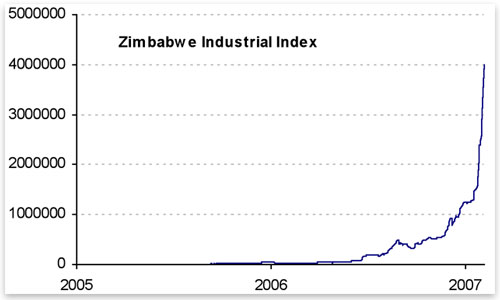
Here's a chart of Venezuela's stock market. It looks like rich people greatly benefit from super high inflation:
IBC_CARACAS_STOCK-MARKET.jpg


And here's Zimbabwe:
ZimbabweIndustrialIndex.jpg


And what does it look like for the people who hold cash instead of stocks? Apparently it's awesome.
Inflation-strikes1-630x410.jpg
 

fskimospy

Elite Member
Mar 10, 2006
88,221
55,760
136
I'll take your inability to actually engage with my numerous depictions of how your ideas are unsupported by data, your logical fallacies, and your basic misunderstanding of debt markets as a sign that you don't really know what to say.

Views of economics are often tribal and emotional in nature.
 

glenn1

Lifer
Sep 6, 2000
25,383
1,013
126
I'll take your inability to actually engage with my numerous depictions of how your ideas are unsupported by data, your logical fallacies, and your basic misunderstanding of debt markets as a sign that you don't really know what to say.

Views of economics are often tribal and emotional in nature.

So speaking of tribal and emotional, how does it feel to have your Krugman stimulus now, stimulus forever views repeatedly rejected by pretty much every nation including now France? Does being ignored and even ridiculed by the leaders of most nations cause you to rethink your positions or just redouble your efforts? And how does it make you feel when even on the occasional time when your ideas are tried, they're done half-assedly and then quickly abandoned as bullshit?
 

Jhhnn

IN MEMORIAM
Nov 11, 1999
62,365
14,686
136
So speaking of tribal and emotional, how does it feel to have your Krugman stimulus now, stimulus forever views repeatedly rejected by pretty much every nation including now France? Does being ignored and even ridiculed by the leaders of most nations cause you to rethink your positions or just redouble your efforts? And how does it make you feel when even on the occasional time when your ideas are tried, they're done half-assedly and then quickly abandoned as bullshit?

So now economics is a popularity contest?

Austerity benefits the wealthy. Who do you think runs the world? poor people?

http://www.ft.com/cms/s/2/f59d7128-d121-11e3-9f90-00144feabdc0.html#axzz3BkeRwSVJ

A source you might even like-

http://www.aei-ideas.org/2013/04/th...friedman-and-the-death-of-austrian-austerity/
 

Bitek

Lifer
Aug 2, 2001
10,676
5,239
136
So speaking of tribal and emotional, how does it feel to have your Krugman stimulus now, stimulus forever views repeatedly rejected by pretty much every nation including now France? Does being ignored and even ridiculed by the leaders of most nations cause you to rethink your positions or just redouble your efforts? And how does it make you feel when even on the occasional time when your ideas are tried, they're done half-assedly and then quickly abandoned as bullshit?

None of what you said is correct. You obviously have not been following the economic or political situation in Europe at all to make this statement.

This is a France govt thread, why did the govt fall? Several members of the cabinet publicly criticized Hollande for the austerity focus, the lack of growth and threatening deflation. Hollande responded by sacking the dissenters. No wonder he is the most unpopular French president in modern history. (17% approval)

From links on the first page:

The time has come for France to resist Germany's "obsession" with austerity and promote alternative policies across the eurozone that support household consumption, firebrand French Economy Minister Arnaud Montebourg said on Sunday.

Deficit-reduction measures carried out since the 2008 financial crisis have crippled Europe's economies and governments need to change course swiftly or they will lose their voters to populist and extremist parties, Montebourg told a socialists' meeting in eastern France.

"France is the eurozone's second-biggest economy, the world's fifth-greatest power, and it does not intend to align itself, ladies and gentlemen, with the excessive obsessions of Germany's conservatives," Montebourg said.

"That is why the time has come for France and its government, in the name of the European Union's survival, to put up a just and sane resistance [to these policies]."

By all measures, the economic recovery in the EU has been a disaster. The ecb has moved on a loose money policy, and has been applying pressure to EU govts to ease fiscal policies. There is a strengthening caucus trying to oppose Merkel and shift gears towards growth.
Deflation risks may force their position. Maybe.

http://www.reuters.com/article/2014/08/31/us-eurozone-draghi-merkel-idUSKBN0GV0DN20140831

(Reuters) - A German news magazine reported on Sunday that Chancellor Angela Merkel is unhappy with European Central Bank chief Mario Draghi for apparently proposing a greater emphasis on fiscal stimulus over austerity in order to boost growth in Europe.

Der Spiegel reported, without citing any sources, that she and Finance Minister Wolfgang Schaeuble had both called the ECB president last week to take him to task about comments he made in a speech at Jackson Hole, Wyoming on Aug 22.

A German government spokesman contradicted Spiegel's version of events, however, saying that "the assertion that the chancellor took President Draghi to task does not correlate to the facts in any way". The spokesman would give no further details of the call.

Draghi told a conference of central bankers that it would be "helpful for the overall stance of policy" if fiscal policy could play a greater role alongside the ECB's monetary policy.
 
Last edited:

fskimospy

Elite Member
Mar 10, 2006
88,221
55,760
136
So speaking of tribal and emotional, how does it feel to have your Krugman stimulus now, stimulus forever views repeatedly rejected by pretty much every nation including now France? Does being ignored and even ridiculed by the leaders of most nations cause you to rethink your positions or just redouble your efforts? And how does it make you feel when even on the occasional time when your ideas are tried, they're done half-assedly and then quickly abandoned as bullshit?

Your laughably inept description of the recommended policy is pretty telling, as you've probably realized you can't argue against it on the merits by now.

I think it's terribly unfortunate that the west has been subject to such extraordinarily foolish economic policy. It certainly doesn't hurt my feelings though. I do find it sad that when conservatives are confronted with the failure of their policies their instinct is to lash out and attack others while doubling down on their failed viewpoints though. How do we prevent it next time if people are too pigheaded to admit when they're wrong?
 

Bitek

Lifer
Aug 2, 2001
10,676
5,239
136
Ironic that the conservatives have waved the white flag of surrender in a thread about France.