• We’re currently investigating an issue related to the forum theme and styling that is impacting page layout and visual formatting. The problem has been identified, and we are actively working on a resolution. There is no impact to user data or functionality, this is strictly a front-end display issue. We’ll post an update once the fix has been deployed. Thanks for your patience while we get this sorted.

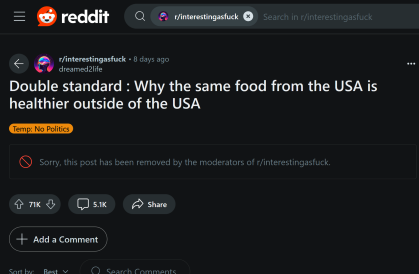
Food comparison between countries

What did it say?

I know it always strikes me when in the US that Americans add a lot of extra sugar (or, rather HFCS) to almost every product (and insist on putting processed cheese in every sandwich). Much as they feel compelled to add heavy metal riffs to every genre of music (though that often works out fairly well).


1727867628793.png
 
What did it say?

I know it always strikes me when in the US that Americans add a lot of extra sugar (or, rather HFCS) to almost every product (and insist on putting processed cheese in every sandwich). Much as they feel compelled to add heavy metal riffs to every genre of music (though that often works out fairly well).


View attachment 108540
It says that the USA has about 9000 ingredients that are allowed but banned in Europe.
 
Changes woukd have to be demand side, I.e buying everything from Whole Foods.

Food companies "nudge" their scientists to make findings that don't damn ingredients and funding from non-tainted sources is less than the ones from thenbog companies themselves.

I personally would rather eat sugar, even though it harms, than acesulfame potassium because it makes me have a headache that even other artificial sweeteners don't do.

Europe is more cautious and liberated from big money capture in that regard, like with Titanium Dioxide. Of course the States don't produce the findings, because that means the making of stuff like M and Ms has to find an alternative or be killed off.

Now, some of the fancy chemical names aren't a big deal, like ascorbic acid, which is vitamin C. Sodium benzoate should give pause though.
 
What did it say?

I know it always strikes me when in the US that Americans add a lot of extra sugar (or, rather HFCS) to almost every product (and insist on putting processed cheese in every sandwich). Much as they feel compelled to add heavy metal riffs to every genre of music (though that often works out fairly well).
Portion size is another thing. Getting huge portions with the intent of boxing up the leftovers is a very US thing.
 
I disagree, the fda can step up and ban additives that are known to be toxic, bad for us, etc…

It’s like, their purpose
You can say the FDA should be doing that. They likeliness of them following the direction of the EU is unlikely.
1. There is enough abiguity in evidnece to interpret whatever they way they want
2. Their interests will lead them to interpret the evidence most favorable to the companies, because the companies are more direct active participants than the masses, and provides more "benefit to the FDA".
3. Regulatory capture or coercion(antagonism leads to loss of further future drug prospects)

People make a false dichotomy between government and private actions. For the matters of "business" and commerce, there is no material difference. One may maximize profit while the other maximizes revenue inflows; the sources of said money are the same and so are the methods of keeping the business alive and well.

The other foolish assumption is believe science is a non-commercial activity. It actually was very much commercial, and in fact, chemistry was eventually borne precisely by the pursuit of gain, namely turning common metals into gold. Well, modern chemicals that can be patented serves the function of generating income very well, even if it isn't turned into the literal element of gold.

The masses of buyers have no need to worry about retaliation from a mass boycott. In fact, the companies are literally afraid of exactly that happening because they can't exercise control over the masses, and it's starting to happen. Some go keto, some go vegan, some just cut the sugar somewhat, some just avoid "processed foods", but the demand is already starting to crater.

Government is dependent on tax revenue, which comes from commerce, whether it is the government's own commerce or "private" individuals. The government's "invisible hand" is against weakening or destroying industries until it is backed into a corner because of the lost revenue. Lead-based paint wasn't addressed until the wealthier people got victimized. Then things started to snowball with advocacy and "science" actually bothering to observe and then authenticate the facts. BPA wouldn't have been addressed if scientists(aka IMPORTANT PEOPLE) were having their results on mice being screwed up by said chemical, and the substitute chemicals might not be that different or better.

Seeing the status of the likes aspartame, actually objectively proving something causes harm that is not immediately acute requires a lot of time and money, and dedication, which the food companies does not want to allocate towards anyone against them.

The regulators also wind up coming from those industries or big AG because that's how you build a resume to become qualified as a government employee. .
 
You can say the FDA should be doing that. They likeliness of them following the direction of the EU is unlikely.
1. There is enough abiguity in evidnece to interpret whatever they way they want
2. Their interests will lead them to interpret the evidence most favorable to the companies, because the companies are more direct active participants than the masses, and provides more "benefit to the FDA".
3. Regulatory capture or coercion(antagonism leads to loss of further future drug prospects)

People make a false dichotomy between government and private actions. For the matters of "business" and commerce, there is no material difference. One may maximize profit while the other maximizes revenue inflows; the sources of said money are the same and so are the methods of keeping the business alive and well.

The other foolish assumption is believe science is a non-commercial activity. It actually was very much commercial, and in fact, chemistry was eventually borne precisely by the pursuit of gain, namely turning common metals into gold. Well, modern chemicals that can be patented serves the function of generating income very well, even if it isn't turned into the literal element of gold.

The masses of buyers have no need to worry about retaliation from a mass boycott. In fact, the companies are literally afraid of exactly that happening because they can't exercise control over the masses, and it's starting to happen. Some go keto, some go vegan, some just cut the sugar somewhat, some just avoid "processed foods", but the demand is already starting to crater.

Government is dependent on tax revenue, which comes from commerce, whether it is the government's own commerce or "private" individuals. The government's "invisible hand" is against weakening or destroying industries until it is backed into a corner because of the lost revenue. Lead-based paint wasn't addressed until the wealthier people got victimized. Then things started to snowball with advocacy and "science" actually bothering to observe and then authenticate the facts. BPA wouldn't have been addressed if scientists(aka IMPORTANT PEOPLE) were having their results on mice being screwed up by said chemical, and the substitute chemicals might not be that different or better.

Seeing the status of the likes aspartame, actually objectively proving something causes harm that is not immediately acute requires a lot of time and money, and dedication, which the food companies does not want to allocate towards anyone against them.

The regulators also wind up coming from those industries or big AG because that's how you build a resume to become qualified as a government employee. .


Some say I’m a dreamer.
 
Back
Top