First complete review of Haswell i7-4770K

Page 14 - Seeking answers? Join the AnandTech community: where nearly half-a-million members share solutions and discuss the latest tech.

A5

Diamond Member
Jun 9, 2000
4,902
5
81
The proc send data to other parts though which means energy leaving out of the system

As IDC said, data != energy.

In an electrical sense, you can't really think of "data" as a discrete thing that moves around the system - it is a change in the energy level that propagates down the wires.
 

inf64

Diamond Member
Mar 11, 2011
3,884
4,692
136
Not bad for same process node, especially the iGPU part. No miracle "+15% IPC" though and those leaks from Far East on early ES and THG preview were spot on. It' ok to doubt early results but when we had multiple sources saying the same thing it was a bit naive to think they were all conspiring or having "bad ES", non working Turbo etc.

Platform is nice, CPU is nice, power draw is improved. For IB (and SB too) users it's maybe not worth it, the CPU part that is. For Nehalem users it's definitely worth it. The one exception are also IB/SB users who exclusively use iGPU- in this case upgrade is worth it too.
 

A5

Diamond Member
Jun 9, 2000
4,902
5
81
Not bad for same process node, especially the iGPU part. No miracle "+15% IPC" though and those leaks from Far East on early ES and THG preview were spot on. It' ok to doubt early results but when we had multiple sources saying the same thing it was a bit naive to think they were all conspiring or having "bad ES", non working Turbo etc.

Platform is nice, CPU is nice, power draw is improved. For IB (and SB too) users it's maybe not worth it, the CPU part that is. For Nehalem users it's definitely worth it. The one exception are also IB/SB users who exclusively use iGPU- in this case upgrade is worth it too.

Yeah, if you game a lot someone on a SB system would be far better served by upgrading their GPU if they haven't done so in the last 2 years.
 
Aug 11, 2008
10,451
642
126
Not bad for same process node, especially the iGPU part. No miracle "+15% IPC" though and those leaks from Far East on early ES and THG preview were spot on. It' ok to doubt early results but when we had multiple sources saying the same thing it was a bit naive to think they were all conspiring or having "bad ES", non working Turbo etc.

Platform is nice, CPU is nice, power draw is improved. For IB (and SB too) users it's maybe not worth it, the CPU part that is. For Nehalem users it's definitely worth it. The one exception are also IB/SB users who exclusively use iGPU- in this case upgrade is worth it too.

I did not struggle to go through the entire article, because somehow it would not translate on my computer. I guess 7% overall is not too bad, but it depends on how they got that average. If it is spread fairly evenly among legacy apps that is one thing. But if it is 0 percent in most apps and 50% in something that uses AVX2, then that is more disappointing. I guess I was hoping for more like 10 to 12 percent, which would have made me happy.

As far as the igp, who cares on the desktop. I also would have been glad to give up the gains in power consumption for more cpu performance. I guess you could say the total performance per watt is up considerably, but unfortunately for the desktop, most of that performance gain is in the igp.
 

mikk

Diamond Member
May 15, 2012
4,333
2,413
136
non working Turbo etc.


But this new test confirmed it once again you were wrong with the Turbo as expected. It didn't work properly in the old test from chinadiy. No surprise for me though.
 

inf64

Diamond Member
Mar 11, 2011
3,884
4,692
136
But this new test confirmed it once again you were wrong with the Turbo as expected. It didn't work properly in the old test from chinadiy. No surprise for me though.
I disagree, that test was just a bit off from this one. I expected ~7-9% faster and that's what we got(7% according to average in this one review).
 

mikk

Diamond Member
May 15, 2012
4,333
2,413
136
I disagree, that test was just a bit off from this one. I expected ~7-9% faster and that's what we got(7% according to average in this one review).


Just a bit off? Cinebench 11.5, SuperPi, Fritchess was slower on Haswell. I explained to you that the reason was a not properly working Turbo. You told turbo did work which was plain wrong.
 

Enigmoid

Platinum Member
Sep 27, 2012
2,907
31
91
Just a bit off? Cinebench 11.5, SuperPi, Fritchess was slower on Haswell. I explained to you that the reason was a not properly working Turbo. You told turbo did work which was plain wrong.

3295869_CineBench-2_thumb.jpg


Another review.
 

inf64

Diamond Member
Mar 11, 2011
3,884
4,692
136
Just a bit off? Cinebench 11.5, SuperPi, Fritchess was slower on Haswell. I explained to you that the reason was a not properly working Turbo. You told turbo did work which was plain wrong.

The 3770K in that review was performing ~5% better than what normal 3770K does.
Numbers for 3770K:
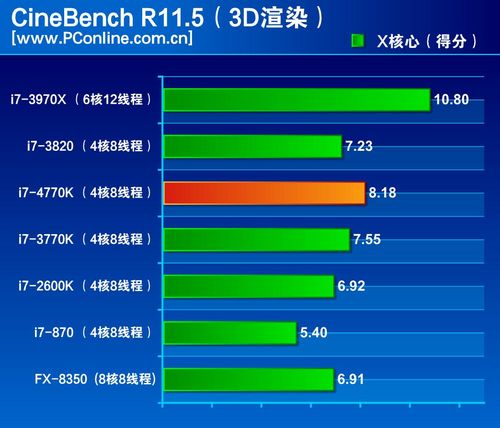
C11.5: 1st review -7.88pts, this latest review-7.55pts. Difference 4.3%!
3dmark11: 1st review-10351pts, this latest review(normal 3770K score)-9478pts. Difference 9%!
Frits Chess: 1st review-14683pts, this latest review(normal 3770K score)-13931pts. Difference 5.3%!

My point, all along, was that 3770K the first review used was not performing like a normal 3770K and I provided hard numbers to show it.
The only Haswell's performance number from 1st review that does not align with the new review is C11.5 and the difference is 8.18pts(new) vs 7.82pts(old)- a 4.6% difference. Fritz results align almost perfectly and 3dmark11 CPU(performance mode) is even higher for Haswell in 1st review (10277pts) vs this latest review that shows 9757pts-a 5% difference ;). Haswell performance is comparable between these 2 reviews while 3770K's performance is not.This is what you fail to understand and I do not know why. It's not like it's rocket science or similar.

As for SPi 1m in 1st review, Haswell basically get the same score as that "boosted" 3770K so it's not slower. Difference is 0.001% which is zero.

@Enigmoid
What do you think we are discussing the last 2 pages. That's been posted already ;).
 
Last edited:

blackened23

Diamond Member
Jul 26, 2011
8,548
2
0
3295869_CineBench-2_thumb.jpg


Another review.

So the jump to Haswell is exactly the same as the jump from Sandy Bridge to Ivy Bridge. Everything happening according to plan, 10-15% IPC increase with a huge efficiency jump. Even the desktop part which has a higher TDP than the 3770k - has better efficiency. This has very good ramifications for ULV Haswell variants which will appear in portables. :)

As long as overclocking is good (and by good, I mean similar to IB) I will be buying a 4770k and a 2013 rMBP whenever that is released. :)
 

krumme

Diamond Member
Oct 9, 2009
5,956
1,596
136
So the jump to Haswell is exactly the same as the jump from Sandy Bridge to Ivy Bridge. Everything happening according to plan, 10-15% IPC increase with a huge efficiency jump. Even the desktop part which has a higher TDP than the 3770k - has better efficiency. This has very good ramifications for ULV Haswell variants which will appear in portables. :)

As long as overclocking is good (and by good, I mean similar to IB) I will be buying a 4770k and a 2013 rMBP whenever that is released. :)

Yeaa ib is a great oc. This cpu is the best thing to happen to desktop ever. Since my 386 this must be absolutely the biggest jump ever. On top of it i get 10percent huge efficiency gain. That rocks.
 

mikk

Diamond Member
May 15, 2012
4,333
2,413
136
The 3770K in that review was performing ~5% better than what normal 3770K does.
Numbers for 3770K:
C11.5: 1st review -7.88pts, this latest review-7.55pts. Difference 4.3%!


Old review

3770k= 7.88
4770k= 7.82 -0.8%

It not only proves your wrongness about the working turbo which clearly didn't properly work as it should in some tests as I told you, it also makes 3770k results from the old review questionable because there are a bit on the high side. Results from the new test are perfectly in line with my expectation.
 

inf64

Diamond Member
Mar 11, 2011
3,884
4,692
136
I already showed you that only outlier from old and new review, when it comes to 4770K's results , is C11.5- 4.6% difference. The rest are in line (3dmark11 CPU and Fritz chess).
3770K results in 1st review were clearly inflated and I also demonstrated this with facts.
I'm ending this back and forth with you since it's pointless. I'm glad that 7% higher x86 performance vs 3770K (so IPC+better Turbo) satisfied the enthusiast in you ;).
 
Last edited:

blackened23

Diamond Member
Jul 26, 2011
8,548
2
0
Yeaa ib is a great oc. This cpu is the best thing to happen to desktop ever. Since my 386 this must be absolutely the biggest jump ever. On top of it i get 10percent huge efficiency gain. That rocks.

Sarcasm duly noted.
 

inf64

Diamond Member
Mar 11, 2011
3,884
4,692
136
Wait, how does 7% overall increased performance become 10-15% IPC?
It's a mystery I guess. The only benchmark that fits that range is Adobe PS (and it's stock 4700K vs stock 3770K so we have no clue at what clock each ran). The rest are much lower.
 

Magic Carpet

Diamond Member
Oct 2, 2011
3,477
234
106
Why not get one yourself and bench it?

In case, you need a compatible mobo. Give them a call, they might have it.
 
Last edited:

Lepton87

Platinum Member
Jul 28, 2009
2,544
9
81
So the jump to Haswell is exactly the same as the jump from Sandy Bridge to Ivy Bridge. Everything happening according to plan, 10-15% IPC increase with a huge efficiency jump. Even the desktop part which has a higher TDP than the 3770k - has better efficiency. This has very good ramifications for ULV Haswell variants which will appear in portables. :)

As long as overclocking is good (and by good, I mean similar to IB) I will be buying a 4770k and a 2013 rMBP whenever that is released. :)

When you double the IPC gain it sounds way better then it really is. Somehow from 7% you arrived at 10-15%, maybe it's 15% faster clock for clock then SB but not IB. Ivy actually delivered much better IPC improvement then I expected, but it was spoiled by thermal problems and lower clock ceiling using conventional cooling. Unfortunately it also looks like Haswell won't use solder either, which means I'm not buying it. If IVY-E won't use solder this will be my longest lasting platform ever. What's interesting is that if they left all IVY-E's cache functional it should easily provide 7% higher IPC then 4-core version and be on par with Haswell IPC-Wise or even better. In some games it should be way faster, in some apps it would be slower but on average they should be pretty similar. It's a bummer that we won't get IVY-E with its massive 30MB cache untouched for desktop. I would choose 22MB more cache L3 then 7% better IPC any day. For example 8-core Xeon E5 3.1GHz with 20mb L3 is faster in WoW then either 3770k or 3970X. It's probably very hard to further improve IPC in this architecture that had its roots in Banias from 2003 which itself is derived from p6 architecture from 1995. Intel probably needs a completely new architecture to keep its CPUs IPC improving.
 

Enigmoid

Platinum Member
Sep 27, 2012
2,907
31
91
When you double the IPC gain it sounds way better then it really is. Somehow from 7% you arrived at 10-15%, maybe it's 15% faster clock for clock then SB but not IB. Ivy actually delivered much better IPC improvement then I expected, but it was spoiled by thermal problems and lower clock ceiling using conventional cooling. Unfortunately it also looks like Haswell won't use solder either, which means I'm not buying it. If IVY-E won't use solder this will be my longest lasting platform ever. What's interesting is that if they left all IVY-E's cache functional it should easily provide 7% higher IPC then 4-core version and be on par with Haswell IPC-Wise or even better. In some games it should be way faster, in some apps it would be slower but on average they should be pretty similar. It's a bummer that we won't get IVY-E with its massive 30MB cache untouched for desktop. I would choose 22MB more cache L3 then 7% better IPC any day. For example 8-core Xeon E5 3.1GHz with 20mb L3 is faster in WoW then either 3770k or 3970X. It's probably very hard to further improve IPC in this architecture that had its roots in Banias from 2003 which itself is derived from p6 architecture from 1995. Intel probably needs a completely new architecture to keep its CPUs IPC improving.

Agree.
 

SiliconWars

Platinum Member
Dec 29, 2012
2,346
0
0
It's probably not a stretch to say that Haswell is Intel's Piledriver. This is what Ivy Bridge should have been a year ago.
 

blackened23

Diamond Member
Jul 26, 2011
8,548
2
0
When you double the IPC gain it sounds way better then it really is. Somehow from 7% you arrived at 10-15%, maybe it's 15% faster clock for clock then SB but not IB. Ivy actually delivered much better IPC improvement then I expected, but it was spoiled by thermal problems and lower clock ceiling using conventional cooling. Unfortunately it also looks like Haswell won't use solder either, which means I'm not buying it. If IVY-E won't use solder this will be my longest lasting platform ever. What's interesting is that if they left all IVY-E's cache functional it should easily provide 7% higher IPC then 4-core version and be on par with Haswell IPC-Wise or even better. In some games it should be way faster, in some apps it would be slower but on average they should be pretty similar. It's a bummer that we won't get IVY-E with its massive 30MB cache untouched for desktop. I would choose 22MB more cache L3 then 7% better IPC any day. For example 8-core Xeon E5 3.1GHz with 20mb L3 is faster in WoW then either 3770k or 3970X. It's probably very hard to further improve IPC in this architecture that had its roots in Banias from 2003 which itself is derived from p6 architecture from 1995. Intel probably needs a completely new architecture to keep its CPUs IPC improving.

My calculation isn't off. You're basing your IPC improvement on one benchmark, or two depending on your perspective. Cinebench improvements don't represent an all encompassing IPC benchmark - If you'll notice the 2600 cinebench score, the performance differential between it and the IB is even smaller. I expect across a wide array of applications, that the IPC increase will be 10-15%, as was the 2600k to the 3770k.

I guess we'll re-visit this on June 3rd.
 

SiliconWars

Platinum Member
Dec 29, 2012
2,346
0
0
The whole benchmark suite has Haswell 7% faster overall blackened. Note that's the average total increase including a more aggressive turbo, so IPC gains are likely to be low to mid single-digit.

ce4hrmph3kt29v6wu.jpg


that's the average of all of the cpu benchmarks as far as i can tell.
 
Last edited:

Lepton87

Platinum Member
Jul 28, 2009
2,544
9
81
My calculation isn't off. You're basing your IPC improvement on one benchmark, or two depending on your perspective. Cinebench improvements don't represent an all encompassing IPC benchmark - If you'll notice the 2600 cinebench score, the performance differential between it and the IB is even smaller. I expect across a wide array of applications, that the IPC increase will be 10-15%, as was the 2600k to the 3770k.

I guess we'll re-visit this on June 3rd.

You also think that IVY has 10-15% higher IPC then SB? According to your estimates 3570K is just as fast at stock as my overclocked SB. (3.8GHz+15%=4.37GHz) I won't argue with that but I don't think its that fast. Most people agree that IB IPC gain over SB is about 7% yet you get 40-120% higher IPC advantage. What interests me personally is how much faster haswell is in games. I don't care about general purpose apps as my SB is good enough and even my notebook is good enough for apps that I use, to the point I don't notice CPU differences.(it has IVY i7 QM3630) It's a shame nobody tested Haswell with proper GPUs (Titan SLI or a single titan at the very least)

ps. 15% is a HUGE advantage, Conroe had about 22% higher IPC then K8 and it was considered a slaughter. 15% is not that far from 22%. In that slide above 3770k is almost 10% faster then 2600k, if we wanted to compare IPC not CPU performance we should compare 3770k to 2700K, I think it's a safe bet that it is at least 2-3% faster then 2600k so we arrive right around 7% IPC speed-up.
It's probably not a stretch to say that Haswell is Intel's Piledriver. This is what Ivy Bridge should have been a year ago.
For a shrink IVY is surprisingly good, according to the benchmarks we've seen so far it has the same IPC improvement over its predecessor as a tock which was supposed to bring much more improvement then a tick. IVY wasn't an instant hit with enthusiasts because of things completely unrelated to its architecture. Its process is tailored for lower power consumption not faster transistors that coupled with not using solder as a thermal interface between its die and IHS resulted in people getting lower frequencies which in some cases ate up much if not all IPC improvements. I bought an i5 because I thought SB shrink would be way better and then I wanted to get an i7, because at the time of SB launch no games took advantage of 8 threads over 4 now its begging to change so I thought it was a sound decision. If I knew what I know now I would have got 2600k right from the start.
 
Last edited: