[Extremetech] Nvidia’s GameWorks program usurps power from developers, end-users, AMD

Page 10 - Seeking answers? Join the AnandTech community: where nearly half-a-million members share solutions and discuss the latest tech.

rtsurfer

Senior member
Oct 14, 2013
733
15
76
With the exception of course, that Nvidia actually is allowed to optimize the TressFX performance in their drivers, whereas AMD isn't allowed to do anything to improve PhysX performance

Well then I guess the optimizations werentcready when TressFx was first introduced.

No reason to blame AMD when unlike Nvidia they actually allow you to optimize it.
 
Last edited:

AtenRa

Lifer
Feb 2, 2009
14,003
3,362
136
Do you just make up random numbers, while you post a slide that shows how wrong you are?

It seams you need to look those numbers again,

HD7970
PCSS = 7%
HBAO+ = 9% = that is almost 30% gain over PCSS

GTX680
PCSS = 27%
HBAO+ = 14% = that is almost 50% LESS than PCSS

GTX680 vs HD7970
PCSS = 27% vs 7% = GTX680 is almost 285% faster or 2.85x faster
HBAO = 14% vs 9% = GTX is almost 55% faster

Im sure you know how to calculate those number.
 

Imouto

Golden Member
Jul 6, 2011
1,241
2
81
Im sure you know how to calculate those number.

I'm sure you know that's absolutely misleading and wrong. So having an increase of 1 fps versus 3 fps means that you can freely post a 200% increase versus the former?

You're converting a 2% gain difference into a 30% one.

What the heck is wrong with you?
 

Gloomy

Golden Member
Oct 12, 2010
1,469
21
81
Yes I did...it makes your "argument" seem false.

Here's what I said:

this is a waste no matter what brand you used. the only difference was amd cards took a 40% hit while nvidia cards only a 20% hit. in either case it was a waste of performance

Here's what your link said:

In our test scene, three settings had a significant impact: post-processing (mainly motion blur in our case), shading (mainly SSDO) and objects (POM and tessellation). It’s this last setting which had most impact and which separates the GeForces from the Radeons most of all. Although the level of performance on the GTX 560 Ti drops by just 20%, it falls by 38% on the Radeon HD 6950!

So again, I have to ask if you actually read what you posted. Because it seems as if you didn't actually read it.
 

BallaTheFeared

Diamond Member
Nov 15, 2010
8,115
0
71
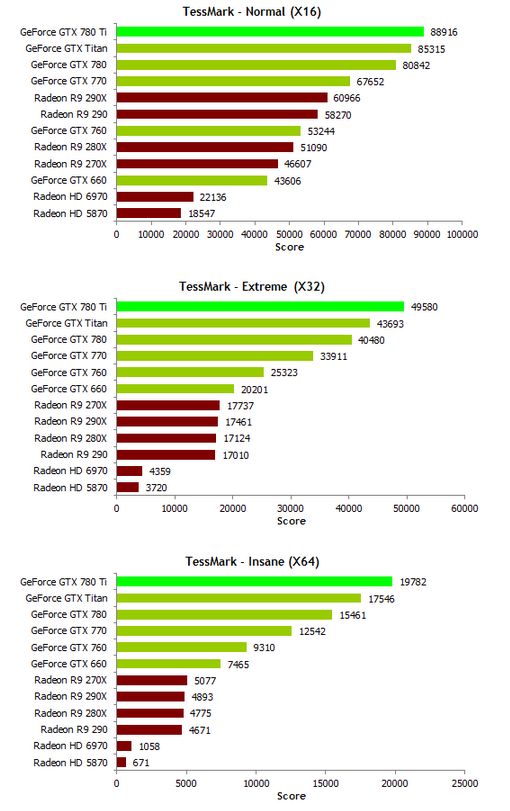
The GeForce GTX 780 Ti smashes all rivals in tessellation, no mercy!

geforce_gtx780ti_tessmark_scores.jpg


GeForce GTX 780 Ti: the King of Tessellation!

http://www.geeks3d.com/20131108/geforce-gtx-780-ti-the-king-of-tessellation/
 

AtenRa

Lifer
Feb 2, 2009
14,003
3,362
136
I'm sure you know that's absolutely misleading and wrong. So having an increase of 1 fps versus 3 fps means that you can freely post a 200% increase versus the former?

You're converting a 2% gain difference into a 30% one.

What the heck is wrong with you?


The percentage difference from 1fps to 3fps is 200% or 2x times faster than 1fps.

If you have 10fps vs 13fps the percentage difference is 30% faster over 10fps

If you have 27fps vs 14fps the percentage difference is ~48% slower than 27fps or almost half the performance.

Do i need to continue ??
 

Gloomy

Golden Member
Oct 12, 2010
1,469
21
81
Really odd results, because Hawaii was supposed to have doubled geometry performance over Tahiti. Doesn't seem to have improved at all!

The Ti's performance is insane though. Will definitely come in handy if Nvidia's tessellated hair is ever used.
 

ShintaiDK

Lifer
Apr 22, 2012
20,378
146
106
It seams you need to look those numbers again,

HD7970
PCSS = 7%
HBAO+ = 9% = that is almost 30% gain over PCSS

GTX680
PCSS = 27%
HBAO+ = 14% = that is almost 50% LESS than PCSS

GTX680 vs HD7970
PCSS = 27% vs 7% = GTX680 is almost 285% faster or 2.85x faster
HBAO = 14% vs 9% = GTX is almost 55% faster

Im sure you know how to calculate those number.

Your "math" forgets that you start at 100%. So even your "285%" case ends up as 18.6%. Not as sensationalistic tho as 285% :(
 

Imouto

Golden Member
Jul 6, 2011
1,241
2
81
The percentage difference from 1fps to 3fps is 200% or 2x times faster than 1fps.

If you have 10fps vs 13fps the percentage difference is 30% faster over 10fps

If you have 27fps vs 14fps the percentage difference is ~48% slower than 27fps or almost half the performance.

Do i need to continue ??

How can you be so obtuse?

You're forgetting the base figures. If we take a base figure of 100 FPS for both samples (which of course is another way you're doing it wrong since both are different) you can do some simple math over these figures.

10 FPS gain vs 13 FPS gain = 10% and 13% with a difference of +3%
27 FPS gain vs 14 FPS gain = 27% and 14% with a difference of -13%

You're doing it wrong since a difference in performance gain of 1 FPS to 3 FPS in a 100 FPS base would be the 200% I mentioned before.

I hope you're not employed in anything related to accounting.
 

AtenRa

Lifer
Feb 2, 2009
14,003
3,362
136
OK guys my bad, I dont know why I took the numbers as fps and not as percentage.

You are both right and im wrong in this one. :$
 

sushiwarrior

Senior member
Mar 17, 2010
738
0
71
The GeForce GTX 780 Ti smashes all rivals in tessellation, no mercy!

snip

GeForce GTX 780 Ti: the King of Tessellation!

http://www.geeks3d.com/20131108/geforce-gtx-780-ti-the-king-of-tessellation/

Can't help but feel there is some kind of optimization/implementation/driver issue when the AMD cards all perform identically, even when some have significantly more hardware than others. That's a really, really strange looking graph. Hawaii has much more tess horsepower than Tahiti, but they're all identical?
 

BallaTheFeared

Diamond Member
Nov 15, 2010
8,115
0
71
AFAIK AMD doesn't have the same implementation as Nvidia.

AMD is still adding tessellators on to the design (same thing they did with Cypress and Cayman), whereas with Nvidia each SMX has it's own poly engine.
 

Gloomy

Golden Member
Oct 12, 2010
1,469
21
81
Should still be much more powerful than Tahiti, though.

Ah, whatever. Expecting AMD to have full support for a card at launch would have been foolish. Probably not fully supported in the driver. :|
 
Last edited:

sushiwarrior

Senior member
Mar 17, 2010
738
0
71
AFAIK AMD doesn't have the same implementation as Nvidia.

AMD is still adding tessellators on to the design (same thing they did with Cypress and Cayman), whereas with Nvidia each SMX has it's own poly engine.

Doesn't change the fact that 290x has undisputably more tessellation horsepower than say, a 280x. It has 2x the geometry engines as Tahiti (Geometry engines each hold a tessellator).

With Hawaii AMD has doubled the number of geometry engines from 2 to 4, and more closely coupling those with the existing 4 rasterizer setup they inherit. The increase in geometry processors comes at an appropriate time for the company as the last time the number of geometry processors was increased was with the 6900 series in 2010, when the company moved to 2 such processors. One of the side effects of the new consoles coming out this year is that cross-platform games will be able to use a much larger number of primitives than before – especially with the uniform addition of D3D11-style tessellation – so there’s a clear need to ramp up geometry performance to keep up with where games are expected to go.

Geometry_575px.jpg


So those numbers are clearly being generated based on something other than hardware performance, it could just be because the benchmark is not working due to a driver issue or perhaps their method of testing only works properly on Nvidia. AMD suggests to keep triangle sizes large, >16 pixels, to keep high rasterizer utilization - perhaps this is why only 32x and 64x performance drops off?

This could suggest some kind of deeper architectural problem perhaps, but either way it's tough to say and I just think those results are very questionable, and not showing the obvious and significant hardware differences.

Should still be much more powerful than Tahiti, though.

Ah, whatever. Expecting AMD to have full support for a card at launch would have been foolish. :|

Well, it's a small benchmark, not a game, so it doesn't really matter too much to end users. I would be more concerned about stuff like game performance issues!

 

DiogoDX

Senior member
Oct 11, 2012
757
336
136
Can't help but feel there is some kind of optimization/implementation/driver issue when the AMD cards all perform identically, even when some have significantly more hardware than others. That's a really, really strange looking graph. Hawaii has much more tess horsepower than Tahiti, but they're all identical?
These are techreport slides. In their 290X review the editor points that the tessmark result is odd based on the heaven extreme tesselation result.

tm-x64.gif


heaven.gif


I'm not sure what to make of these results. I expected to see some nice gains out of the 290X thanks to its higher rasterization rates, but the benefits are only evident in TessMark's x16 subdivision mode and with our low-res/extreme tessellation scenario in Unigine Heaven.

A couple of potential explanations come to mind. One, TessMark uses OpenGL, and it's possible AMD hasn't updated its OpenGL drivers to take full advantage of Hawaii's quad geometry engines. Two, the drivers could be fine, and we could be seeing an architectural limitation of the Hawaii chip. As I noted earlier, large amounts of geometry amplification tend to cause data flow problems. It's possible the 290X is hitting some internal bandwidth barrier at the x32 and x64 tessellation levels that's common to GCN-based architectures. I've asked AMD to comment on these results but haven't heard back yet. I'll update this text if I find out more.
http://techreport.com/review/25509/amd-radeon-r9-290x-graphics-card-reviewed/6
 

Lonbjerg

Diamond Member
Dec 6, 2009
4,419
0
0
Here's what I said:


Here's what your link said:


So again, I have to ask if you actually read what you posted. Because it seems as if you didn't actually read it.

So you think 20% drop in performance in unreaonable why?
I think it's quite good that the drop is not more.
And it really shows the inherent flaws in AMD's fixed design tesselaion architechture...and NVIDIA's unified design.
 

BallaTheFeared

Diamond Member
Nov 15, 2010
8,115
0
71

Lonbjerg

Diamond Member
Dec 6, 2009
4,419
0
0
These numbers aren't odd.
Heaven is only using a max factor of 8-16x. Tessmark - like Stone Giant - uses up to factor 64x.

AMD has still the problem that with a higher factor and the workload the information needs to stored in the off-chip memory. And then the performance falls back to Tahiti level:

tessg0j8u.png

http://www.computerbase.de/artikel/grafikkarten/2013/amd-radeon-r9-290x-im-test/13/

That is funny...AMD only has peformance on the area of tesselation...where tesselation makes the least sense.
 

DiogoDX

Senior member
Oct 11, 2012
757
336
136
These numbers aren't odd.
Heaven is only using a max factor of 8-16x. Tessmark - like Stone Giant - uses up to factor 64x.

AMD has still the problem that with a higher factor and the workload the information needs to stored in the off-chip memory. And then the performance falls back to Tahiti level:

tessg0j8u.png

http://www.computerbase.de/artikel/grafikkarten/2013/amd-radeon-r9-290x-im-test/13/
That explains the results. Seems Hawaii is not so diferent than Thaiti after all.
 

Gloomy

Golden Member
Oct 12, 2010
1,469
21
81
That makes sense sontin, the Anandtech review mentioned that the performance gain in tessellation at higher factors over Tahiti corresponded to the memory bandwidth gain. If the tessellator is choking by having to go off-chip, this makes sense.

So you think 20% drop in performance in unreaonable why?

Because it's tessellating something you can't see using that 20% performance.
 

Unoid

Senior member
Dec 20, 2012
461
0
76
Until it is proven that Nvidia is contractually restricting developers from accepting AMD-provided support when using Gameworks or other Nvidia developer programs, this is a non-issue.

There is nothing stopping a developer from using AMD-optimized code written by either AMD or the developer themselves. What they are stopping is AMD from leveraging Nvidia's source.

Ever heard of Intel and Dell? and how AMD won massive amounts of money from Intel.

Not need to be naive.