Economists Alter Views on Government Debt

Page 2 - Seeking answers? Join the AnandTech community: where nearly half-a-million members share solutions and discuss the latest tech.

fskimospy

Elite Member
Mar 10, 2006
88,233
55,782
136
You called it "too tight". For someone familiar with economic terminology(I have studied it formally), tight is synonymous with contractionary. In addition, policy is better called appropriate or inappropriate, because no one policy works for every situation at hand.

Right, because too tight is the correct descriptor for it. Whether or not a policy is contractionary is only meaningful as compared to something else. For example raising interest rates from 1% to 1.25% is contractionary while lowering them from 10% to 9.75% is expansionary, despite the second number being much higher in relative terms.

As to referring to them as appropriate or not, saying it is too tight is saying it is tighter than appropriate.

One of the tools of monetary policy is lowering interest rates. That had been lowered to the point there is no further room during the recession. The gradual increase began significantly in 2017. The federal funds rate only peaked in 2018 and was gradually decreased during 2019, in part to enable Trump's trade war.

Right, and raising it was a dumb idea.

The graph doesn't show how incremental in the increases are, and certainly nowhere near rates that been reached historically, such as 5-6% before just the recession or during the Clinton administration.

What interest rates were in the 1990's is not relevant to what they should be today. What the chart shows is that interest rates were increasing despite us not being at full employment and inflation being low. As the Fed's dual mandate calls for limiting inflation AND maximum employment this policy was bad.

What you call insane is something that's been there for a long time. On the business level, lowering interest rates loosens the chains on lending. That makes it easier to get loans to buy houses, lease cars, fund some other project. But if economic activity is normalized at a low or no interest rate, and there's a need to get more business activity, the interest rate tool has no to be used. Investors looking for yield would take their chances in corporate bonds than the low-yielding government bonds.

Higher interest rates slows lending but provides some benefits to the lender(more interest profits for banks) and certain investors with savings looking for a safe investment with more yield. (Short term T-Bills and CDs become mighty attractive with a 5% yield)

When monetary policy runs out of bullets that's when you use fiscal policy as I previously said. That's why we need huge deficit spending. Let's build schools, hospitals, roads, etc. Let's helicopter drop money on people like it's raining. Keep doing that until we see some serious, sustained inflation. Then dial it back, raise interest rates, etc.
 

ivwshane

Lifer
May 15, 2000
33,727
17,377
136
This is like saying rocket science is simple. A rocket engine pushes the rocket up.

Actually your rocket analogy is spot on. Building a rocket is extremely simple, hell, who didn’t have one when they were kids? (kids make rockets all the time, think of mentos and coke, or pressurized air or water in a bottle). The difficulty with rockets, is making them efficient enough to carry a payload and reach a particular height. Like debt, the details and balancing on what’s effective and efficient is where the difficulty lies.
 
  • Like
Reactions: DarthKyrie

Bitek

Lifer
Aug 2, 2001
10,676
5,239
136
Yes, this is one of the major points of Krugmann's book, "Arguing with Zombies". Its one of those topics where the evidence is overwhelming, but the repblican party holds to it with religious zealotry.

Yep. Krugman has been making this point since 2008. Not really revolutionary IMO, other than the field catching up.
See Japan as model.

Cynically, I'd say it helps that the GOP blew up the deficit under Trumpers, and now the conservative side of academia is covering. Recall it was all about austerity and Austrian models in 2009-2010+....

From my simplified understanding, total deficits not so much a concern, rather growth rate vs inflation vs interest rates.

In low/ low/ low situations like now, we should be spending big to fuel growth.
Cutting spending to cut deficits will only further kill growth and on net have minimal impact on deficits as a consequence. Strong spending, in effective areas, can grow our way out of debt (see post WWII era.)

But the GOP hates success of the country under D leadership more than anything, so expect them to cut spending to fuck the economy so they can blame Biden in midterms.
 
  • Like
Reactions: DarthKyrie

Greenman

Lifer
Oct 15, 1999
22,454
6,546
136
It's absolutely counter-intuitive, and therefore scary to me.
Totally get it. It's classic old guy thinking. Don't spend what you don't have, pay your bills promptly, and pay your own way. I cut my teeth on those concepts, and it's very hard to get past them.
 

Greenman

Lifer
Oct 15, 1999
22,454
6,546
136
The best way to understand it is to remember that national finances and household/business finances have functionally nothing to do with one another.

1) The US government is borrowing money in a denomination it prints. Clearly you owing someone $1,000 US dollars vs. owing someone $1,000 GreenmanBucks is very different.
2) This borrowed money is overwhelmingly owed to ourselves. Yes, foreign entities own some of it but mostly it's owned by Americans. If you borrow $1,000 from your wife did your family (country) get any poorer? No, it's a net zero from an accounting perspective.
3) The main issue we would see from excessive debt and deficits is inflation, but if anything inflation has been consistently too low for the last ~15 years.
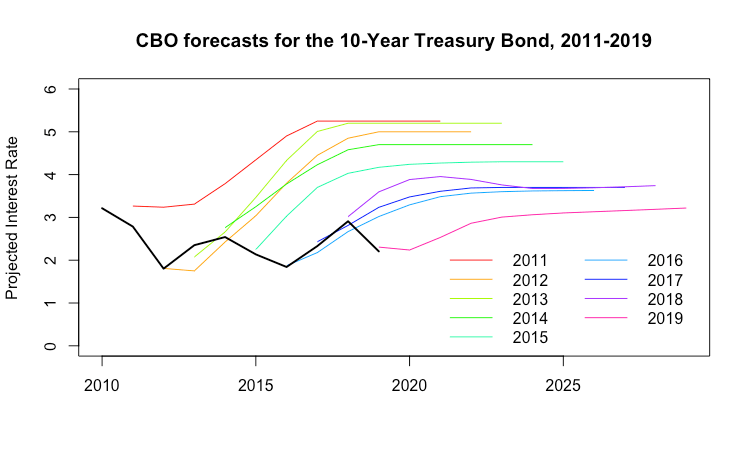
4) This is not well understood by our policymakers who keep relying on inflation/interest rate projections that have been consistently wrong for years and years now. This isn't due to normal modeling uncertainty either as they are always, ALWAYS wrong in predicting inflation/interest rates to be higher than they end up being. Check this out - each year they project a climb in interest rates that never happens. Something is wrong with how we are predicting this.

CBO-interest.png


Considering fiscal/monetary policy has been too tight for such a long time we should take a crack at making it too loose instead and see where we end up. Spend, spend, spend!
I was following right along until I saw those last three words, then a chill ran up my spine. You're asking me to give up a lifetime of very simple, straight forward, fiscal policy for what sounds like an accounts wet dream. You're going to give me a stroke.
 

fskimospy

Elite Member
Mar 10, 2006
88,233
55,782
136
I was following right along until I saw those last three words, then a chill ran up my spine. You're asking me to give up a lifetime of very simple, straight forward, fiscal policy for what sounds like an accounts wet dream. You're going to give me a stroke.
But why? Serious question, if we can agree that inflation is too low, we have elevated unemployment, and that monetary policy is at the zero lower bound, why wouldn't that be better?
 

Greenman

Lifer
Oct 15, 1999
22,454
6,546
136
But why? Serious question, if we can agree that inflation is too low, we have elevated unemployment, and that monetary policy is at the zero lower bound, why wouldn't that be better?
I don't know. Clearly I don't understand the concepts here, but it sounds like a free lunch, and that violates the one golden rule that controls the entire universe.
To be clear, I'm not arguing against the concept, I'm simply saying I don't understand it.

Edit: Why does there have to be any inflation? What's the benefit of constantly rising prices?
 

fskimospy

Elite Member
Mar 10, 2006
88,233
55,782
136
I don't know. Clearly I don't understand the concepts here, but it sounds like a free lunch, and that violates the one golden rule that controls the entire universe.
To be clear, I'm not arguing against the concept, I'm simply saying I don't understand it.

Edit: Why does there have to be any inflation? What's the benefit of constantly rising prices?
In economics there's definitely such thing as a free lunch, at least insofar as if you have people sitting around not doing productive things all else being equal it would be better if they were doing productive things. I think we would agree on that. Once you have that idea the question is, in a fundamental sense, 'how do we get the most people to be the most productive?'

As far as inflation goes there doesn't NEED to be inflation, although I think some modest, sustained inflation would make the average American better off. Price stability is impossible though - that's what people thought they were getting with the gold standard but that had wild price swings and trended towards deflation, which is a catastrophe. That leads to the main thing about what is so good about inflation and why we need it - it guards against deflation and deflation is absolutely catastrophic from an economic perspective. It's so bad that this is the primary reason central banks target a ~2% inflation rate, to try and ensure we never, ever experience deflation.

Deflation is bad because it means your money gets more valuable every day. On the surface that sounds good, right? Who doesn't want more stuff for their money. The problem is that it acts as a disincentive to economic activity. If I can buy something today but it will be cheaper next week why not wait a week? Or two? Or a month? It's fine if one person does that but if everyone does then economic activity grinds to a halt, people start cutting prices further to gin up sales, leading to more deflation, etc. It's a death spiral, leading to things like the Great Depression. (in the worst depths of the Great Depression deflation was going at about 10% a year)
 

ElFenix

Elite Member
Super Moderator
Mar 20, 2000
102,407
8,595
126
TVs have been deflating for the last 20 years and everyone rushes out to buy more all the time.
 

ElFenix

Elite Member
Super Moderator
Mar 20, 2000
102,407
8,595
126
I was following right along until I saw those last three words, then a chill ran up my spine. You're asking me to give up a lifetime of very simple, straight forward, fiscal policy for what sounds like an accounts wet dream. You're going to give me a stroke.
the economy's limit is its full employment production. iow, its productive capacity. if the economy is not at full employment, then that productive capacity is going to waste. we aren't necessarily storing it somewhere for a rainy day, a large part of it is gone.

so the question is how do you harness that productive capacity that is otherwise going to waste? one answer might be government demand to get that supply engaged. that isn't any more of a free lunch than you or i doing work rather than posting here.
 
Last edited:

dlerious

Platinum Member
Mar 4, 2004
2,211
988
136
Actually your rocket analogy is spot on. Building a rocket is extremely simple, hell, who didn’t have one when they were kids? (kids make rockets all the time, think of mentos and coke, or pressurized air or water in a bottle). The difficulty with rockets, is making them efficient enough to carry a payload and reach a particular height. Like debt, the details and balancing on what’s effective and efficient is where the difficulty lies.
It was baking soda and vinegar when I was a kid.
 

blackangst1

Lifer
Feb 23, 2005
22,902
2,359
126
But then you have all the super enlightened people in the middle who think all debt is bad, and inflation is bad for them because while they notice their food costs more they don't notice they got a raise to compensate for it.

Im in the middle and dont think that. I dont intrinsically believe debt is bad, and also believe a slow, moderate inflation rate is good.
 

fskimospy

Elite Member
Mar 10, 2006
88,233
55,782
136
the economy's limit is its full employment production. iow, it's productive capacity. if the economy is not at full employment, then that productive capacity is going to waste. we aren't necessarily storing it somewhere for a rainy day, a large part of it is gone.

so the question is how do you harness that productive capacity that is otherwise going to waste? one answer might be government demand to get that supply engaged. that isn't any more of a free lunch than you or i doing work rather than posting here.
Yes this is something a lot of people don't get about sovereign debt or why they think the social security trust fund is real and exists. Every year our country has the sum total of what we produce to live on. (basically) If we let some of it go unused this year it's not like those people will just be really well rested and will work twice as hard next year, it's gone forever. There's no storing it, but there is wasting it. (since foreign transactions exist this isn't 100% true, but it's largely true)

It's just like how we didn't need to build tanks in the 1950's and send them back in time to the 1940's to make good the debt the government ran up in WW2. I always found it weird that people think that as a society if we just collectively save a whole bunch of money that we can then all collectively spend it in the future and move prosperity forward. That is affirmatively not how the world works.
 
  • Like
Reactions: DarthKyrie

nickqt

Diamond Member
Jan 15, 2015
8,250
9,308
136
I'd argue that MMT is the best descriptor of how the US Economy works, mostly because it better explains what is happening with the economy than any other explanation. Ultimately, the "economy" doesn't actually exist, although I think for a lot of people, even that obvious fact would be heretical because, well, the economy has to exist, because there's a word for it and everything!

So, here's a "simple" explanation of what money and the non-existent economy is kinda like: oil in an engine. Here goes!

1. Economy need money like car engine need oil. Money in economy keep people moving around doing things, like oil in engine keep moving parts moving.
2. Too much money in economy like too much oil in engine: not do what supposed to do, flow easily to the right places to keep moving parts moving.
3. Too little money in economy like too little oil in engine: not do what supposed to do, flow easily to all places to keep moving parts moving.
4. If too much money in economy, inflation. If too little money in economy, widespread individual debt.

Does it seem like we have too much money, or too little money, in our "economy"? The answer I believe, is both, in the sense that we have too much money being siphoned directly to people who already have most of the money, and too little money going to the people who actually need money.

The national debt is just an accounting column showing how much money is out and about flowing in the economy. It doesn't really matter who it is owed to, although the largest creditor of the US Government is...The US Government!

Most Americans do NOT have enough money, and money is not flowing to where it is needed. Not because there is too much money, but because there is not enough money. Want "evidence"? Inflation. Inflation occurs when there is too much money. It. Isn't. Happening. This isn't Weimar Germany or Zimbabwe.

The US Governement, additionally, can just PRINT MONEY without INCURRING DEBT, but it INCURS DEBT to CONTROL INFLATION. Capitalization there is to emphasize that the debt is created to control inflation. The US Government could just create $3T in dollars without creating debt of $3T + Interest, and give every US Adult $20,000. And I bet that within a year, there'd be no Weimar/Zimbabwe inflation created, because almost all of the money would go to paying down debt, paying for durable goods, and egads, savings.

Of course, the people who own and operate the corporations and who write the laws to benefit themselves, do not want that to happen, because for oligarchs, their creditor status and most people's debtor status is actually just LEVERAGE and POWER. And oligarchs are not known for wanting to share power with non-oligarchs - especially when those oligarchs are currently trying to establish an aristocracy.