

You called it "too tight". For someone familiar with economic terminology(I have studied it formally), tight is synonymous with contractionary. In addition, policy is better called appropriate or inappropriate, because no one policy works for every situation at hand.
Right, because too tight is the correct descriptor for it. Whether or not a policy is contractionary is only meaningful as compared to something else. For example raising interest rates from 1% to 1.25% is contractionary while lowering them from 10% to 9.75% is expansionary, despite the second number being much higher in relative terms.
As to referring to them as appropriate or not, saying it is too tight is saying it is tighter than appropriate.
One of the tools of monetary policy is lowering interest rates. That had been lowered to the point there is no further room during the recession. The gradual increase began significantly in 2017. The federal funds rate only peaked in 2018 and was gradually decreased during 2019, in part to enable Trump's trade war.
Right, and raising it was a dumb idea.
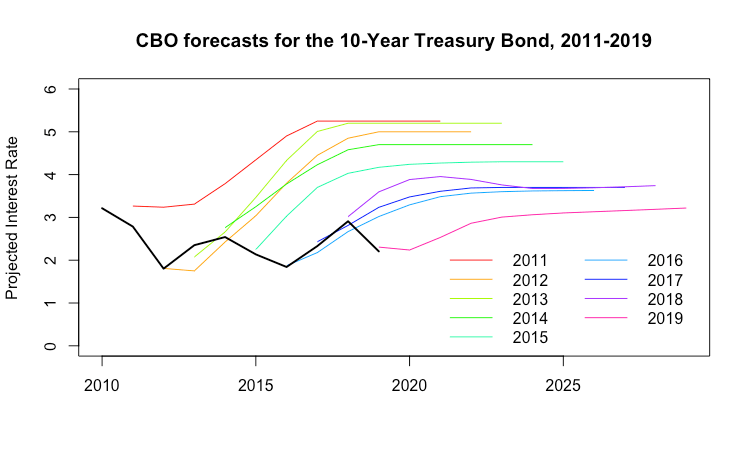
The graph doesn't show how incremental in the increases are, and certainly nowhere near rates that been reached historically, such as 5-6% before just the recession or during the Clinton administration.
What interest rates were in the 1990's is not relevant to what they should be today. What the chart shows is that interest rates were increasing despite us not being at full employment and inflation being low. As the Fed's dual mandate calls for limiting inflation AND maximum employment this policy was bad.
What you call insane is something that's been there for a long time. On the business level, lowering interest rates loosens the chains on lending. That makes it easier to get loans to buy houses, lease cars, fund some other project. But if economic activity is normalized at a low or no interest rate, and there's a need to get more business activity, the interest rate tool has no to be used. Investors looking for yield would take their chances in corporate bonds than the low-yielding government bonds.
Higher interest rates slows lending but provides some benefits to the lender(more interest profits for banks) and certain investors with savings looking for a safe investment with more yield. (Short term T-Bills and CDs become mighty attractive with a 5% yield)
When monetary policy runs out of bullets that's when you use fiscal policy as I previously said. That's why we need huge deficit spending. Let's build schools, hospitals, roads, etc. Let's helicopter drop money on people like it's raining. Keep doing that until we see some serious, sustained inflation. Then dial it back, raise interest rates, etc.





 Facebook
 Twitter