Economists Alter Views on Government Debt

Perknose

Forum Director & Omnipotent Overlord
Forum Director
Oct 9, 1999
46,908
10,748
147
Economics is going through an intellectual revolution on public debt

"What happened? Mainly, the gap between theory and fact became too large to ignore: The Congressional Budget Office’s 10-year forecast of U.S. government debt as a share of total output grew from a mere 6 percent in 2000 to 109 percent in 2020. Yet in that same decade, real (inflation-adjusted) interest rates on benchmark U.S. government bonds fell from 4.3 percent to negative 0.1 percent, as two top former Obama administration economists, Jason Furman and Lawrence H. Summers, point out in a new paper that’s attracting attention in pre-Biden Washington.

In fiscal 2020, the U.S. government borrowed a staggering 15 percent of gross domestic product, yet the 10-year government bond still pays less than one percent.

[...]

Far from burdening future generations, governments have a golden opportunity to fund long-standing needs by borrowing for investments in future prosperity — the list includes child care, early education, job training and clean water.

In light of the past 20 years’ experience, the oft-cited metric of total public debt as a share of total output does not truly capture the burden of borrowing.
Rather, the focus should be on annual inflation-adjusted interest payments as a share of annual output; anything under 2 percent should be sustainable, according to the Furman-Summers analysis. At present, the figure is well below that."


^^^ Yet Republicans, who voted for Trump's tax breaks for the rich, are resistant to providing more robust covid stimulus because . . . gasp . . . they are (now, again?) deficit hawks?
 
  • Love
  • Wow
Reactions: KMFJD and Pohemi

Pohemi

Lifer
Oct 2, 2004
10,918
17,034
146
If 'deficit hawks' equates to hypocrites? Yep. Agreed.

And we likely all saw it coming (the rational, logical ones did, anyway).
 

Greenman

Lifer
Oct 15, 1999
22,425
6,534
136
Wish I had a better understanding of economics. I read an article like that and think "that makes sense", then realize that the idea is borrowing ourselves into prosperity. I've seen that work on a small scale frequently, but have trouble grasping how it works on a national level.

Guess I can give up on the presidential adviser idea.
 
  • Like
Reactions: Ken g6

Perknose

Forum Director & Omnipotent Overlord
Forum Director
Oct 9, 1999
46,908
10,748
147
Wish I had a better understanding of economics. I read an article like that and think "that makes sense", then realize that the idea is borrowing ourselves into prosperity. I've seen that work on a small scale frequently, but have trouble grasping how it works on a national level.

Guess I can give up on the presidential adviser idea.
It's absolutely counter-intuitive, and therefore scary to me.
 
  • Like
Reactions: Ken g6

DarthKyrie

Golden Member
Jul 11, 2016
1,617
1,395
146
Wish I had a better understanding of economics. I read an article like that and think "that makes sense", then realize that the idea is borrowing ourselves into prosperity. I've seen that work on a small scale frequently, but have trouble grasping how it works on a national level.

Guess I can give up on the presidential adviser idea.

The way that the US system was set up by Alexander Hamilton back at its founding used the collective debt of the 13 colonies to establish the credit of the United States. In other words, our debt is our source of credit.
 
  • Like
Reactions: nickqt

fskimospy

Elite Member
Mar 10, 2006
88,154
55,704
136
Wish I had a better understanding of economics. I read an article like that and think "that makes sense", then realize that the idea is borrowing ourselves into prosperity. I've seen that work on a small scale frequently, but have trouble grasping how it works on a national level.

Guess I can give up on the presidential adviser idea.
The best way to understand it is to remember that national finances and household/business finances have functionally nothing to do with one another.

1) The US government is borrowing money in a denomination it prints. Clearly you owing someone $1,000 US dollars vs. owing someone $1,000 GreenmanBucks is very different.
2) This borrowed money is overwhelmingly owed to ourselves. Yes, foreign entities own some of it but mostly it's owned by Americans. If you borrow $1,000 from your wife did your family (country) get any poorer? No, it's a net zero from an accounting perspective.
3) The main issue we would see from excessive debt and deficits is inflation, but if anything inflation has been consistently too low for the last ~15 years.
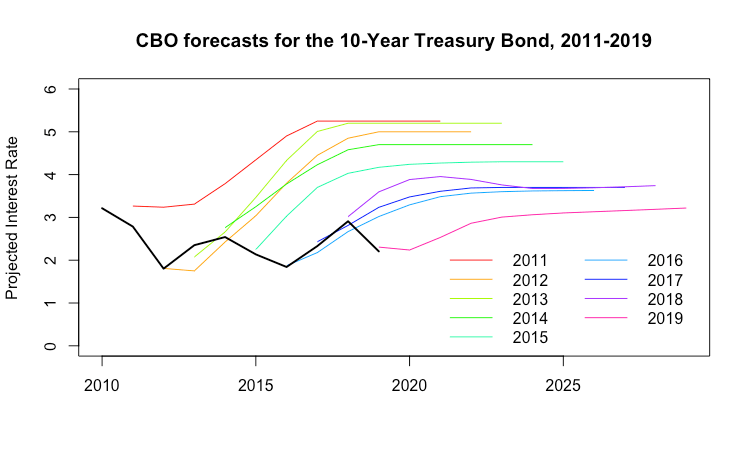
4) This is not well understood by our policymakers who keep relying on inflation/interest rate projections that have been consistently wrong for years and years now. This isn't due to normal modeling uncertainty either as they are always, ALWAYS wrong in predicting inflation/interest rates to be higher than they end up being. Check this out - each year they project a climb in interest rates that never happens. Something is wrong with how we are predicting this.

CBO-interest.png


Considering fiscal/monetary policy has been too tight for such a long time we should take a crack at making it too loose instead and see where we end up. Spend, spend, spend!
 

mect

Platinum Member
Jan 5, 2004
2,424
1,637
136
Yes, this is one of the major points of Krugmann's book, "Arguing with Zombies". Its one of those topics where the evidence is overwhelming, but the repblican party holds to it with religious zealotry.
 

dlerious

Platinum Member
Mar 4, 2004
2,196
981
136
I'd take the opinion of Stephanie Kelton over Larry Summers (who supported bail outs under Obama, but did nothing for the mortgage crisis).
 

Jaskalas

Lifer
Jun 23, 2004
36,099
10,422
136
Achieving the sweeping policy goal of a robust safety net doesn't even require going into debt if we taxed for it. Though the idea of a takeover of home loans would require an up front cost... the perfect test for this economic... view.

I say spend... but I also say you better make it something the people can materially enjoy and immediately and directly benefit from.
 

Torn Mind

Lifer
Nov 25, 2012
12,086
2,774
136
Just because you can print money doesn't mean you should. That caveat is actually in the article near the end. Just because you can spend, doesn't mean remove the responsibility spending the money well.
The new proponents of greater government debt distinguish between spending money and spending it wisely, to be sure. Relieving Congress of simplistic budget-balancing worries, they argue, does not relieve it of responsibility to vet public investments for their likely impact on genuine unmet human needs and the economy’s future capacity to grow. It’s an entirely valid caveat — whose consistency with the way Congress works is, unfortunately, debatable.

Economics is not a subject that is easily reduced to one "always" axiom. It's about variables affecting other variables and people are the test subjects of policymakers.


Debt is simple. You issue it. Someone buys it. You owe the buyer the principal and interest over time.


This works fine because the modern world is currently politically stable and currency systems facilitate that.

Debt makes sense if the good or service the state requires funding is worth obtaining in the here and now.

Eventually, the payment will need to be funded via tax revenue in the future.

Bond rates are affect by numerous variables, and we've been in an expansionary monetary policy phase since the Great Recession.
 

Torn Mind

Lifer
Nov 25, 2012
12,086
2,774
136
Considering fiscal/monetary policy has been too tight for such a long time we should take a crack at making it too loose instead and see where we end up. Spend, spend, spend!
Monetary policy has been very much expansionary and so has fiscal policy(tax breaks). You can argue the particular target of the breaks was not optimal, but a tax break is very much expansionary fiscal policy.
 

fskimospy

Elite Member
Mar 10, 2006
88,154
55,704
136
Monetary policy has been very much expansionary and so has fiscal policy(tax breaks). You can argue the particular target of the breaks was not optimal, but a tax break is very much expansionary fiscal policy.

Right. Who is arguing tax breaks aren't expansionary though? The problem is, as you point out, that they were dumb expansionary policy but dumb expansionary policy is better than nothing.

The best policy would be to raise taxes on the rich significantly and then use that additional headroom to spend even MORE on more useful things.

The second best policy would be to cut taxes on rich people in exchange for actually useful spending. Republicans might actually go for this as cutting taxes/regulations for rich people is their only real policy goal.

The third best policy (really, least bad of the bad policies) would be to do nothing.

The worst policy would be to lower the deficit.

Monetary policy has once again become expansionary but was definitely contractionary from the end of 2015 through mid-2019. This was based off the insane idea that in order to combat future inflation or a future recession we needed to make the economy worse in advance.

fredgraph.png
 

ElFenix

Elite Member
Super Moderator
Mar 20, 2000
102,405
8,585
126
This was based off the insane idea that in order to combat future inflation or a future recession we needed to make the economy worse in advance.

and that squeezes labor which is, ultimately, why an economy set up to favor rent seekers does it.
 

fskimospy

Elite Member
Mar 10, 2006
88,154
55,704
136
and that squeezes labor which is, ultimately, why an economy set up to favor rent seekers does it.
Yep. The fundamental point that I think most people don't understand or really, get precisely backwards, is that all else being equal inflation is good for the average person. Modest, sustained inflation is good for net debtors and bad for net creditors and the average American is a net debtor. (that is, sum of debts including mortgage vs. sum of invested capital)

So basically if you have a lot of money lent out to other people inflation is bad news. If you don't, it's good news.
 
  • Like
Reactions: DarthKyrie

dank69

Lifer
Oct 6, 2009
37,536
33,265
136
Yep. The fundamental point that I think most people don't understand or really, get precisely backwards, is that all else being equal inflation is good for the average person. Modest, sustained inflation is good for net debtors and bad for net creditors and the average American is a net debtor. (that is, sum of debts including mortgage vs. sum of invested capital)

So basically if you have a lot of money lent out to other people inflation is bad news. If you don't, it's good news.
But then you have all the super enlightened people in the middle who think all debt is bad, and inflation is bad for them because while they notice their food costs more they don't notice they got a raise to compensate for it.
 
  • Like
Reactions: DarthKyrie

ElFenix

Elite Member
Super Moderator
Mar 20, 2000
102,405
8,585
126
We need to watch inflation. No one says don't watch inflation. But we've defined inflation in such a way and set up our institutions in such a way that the only rising prices that get the clampdown are wages.
 

ivwshane

Lifer
May 15, 2000
33,669
17,274
136
Achieving the sweeping policy goal of a robust safety net doesn't even require going into debt if we taxed for it. Though the idea of a takeover of home loans would require an up front cost... the perfect test for this economic... view.

I say spend... but I also say you better make it something the people can materially enjoy and immediately and directly benefit from.


And that there is the issue. While I completely agree with you, not everyone will and what are beneficial to the people can be debated (most likely dishonestly).
 

interchange

Diamond Member
Oct 10, 1999
8,031
2,886
136
In the absolute best case scenario, we just habituate ourselves to borrowing up until that limit and are unable to stop until it's too late, but things won't immediately collapse. They'll just be irreparably catastrophic when they do.

Wait, we're talking about economics not climate change.
 

SMOGZINN

Lifer
Jun 17, 2005
14,359
4,640
136
Achieving the sweeping policy goal of a robust safety net doesn't even require going into debt if we taxed for it. Though the idea of a takeover of home loans would require an up front cost... the perfect test for this economic... view.

I say spend... but I also say you better make it something the people can materially enjoy and immediately and directly benefit from.

Republican's read this and think 'So, you are saying we should start another war!'
 

Torn Mind

Lifer
Nov 25, 2012
12,086
2,774
136
Right. Who is arguing tax breaks aren't expansionary though? The problem is, as you point out, that they were dumb expansionary policy but dumb expansionary policy is better than nothing.

The best policy would be to raise taxes on the rich significantly and then use that additional headroom to spend even MORE on more useful things.

The second best policy would be to cut taxes on rich people in exchange for actually useful spending. Republicans might actually go for this as cutting taxes/regulations for rich people is their only real policy goal.

The third best policy (really, least bad of the bad policies) would be to do nothing.

The worst policy would be to lower the deficit.

Monetary policy has once again become expansionary but was definitely contractionary from the end of 2015 through mid-2019. This was based off the insane idea that in order to combat future inflation or a future recession we needed to make the economy worse in advance.

fredgraph.png
You called it "too tight". For someone familiar with economic terminology(I have studied it formally), tight is synonymous with contractionary. In addition, policy is better called appropriate or inappropriate, because no one policy works for every situation at hand.

One of the tools of monetary policy is lowering interest rates. That had been lowered to the point there is no further room during the recession. The gradual increase began significantly in 2017. The federal funds rate only peaked in 2018 and was gradually decreased during 2019, in part to enable Trump's trade war.

The graph doesn't show how incremental in the increases are, and certainly nowhere near rates that been reached historically, such as 5-6% before just the recession or during the Clinton administration.

What you call insane is something that's been there for a long time. On the business level, lowering interest rates loosens the chains on lending. That makes it easier to get loans to buy houses, lease cars, fund some other project. But if economic activity is normalized at a low or no interest rate, and there's a need to get more business activity, the interest rate tool has no to be used. Investors looking for yield would take their chances in corporate bonds than the low-yielding government bonds.

Higher interest rates slows lending but provides some benefits to the lender(more interest profits for banks) and certain investors with savings looking for a safe investment with more yield. (Short term T-Bills and CDs become mighty attractive with a 5% yield)
 
  • Like
Reactions: ivwshane