• We’re currently investigating an issue related to the forum theme and styling that is impacting page layout and visual formatting. The problem has been identified, and we are actively working on a resolution. There is no impact to user data or functionality, this is strictly a front-end display issue. We’ll post an update once the fix has been deployed. Thanks for your patience while we get this sorted.

Do you buy name brand or generic batteries?

Page 2 - Seeking answers? Join the AnandTech community: where nearly half-a-million members share solutions and discuss the latest tech.
I was going to use my nice multiprobe meat thermometer for our Thanksgiving turkey. Turns out the AA batteries in it leaked so that now has to be cleaned...

We have a bunch of eneloops because photography gear loves AA and AAA for flashes, triggers etc. Now that we're almost entirely done with that side business they're going into everything else that needs a AAA or AA battery
I have dozens and dozens of Eneloops and have never seen one leak and have rarely seen one go bad. Most everything works with them but there are exceptions. One of my digital scales doesn't like the lower voltage. I've put Lithium batteries in it.
 
I was going to use my nice multiprobe meat thermometer for our Thanksgiving turkey. Turns out the AA batteries in it leaked so that now has to be cleaned...

We have a bunch of eneloops because photography gear loves AA and AAA for flashes, triggers etc. Now that we're almost entirely done with that side business they're going into everything else that needs a AAA or AA battery
Were they Duraleaks?


Gogo Project Farm.

 
Last edited:
Modern alkalines seem bad for leaking. Duracell and Energizer are the worse. Never personally seen ni-mh ones leak. I have seen nicad leak somewhat, but it's more like surface corrosion.
 
Question:

Power outages an be a problem here, in particular if there's a large earthquake.

I have a couple of emergency lamps that each have two 4 1/2 inch long fluorescent bulbs. Can be switched both on or one on. Bought them at Costco and they are branded Energizer.

Each lamp uses 4 D cells. Need new batteries for them. Going to Costco in a couple days. No need to buy there, I think their D cells may just be Duracells.

I think I have some cases that convert a C cell into a D cell, would have to find them to use them and gave away my C cells anyway.

Well, what D cells would you recommend for these? Longevity and no leaks would be the issues, I figure. I actually need to clean out some crystal chemical leaks from Duracells in at least one lamp before setting them back up.
 
Last edited:
Question:

Power outages an be a problem here, in particular if there's a large earthquake.

I have a couple of emergency lamps that each have 2 ~3 inch long fluorescent bulbs. Can be switched both on or one on.

Each lamp uses 4 D cells. Need new batteries for them. Going to Costco in a couple days. No need to buy there, I think their D cells may just be Duracells.

I think I have some cases that convert a C cell into a D cell, would have to find them to use them and gave away my C cells anyway.

Well, what D cells would you recommend for these? Longevity and no leaks would be the issues, I figure. I actually need to clean out some crystal chemical leaks from Duracells in at least one lamp before setting them back up.
Without knowing exactly what they look like, I'd look into ditching the Ds altogether, and see if a lithium battery pack could be hacked onto it. You can get bare batteries with a wallwart charger from amazon pretty cheaply. You could as of a couple years ago anyway. I used to buy them to power my robot/radios for work.
 
If 5V will work, that opens up a ton of options using a cellphone battery bank. You can get those cheap at meh.com, and their sister companies. Power the lamp, and charge it from any usb port.
 
Well, what D cells would you recommend for these? Longevity and no leaks would be the issues, I figure. I actually need to clean out some crystal chemical leaks from Duracells in at least one lamp before setting them back up.
If you go with D cells, then just store the batteries outside the lamp (but nearby so that you can find both at the same time). That would go a long way towards your problems with leaking.

Although for emergencies, I swear by a different type of product. Get yourself a car jump starter. I have a slightly older version of this one: https://www.amazon.com/dp/B0FSSD3PWS/ Has emergency light, can power up your devices, and can jump start your car. Basically, if you are going to spend money, get something far more versatile. They make versions with longer battery life or more current for larger vehicles--it just will cost a bit more.
 
Question:

Power outages an be a problem here, in particular if there's a large earthquake.

I have a couple of emergency lamps that each have 2 ~3 inch long fluorescent bulbs. Can be switched both on or one on.

Each lamp uses 4 D cells. Need new batteries for them. Going to Costco in a couple days. No need to buy there, I think their D cells may just be Duracells.

I think I have some cases that convert a C cell into a D cell, would have to find them to use them and gave away my C cells anyway.

Well, what D cells would you recommend for these? Longevity and no leaks would be the issues, I figure. I actually need to clean out some crystal chemical leaks from Duracells in at least one lamp before setting them back up.
Runtime will probably be short, but Eneloop makes converters. If you're keeping a lot of Ladda AA cells charged up, I like this solution.
These were the third set of D-cell converters I bought. The cheap Chinese ones were junk, and the older style Eneloop spacers don't have a "bottom" cap.


The Project Farm video I linked yesterday is good if you want to buy some new batteries, although he tested only AAs. YMMV


To piggyback onto the last suggestion, a combo jump starter + tire inflator is not a bad idea.

 
To avoid needing to buy different size batteries I ended up getting some D cell adapters that let you put a AA battery in it. Of course if it's a high draw device then you'll get way reduced run time but for something like a radio or lantern it should work fine.

Lot of the major tool brands also make inverters that take their batteries now, which is a nice way to power a 120v item with a tool battery if you have lot of them. Just wish they were pure sine though, since the square wave does not play nice with certain things like fans and even some LED bulbs.
 
If you go with D cells, then just store the batteries outside the lamp (but nearby so that you can find both at the same time). That would go a long way towards your problems with leaking.

Although for emergencies, I swear by a different type of product. Get yourself a car jump starter. I have a slightly older version of this one: https://www.amazon.com/dp/B0FSSD3PWS/ Has emergency light, can power up your devices, and can jump start your car. Basically, if you are going to spend money, get something far more versatile. They make versions with longer battery life or more current for larger vehicles--it just will cost a bit more.
Actually, I have a Gooloo. This one:


Don't know if it features emergency light.

Edit: Guess it does...

About this item​


  • 3000A PEAK POWER FOR ANY 12V VEHICLE: This jump starter booster pack can Jumpstart 9L gas/7L diesel engines (cars, trucks, RVs, boats) in seconds—even at -4°F! The "BOOST" mode instantly activates when batteries drop below 9V, ensuring reliable starts for dead batteries. 30% stronger than standard 2000A models.
  • 10-LAYER SAFETY BATTERY JUMP PACK TECHNOLOGY: Engineered with spark-proof clamps and reverse polarity alerts, this car battery charger jump starter features 10 protections (over-current/short-circuit/overload). Built for extreme environments (-4°F to 140°F), our jump starter battery pack is 3 times safer than generic portable jump starters for cars.
  • 4-IN-1 EMERGENCY BATTERY JUMPER STARTER & POWER BANK: 15W USB-C/Quick charge3.0 ports (charge phones 50% faster), 400-lumen LED jump box flashlight (SOS/Strobe modes), 15V DC port powers tire inflators , Lithium car starter doubles as a massive power bank.
  • RUGGED 12V PORTABLE JUMP STARTER : Shockproof jump pack survives 5ft drops with scratch-resistant armor shell. Auto-sleep tech keeps charge for 18 months (recharge every 90 days). 50% longer lifespan vs. standard car battery starters.
  • PRO-LEVEL KIT + LIFETIME SUPPORT: Includes: GOOLOO 3000A Car Jump Starter, Heavy-duty clamps (10,000+ clamp tests), USB-C cables, storage bag. Backed by GOOLOO’s 18-month warranty and 24/7 online assistance.
 
Last edited:
If 5V will work, that opens up a ton of options using a cellphone battery bank. You can get those cheap at meh.com, and their sister companies. Power the lamp, and charge it from any usb port.
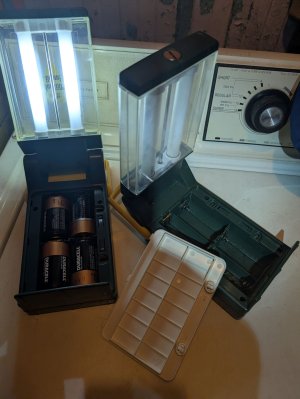
Here is a photo of the lanterns. One has 4 D cells installed, they are around 1.50 volts now, old batteries but have enough oomph to shine the light. The lanterns have a rotation pivot and a switch for Off, one or both lamps. Here, the door to the battery chamber is removed from both, one is shown. I suppose a battery pack that fit in the chamber could be attached to the terminals that otherwise would contact D cells. Maybe a USB charging solution rigged up. In an emergency, my Gooloo could be used to recharge the cell pack.

San Francisco had a major electrical outage over this week, I think over 100,000 customers in the "dark" for hours. Being across the Bay I wasn't affected. Still a lot of power outages in northern California.
Two Energizer 4 D cell lanterns.jpg
 
Last edited:
Here is a photo of the lanterns. One has 4 D cells installed, they are around 1.50 volts now, old batteries but have enough oomph to shine the light. The lanterns have a pivot and switch that lights 0, 1 or both lamps. Here, the door to the battery chamber is removed from both, one is shown.
View attachment 135682
I wonder what overvolting it to 5V would do? It could be stepped down, but that's beyond the effort *I'm* willing to put into something like that. Nibbling out some plastic, a cell phone battery bank would fit nicely in the compartment.

edit:
You could even cut slots in the cover, and just velcro strap a battery to the outside. It would be minimally destructive, and you could go back to using D cells with minimal solder removal.
 
I wonder what overvolting it to 5V would do? It could be stepped down, but that's beyond the effort *I'm* willing to put into something like that. Nibbling out some plastic, a cell phone battery bank would fit nicely in the compartment.

edit:
You could even cut slots in the cover, and just velcro strap a battery to the outside. It would be minimally destructive, and you could go back to using D cells with minimal solder removal.
1.55 x 4 = 6.2. So, 5V would be undervolting it, right?
 
1.55 x 4 = 6.2. So, 5V would be undervolting it, right?
I think that setup is 1.5V*2, isn't it? The extra two batteries add capacity, not voltage. I could be wrong. I know fuckall about electronics. I'm just a hack that slaps stuff together :^D
 
I think that setup is 1.5V*2, isn't it? The extra two batteries add capacity, not voltage. I could be wrong. I know fuckall about electronics. I'm just a hack that slaps stuff together :^D
I would guess all in series since the direction reverses on the batteries. It would be simpler to design that layout in series.
 
Youse guys do know that rechargeable batteries are 1.2 volts where dry cells (non-rechargeable) are 1.5 volts. That means you're starting off at 80%.

I use rechargeable batteries for some things, but things like flashlights, I want the extra voltage.
You are comparing apples and oranges.

NiMH charge to about 1.4V, and instead of a more linear decline like alkalines, stay at around 1.2V for the greatest period in their discharge curve while the alkalines would have dropped below 1.2V.

Now if you're talking about old school incandescent bulbed lights or the really crappy driverless LED lights (typically using 3x # of AA or AAA cells) then voltage matters quite a lot, but if talking about any decent quality LED light made in the last dozen years, it's going to have a boost or buck circuit where the specific voltage of the battery isn't nearly as linear a relationship to the brightness, and in fact that can run dimmer on alkalines because they can't supply as much current as NiMH, so literally you could have for example a 250 lumen 1 x AA flashlight with an alkaline in it at 1.4V at it's no-load voltage, but under load powering the light, it's voltage drops lower than if you had a NiMH with the same % charge in it.

The only benefit to alkalines for decent flashlights is their long shelf life with lower self discharge rate, that you can leave it in a glovebox or wherever for 5 years and expect the alkaline to have retained a higher charge % at that point - but if that's really important then better to use lithium primary cells as they are even better at that and higher energy density as well - but too expensive for my purposes.

Personally I have zero interest in ever putting an alkaline in a flashlight unless it's an emergency, and especially not 2 or more alkalines for example Duracells in one stored for years as alkalines are far more likely to leak and corrode the flashlight than NiMH which hardly ever leak, potentially fusing themselves inside from the corrosion, to the point of having to trash the flashlight.

I can't imagine going back to alkalines for all the flashlights I have, though full disclosure would be that I no longer buy flashlights that take alkaline or NiMH AA or AAA as I already had too many and Li-Ion cells are where it's at for higher output and energy density in the better lights produced today, designed for them - with one exception which is an EDC 1 x AAA keychain light, that I use more than any other because it's always with me if wearing pants.

 
Last edited:
When Nimh first came out I found some devices were picky, such as Wii remotes as the voltage would be too low. But I find the newer Nimh batteries are better now, guess they hold their voltage long enough that the devices don't complain about undrevoltage. Could also be that more modern devices are just more tolerant. A lot of chips now days can run fine at 3.3v or even a little lower, some can even run at like 1.3. So that may also be a factor.
 
I hardly buy alkalines, got some Amazon Basics 9V for backup batteries in mains powered smoke detectors and CO monitors, and have a doorbell taking a tiny 12V alkaline, a few dirt cheap widgets that take LR44 but that's about it besides my mother's HVAC thermostat which I felt would be more of a long term issue if using NiMH that she might even throw away without realizing they were rechargeable.

Otherwise the alkaline or zinc carbon that come with product remote controls, I put into clocks that run for years and use NiMH in the remotes. I've only bought LSD type NIMH for the past 15+ years.

They were a game changer for me, as well as a couple better chargers that are both gentler at recharging and reach nearer full batt. capacity while doing so. I used to exclusively buy Eneloops but decided they aren't worth the extra cost, usually getting LSD aka precharged Amazon Basics or Tenergy Centura instead.
 
Last edited:
I think RayOVac has become a discount line, and maybe not even made by a primary manufacturer. That's just my impression, and I haven't looked it up. My feeling is it's one of those brand names that's been sold a few times, and nobody really gives a shit about making good batteries.
RayOvacs was bought by Energizer years ago. After that, they seem to leak every time I use them. Used to be my favorite.

I switched to Panasonic "Platinum Power" alkaline batteries about 5 years ago. So far I have never had one leak, which to me is the most important thing. Too many items ruined by Duracell, RayOvac, and Energizer.

Only thing with the Panasonic alkaline, is I have never found them anywhere but Amazon, in 48 packs. The local stores just seem to sell the cheap "heavy duty" non alkaline version.

Love my Eneloops as well, but I have items that won't work with the lower voltage. Like my thermostat, that will start showing "low voltage" immediately.
 
I can't imagine going back to alkalines for all the flashlights I have, though full disclosure would be that I no longer buy flashlights that take alkaline or NiMH AA or AAA as I already had too many and Li-Ion cells are were it's at for higher output and energy density in the better lights produced today, designed for them - with one exception which is an ECD 1 x AAA keychain light, that I use more than any other because it's always with me if wearing pants.
Yeah, I always have a single cell AAA flashlight in my pants. Until lately had a Ladda NiMH 900mah AAA in it (said to be same as Eneloop Pro). Relative gave me a Linogy kickstarter setup a month ago, which includes a gimicky charger (drops cells into container after all are charged), and what seems to be some kind of proprietary Lithium-ion rechargeables (AA and AAA). Linogy rates the AAAs at 1300 mah. I very much doubt they have that energy density. First cell I used seemed to die pretty fast. Maybe with repeated charges they'll do better. Crazy thing is my Xtar VC4 charger won't charge them! Linogy rates them at 1.5V and my multimeter says that's what they're at. My La Cross BC700 if functional could test the energy density but won't respond to the button that would set up the test. Still charges batteries but a lot of the functionality of the charger's not accessible anymore.
 
Last edited:
Relative gave me a Linogy kickstarter setup a month ago, which includes a gimicky charger (drops cells into container after all are charged), and what seems to be some kind of proprietary Lithium-ion rechargeables (AA and AAA). Linogy rates the AAAs at 1300 mah. I very much doubt they have that energy density. First cell I used seemed to die pretty fast. Maybe with repeated charges they'll do better.
The makes I've seen of those, rated them as mWh instead of mAh, so might be 1300 mWh, which divided by 1.5V = 867mAh.

Edit: Yes that is what they're doing according to this amazon listing that spec's 1300mWh:

Project Farm youtube channel did a review on a few - I don't remember all the details but one thing noted was if there's much current draw (even as low as 250mA), they drooped pretty significantly in voltage. I've also linked the battery hits for the channel as he's done other relevant battery testing too.

 
Last edited:
Question:

Power outages an be a problem here, in particular if there's a large earthquake.

I have a couple of emergency lamps that each have two 4 1/2 inch long fluorescent bulbs. Can be switched both on or one on. Bought them at Costco and they are branded Energizer.

Each lamp uses 4 D cells. Need new batteries for them. Going to Costco in a couple days. No need to buy there, I think their D cells may just be Duracells.

I think I have some cases that convert a C cell into a D cell, would have to find them to use them and gave away my C cells anyway.

Well, what D cells would you recommend for these? Longevity and no leaks would be the issues, I figure. I actually need to clean out some crystal chemical leaks from Duracells in at least one lamp before setting them back up.
How much are the lamps worth? I'd consider getting some tool brand LED lights from whichever tool brands you have batteries for already.

As far as powering those lamps, I like the suggestion someone else made which is to see if they run well enough at 5V then use an external USB power pack (or jump starter pack that has USB output too) and just lop the end off a USB cable to wire it up to the lamp battery bay terminals. There might even be the option to put the right size USB power pack directly in it's existing battery bay if some plastic is removed but I'd hate to hack the bay until you're sure it's going to be a workable solution.

I would've expected them to have the 4 x D cells in series so call it 6V at start of operation but see how low the voltage can drop before it stops working - odds are fair that they would still work at 5V which isn't really undervolting them if you consider that they are intended to run as long as possible through the range of voltage that 4 x D cells would have as they discharge and drop voltage. 5V would still be 1.25V per cell x 4.

There are more elaborate options too like a few Li-Ion cells with a BMS protection board, or the USB power bank, and a SMPS boost regulator board to arrive at whatever voltage you want.

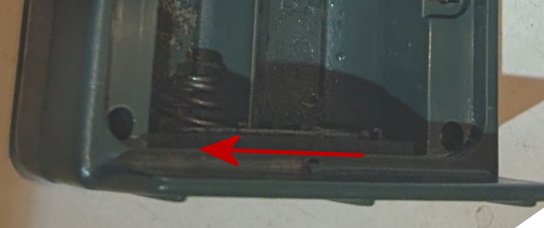
Edit: Yeah I tweaked the picture a bit and it does seem to run all 4 x D cells in series for 6V as the battery contact at the bottom appears to connect the two series into a series of 4, which would make sense anyway because the higher the input voltage, the more efficient it's going to be to boost that to the much higher voltage the FL tubes need.

series_connection.jpg
 
Last edited:
The makes I've seen of those, rated them as mWh instead of mAh, so might be 1300 mWh, which divided by 1.5V = 867mAh.

Edit: Yes that is what they're doing according to this amazon listing that spec's 1300mWh:

Project Farm youtube channel did a review on a few - I don't remember all the details but one thing noted was if there's much current draw (even as low as 250mA), they drooped pretty significantly in voltage. I've also linked the battery hits for the channel as he's done other relevant battery testing too.

Yeah, the cells say mWh which had me confused. I always see mah on them. Well, the energy density on those Linogy AAAs would then be similar to my LADDA LSD AAA's of which I have a small bunch, 8-12, don't remember. Supposed to be rebranded Eneloop AAA Pros. Truly, I have an embarrassment of many AA and AAA batteries now! Occasionally one goes bad and I recycle (throw a bag of bad batteries to bring to recycling center, a trip I make every few years).

I should be using my Gooloo to recharge some stuff and then recharge the Gooloo, just to keep it healthy, also keep "some stuff" healthy, not sure how to regulate all that. I have a lot of rechargeable stuff, some with removable batteries others not removable.
 
Back
Top