Youse guys do know that rechargeable batteries are 1.2 volts where dry cells (non-rechargeable) are 1.5 volts. That means you're starting off at 80%.
I use rechargeable batteries for some things, but things like flashlights, I want the extra voltage.
You are comparing apples and oranges.
NiMH charge to about 1.4V, and instead of a more linear decline like alkalines, stay at around 1.2V for the greatest period in their discharge curve while the alkalines would have dropped below 1.2V.
Now if you're talking about old school incandescent bulbed lights or the really crappy driverless LED lights (typically using 3x # of AA or AAA cells) then voltage matters quite a lot, but if talking about any decent quality LED light made in the last dozen years, it's going to have a boost or buck circuit where the specific voltage of the battery isn't nearly as linear a relationship to the brightness, and in fact that can run dimmer on alkalines because they can't supply as much current as NiMH, so literally you could have for example a 250 lumen 1 x AA flashlight with an alkaline in it at 1.4V at it's no-load voltage, but under load powering the light, it's voltage drops lower than if you had a NiMH with the same % charge in it.
The only benefit to alkalines for decent flashlights is their long shelf life with lower self discharge rate, that you can leave it in a glovebox or wherever for 5 years and expect the alkaline to have retained a higher charge % at that point - but if that's really important then better to use lithium primary cells as they are even better at that and higher energy density as well - but too expensive for my purposes.
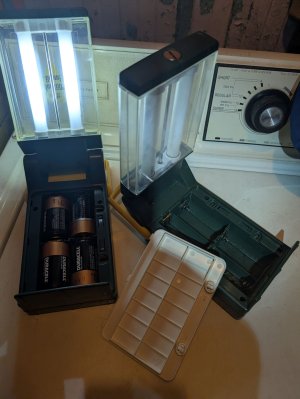
Personally I have zero interest in ever putting an alkaline in a flashlight unless it's an emergency, and especially not 2 or more alkalines for example Duracells in one stored for years as alkalines are far more likely to leak and corrode the flashlight than NiMH which hardly ever leak, potentially fusing themselves inside from the corrosion, to the point of having to trash the flashlight.
I can't imagine going back to alkalines for all the flashlights I have, though full disclosure would be that I no longer buy flashlights that take alkaline or NiMH AA or AAA as I already had too many and Li-Ion cells are where it's at for higher output and energy density in the better lights produced today, designed for them - with one exception which is an EDC 1 x AAA keychain light, that I use more than any other because it's always with me if wearing pants.