
-
We’re currently investigating an issue related to the forum theme and styling that is impacting page layout and visual formatting. The problem has been identified, and we are actively working on a resolution. There is no impact to user data or functionality, this is strictly a front-end display issue. We’ll post an update once the fix has been deployed. Thanks for your patience while we get this sorted.
You are using an out of date browser. It may not display this or other websites correctly.
You should upgrade or use an alternative browser.
You should upgrade or use an alternative browser.
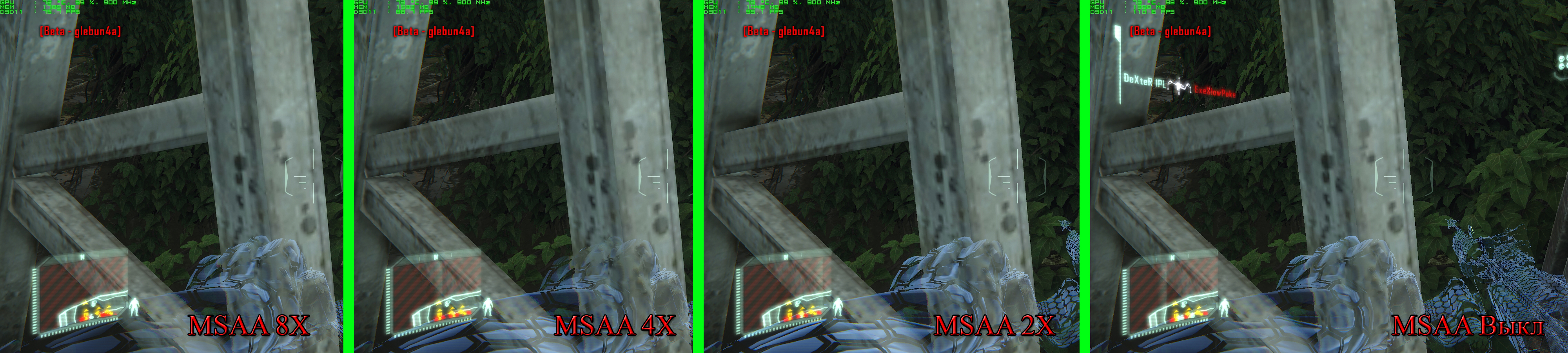
Crysis 3 - Return of real PC Anti-Aliasing (MSAA)
Page 3 - Seeking answers? Join the AnandTech community: where nearly half-a-million members share solutions and discuss the latest tech.

Elfear
Diamond Member
Lol, on high settings HD 7970 GHz can't win against GTX 660 Ti. 😀
I'm not too worried. Game is still in beta so AMD and NV have awhile to improve drivers.
Way to make it into another flamewar though. 🙄
Indeed the advantages of forward+ lie elsewhere.Forward+ is not resolving the performance problem. In Dirt:Showdown AMD cards lost 40%+ and nVidia cards over 60%. Forward+ is only good to win benchmarks but not to help to make MSAA a lot more useful in the latest game engines.
IE. Ability to render transparent surfaces using same lighting methods as anything else is a big win.
VulgarDisplay
Diamond Member
Sure, because then your company can actually win a DX11 benchmark with MSAA when bandwidth is not the limiting factor. :awe:
Forward+ is not resolving the performance problem. In Dirt:Showdown AMD cards lost 40%+ and nVidia cards over 60%. Forward+ is only good to win benchmarks but not to help to make MSAA a lot more useful in the latest game engines.
Making MSAA work on the entire scene is not useful?

Red Hawk
Diamond Member
Yeah, this just seems like the "MSAA" that's used in Battlefield 3 and Far Cry 3 -- it's there, but it works very selectively because deferred rendering engines do not play nice with MSAA, and even then it still incurs a large performance hit. Forward+ rendering which allows similar lighting as deferred rendering but also also MSAA to be applied to the whole frame with a reasonable performance hit really needs to catch on.

chimaxi83
Diamond Member

Lol, on high settings HD 7970 GHz can't win against GTX 660 Ti. 😀
Et tu, Balla? 🙄
lavaheadache
Diamond Member
Et tu, Balla? 🙄
You know it's not him or else we would have gotten 470 tri sli benchies in comparison.
😛
Elfear
Diamond Member
You know it's not him or else we would have gotten 470 tri sli benchies in comparison.
😛
:biggrin:

3lackDeath
Junior Member
Lol, on high settings HD 7970 GHz can't win against GTX 660 Ti. 😀[/QUOTE]
It's really embarrassing is it what it is, to think the game is not playable on high with msaa 4x
It's really embarrassing is it what it is, to think the game is not playable on high with msaa 4x
lavaheadache
Diamond Member
dp
lavaheadache
Diamond Member
Lol, on high settings HD 7970 GHz can't win against GTX 660 Ti. 😀
It's really embarrassing is it what it is, to think the game is not playable on high with msaa 4x[/QUOTE]
It's in BETA for pete's sake... 🙄

BrightCandle
Diamond Member
This has been a common trend all year actually. A lot of games in beta and on day of release performed better on NVidia and then AMD releases a drive/profile and the games performance was then better than NVidia's. I don't know why it is AMD insistes on releasing their profiles after the game is out and NVidia does it before but that has kind of been the way its worked for a couple of years now. I have no doubt the 7970GE will end up faster than the 680, and certainly better than the 660ti/670 once AMD gets around to fixing it.
ShadowOfMyself
Diamond Member
So sad (regarding the AA performance)
Im getting used to playing without AA already... Midrange cards get slaughtered with AA on any recent game in high settings, sigh
Anyway, I hope this is like Crysis 2 and looks great even with the settings on "high" (which should be the minimum option?) so I can actually play it
Im getting used to playing without AA already... Midrange cards get slaughtered with AA on any recent game in high settings, sigh
Anyway, I hope this is like Crysis 2 and looks great even with the settings on "high" (which should be the minimum option?) so I can actually play it
thilanliyan
Lifer
This has been a common trend all year actually. A lot of games in beta and on day of release performed better on NVidia and then AMD releases a drive/profile and the games performance was then better than NVidia's. I don't know why it is AMD insistes on releasing their profiles after the game is out and NVidia does it before but that has kind of been the way its worked for a couple of years now. I have no doubt the 7970GE will end up faster than the 680, and certainly better than the 660ti/670 once AMD gets around to fixing it.
If this is a TWIMTBP game, why are you surprised that on launch it performs better on nVidia hardware? It would be a real surprise if it DIDN'T.
Did all the recent Gaming Evolved titles play worse on AMD hardware on launch? I have no idea.
Last edited:

RussianSensation
Elite Member
Sure, because then your company can actually win a DX11 benchmark with MSAA when bandwidth is not the limiting factor. :awe:
There is nearly a 20 fps drop on the GTX680 by forcing MSAA. You do not see how this is a problem but instead you read my post as me comparing HD7970 to GTX680 and calling MSAA unfair?
🙄 Are you serious right now? I am simply commenting that the performance hit with MSAA on both brands is way too high. It's time developers rethink deferred lighting game engines because obviously as AMD has shown with a forward+ model in the Leo Demo, you can retain MSAA and minimize the performance hit. Maybe you forgot that in the past you could enable 4xMSAA with a 15% performance hit and even 8xMSAA worked fine. Those days are gone.
Everyone here knows I favour price/performance. My HD7970s were free because of bitcoin mining and are saving up more $ for a free upgrade to 8970s/9970s (as long as BTC continues). Now you can keep accusing me of being AMD-biased all you want (which you seem to be doing no matter what I post), and I'll just keep saving $$$ every generation and spending it on other things in life. Thank you. :whiste:
Forward+ is not resolving the performance problem. In Dirt:Showdown AMD cards lost 40%+ and nVidia cards over 60%. Forward+ is only good to win benchmarks but not to help to make MSAA a lot more useful in the latest game engines.
Yes it is. Let's stop pulling #s out of thin air.

16% performance hit going from 0xMSAA to 4xMSAA at 1080P on 7970GE, 18% hit at 1600P.
You seem to be confusing the performance hit associated with turning on the Global Illumination setting in this game with the performance hit of 0xMSAA vs. 4xMSAA. The forward+ MSAA fixes the MSAA performance hit normally incurred under deferred + MSAA game engines.
Last edited:
RussianSensation
Elite Member
Indeed the advantages of forward+ lie elsewhere.
IE. Ability to render transparent surfaces using same lighting methods as anything else is a big win.
The problem with deferred rendering (DR) is that it brings a list of cons in the form of heavier performance hit when handling multiple materials, and because it usually discards the geometry data it can't really apply proper MultiSampling antialiasing.
One solution is to run a compute shader to apply the lighting to the Forward Rendered image, instead of the usual way of "Render everything 1 time for each light source in the scene!" This way you save a great deal of passes, save on memory by not needing the G buffer (the geometry is always present on a Forward Renderer, instead of discarded), and you also get the proper MSAA that's been included on every traditional GPU design in the last 10 years. Finally, multiple materials can be used without the big performance & memory hit of the DR. All it takes is compute time for the new compute shader.
It's pretty obvious why NV isn't promoting forward+ lighting game engines with developers. Their existing GK104 GPU generation tanks when Compute shaders need to do any work. Additionally, because traditional MSAA doesn't work properly with deferred lighting engines, it results in an exponentially large performance hit on AMD cards. The end result is both NV and AMD GPUs take a huge performance hit with MSAA but NV tends to do a little better. The problem is we gamers suffer because even with NV there is still a > 30% performance hit most of the time.
Forward+ lighting model + compute shaders allow you to bring back the traditional MSAA approach, and you minimize the performance hit at the same time.
http://forums.anandtech.com/showpost.php?p=33832466&postcount=5
I am personally of the view that software developers should adopt superior programming methods that maximize image quality and performance, if these alternatives are available, even if it means for GPU developers to rethink their hardware designs (i.e., focus more on compute for example). Recently, the intermediary solution has been the introduction of FXAA/MLAA/TXAA filters which especially in TXAA's case blur details in games. These are not great solutions because they are trying to fix what is a fundamentally flawed approach to game engine design in the first place. IMO instead of trying to come up with some hybrid AA filters, they should just revamp how the engines are coded for in the first place and traditional MSAA can be properly applied to the entire scene. When you have a situation where a 2013 game suffers from a 33-52% performance hit when forcing just 4xMSAA, it is a problem.
This pretty much shows that traditional MSAA has been surpassed in every way.
SMAA done properly with subsamples and temporal information looks a lot better and so does TXAA especially when in motion.
While TXAA reduces pixel crawl, it blurs the entire picture and thus reduces details. TXAA, without tweaks in SweetFX, has atrocious native IQ filter quality. It's like playing a game with a wrong set of prescription glasses.
A clear example of why TXAA is inferior to MSAA is Black Ops 2 or the Secret World on the PC:
COD BO2 8xMSAA
COD BO2 4xTXAA
Now if you want to spend $800+ on high-end GPUs and turn your game to look more like a blurry console title, by all means. In that case, I'd rather save $400 and get a PS4...
Your opinion that MSAA is outdated even contradicts the IQ in Crysis 3, where MSAA clearly provides superior IQ to FXAA or TXAA.
FXAA 4x (anti-aliasing doesn't even work)
TXAA 4x (significant detail texture quality degradation/blurring)
MSAA 4x (way better IQ than FXAA without any of the blurfest of TXAA).
I'm interested in the x2 TXAA setting.
See above. TXAA is a blurfest, as usual.
Lol, on high settings HD 7970 GHz can't win against GTX 660 Ti. 😀
Ironically none of the single GPU cards are playable either. 28 fps min and 36 fps avg on 680? This again goes back to the unreasonable performance hit of MSAA in this deferred lighting game engine.
At 1080P VHQ with 4xMSAA, neither the GTX680 nor the HD7970GE seems to be fast enough with current drivers.

Last edited:

blackened23
Diamond Member
Maybe it's too early to declare winners and losers?
The game is not released, drivers are in beta, dust hasn't settled yet.
The game is not released, drivers are in beta, dust hasn't settled yet.
Thanks, it works now.

Everything on high with 4xMSAA is not playable for me on my setup imo. Too many dips to 40FPS. This is with SMAA MGPU on.
Since it's in beta, the exe was probably compiled with the debug and symbols flags tagged on, that probably causing somewhat of an FPS hit. That, and they are probably still optimizing GFX during the beta.

SirPauly
Diamond Member
I am personally of the view that software developers should adopt superior programming methods that maximize image quality and performance, if these alternatives are available, even if it means for GPU developers to rethink their hardware designs (i.e., focus more on compute for example).
Personally pleased by the sheer flexibility of in-game AA options available.
RussianSensation
Elite Member
Personally pleased by the sheer flexibility of in-game AA options available.
You completely evaded the point I made. FXAA and TXAA provide worse IQ in this game than MSAA. If this game was a forward+ with a traditional 15-18% MSAA performance hit, you wouldn't even need to think about using FXAA/TXAA as a last resort. FXAA/MLAA and TXAA are 'poor man's AA modes' in this case. The only reason you'd use those in Crysis 3 is if your GPU can't handle MSAA/SMAA/SSAA.
Last edited:
TRENDING THREADS
-
 Discussion Zen 5 Speculation (EPYC Turin and Strix Point/Granite Ridge - Ryzen 9000)
- Started by DisEnchantment
- Replies: 25K
-
Discussion Intel Meteor, Arrow, Lunar & Panther Lakes + WCL Discussion Threads
- Started by Tigerick
- Replies: 25K
-
 Discussion Intel current and future Lakes & Rapids thread
- Started by TheF34RChannel
- Replies: 24K
-

-
