
Grooveriding
Diamond Member
Poll choices are off. Major improvement is not over 5%, maybe something on the order of 25% would qualify as a major improvement. We've been getting minor improvements for years now.

Intels ES are mostly run at production clock speeds, at least the ones that show up only a few months vefore launch like these ones.
Isn't that what happened over at AMD after the Phenom II's?
If the choice was to accept a small hit in absolute performance to get much higher performance/watt, I suspect most proud engineer\manager\VP\etc would happily swallow their pride. I guess it also depends which aspect of CPU you are more proud of: its outright performance or peerless performance/watt.
Anyway, looks like I was freaking out over nothing. Y'all guys are confident Skylake should be a decent improvement over Broadwell and that's good enough for me. I was just beginnning to fret if Intel had extracted all the performance from their core design and now their focus would shift to increasing performance/watt at all costs.

It's extremely unlogical that overall Intel would sell a product with worse IPC across the line.

AVX-512 is only for Skylake EP/EX and KNL most likely.
What norm? Intel has become dumber and dumber with utterly silly segmentation. I wouldn't be surprised to not see AVX-512 on all Skylake variants. Even AVX isn't available on all Haswell 🙄 And TSX is not on all K variants.That would be an interesting departure from the norm.
What norm? Intel has become dumber and dumber with utterly silly segmentation. I wouldn't be surprised to not see AVX-512 on all Skylake variants. Even AVX isn't available on all Haswell 🙄 And TSX is not on all K variants.
Assuming AVX-512 support includes the implementation of 512-bit vector units, mikk's claim, if true, would undoubtedly mean that Skylake-E would have a different core layout compared to 1151 variants. The units would be too large to sit there unutilized.What norm? Intel has become dumber and dumber with utterly silly segmentation. I wouldn't be surprised to not see AVX-512 on all Skylake variants. Even AVX isn't available on all Haswell 🙄 And TSX is not on all K variants.
Agreed, but do you really think having 512-bit SIMD on ultra low power mobile chips makes any sense? We are already seeing Intel decreasing frequency when AVX is getting used in higher-end Haswell chips, and I can see voltage being increased on my Haswell when AVX is used. I doubt 14nm will bring enough magic dust to overcome the power cost of 512-bit wide SIMD units 😉 So either Intel will have different masks, or will simply accept to have a significant part of the die unused (though note AVX{2,-512} probably isn't that large compared to the rest of CPU and the GPU). And if they do that for mobile parts, why not do that for other parts too?Assuming AVX-512 support includes the implementation of 512-bit vector units, mikk's claim, if true, would undoubtedly mean that Skylake-E would have a different core layout compared to 1151 variants. The units would be too large to sit there unutilized.
I wouldn't be surprised to not see AVX-512 on all Skylake variants.
Heh, and it correctly said what I meant 😉Holy double negative Batman!

What do you base all this hype ("expect big things") on, exactly?Skylake is the architectural successor to Tejas.
P6M Generation;
- Banias
- Dothan
- Yonah
- Core
- Penryn
- Nehalem
- Westmere
- Sandy Bridge
- Ivy Bridge
- Haswell
- Broadwell
Skylake is the evolution of P68(Netburst) and P7(Itanium). Technically, it would be P8 if Intel was still using that scheme.
So, expect big things from an architecture, so efficient they dropped FIVRs.
Do you notice the trend?To be fair, that's precisely what Intel did with Pentium 4. I guess *in theory* they might drop IPC if it lets them hit their high clocks at a lower power consumption- a 3GHz processor in the Surface Pro 4 would be pretty awesome, and increasing clock speeds on their multicore server chips might be nice. Doesn't seem very likely though.
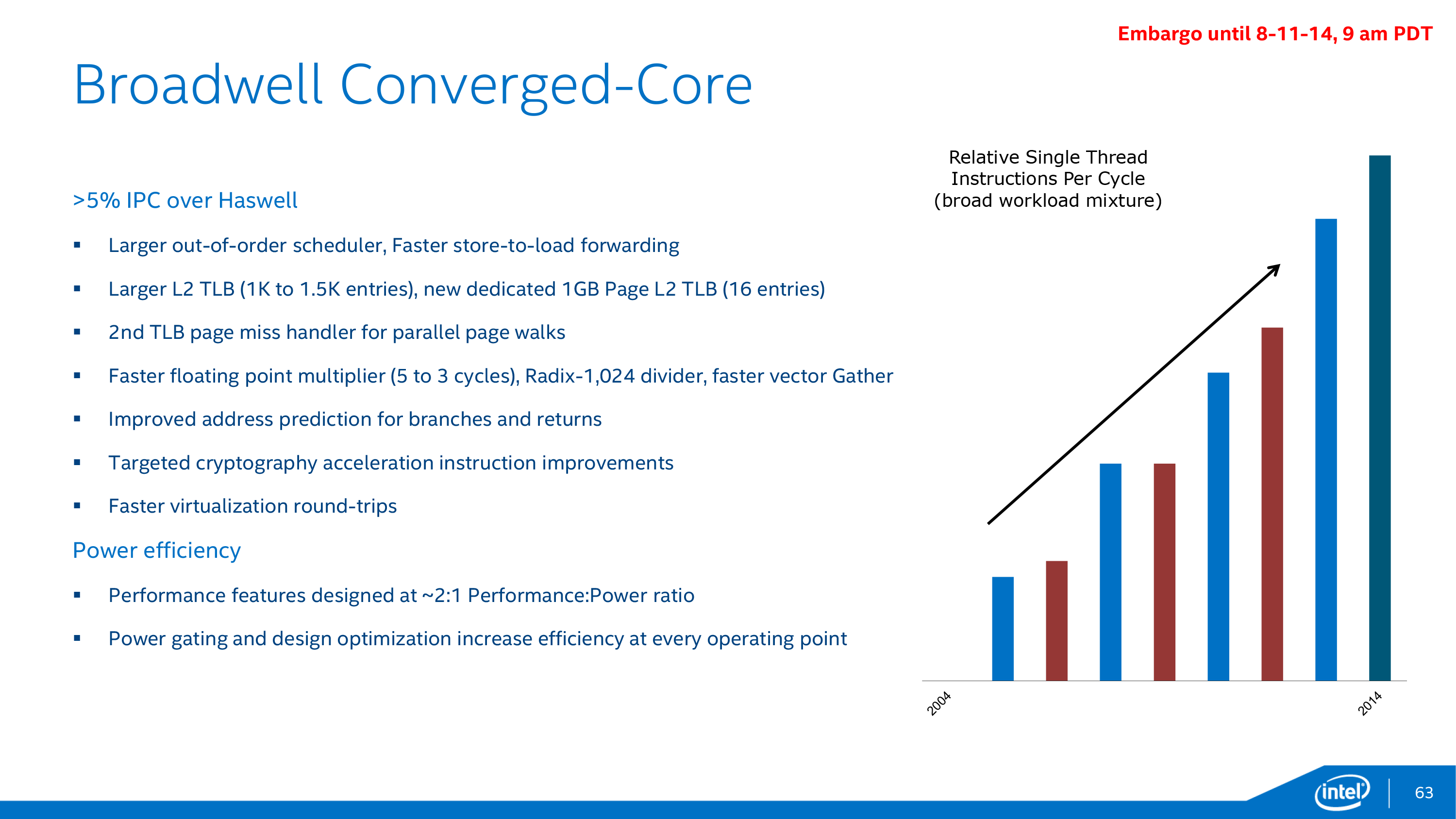

Do you notice the trend?
What they said about Broadwell didn't make me think they had have intention to do worse with the next architecture.
Tejas/Nehalem (Netburst) would have used Enhanced Hyperthreading. Which has only been used in Poulson (Itanium).I expect any useful concepts from it were already integrated long ago.

I predict that desktop Skylake won't come out for a long time after mobile Skylake.
Tejas/Nehalem (Netburst) would have used Enhanced Hyperthreading. Which has only been used in Poulson (Itanium).
Skylake is architecturally the successor to Tejas (Netburst).
The performance and efficiency improvement is >2x. Between that of Broadwell and Skylake.
It's not a theory.Dude, you always have the most strange theories here, especially about SOI.


