Discussion Cinebench 2026

poke01

Diamond Member
Mar 8, 2022
4,670
6,011
106

What’s new:
Cinebench 2026 takes advantage of the latest developments in hardware technology, adding compatibility with NVIDIA's new Blackwell GPUs (5000 series) and AMD 9000 series GPUs on Windows, as well as NVIDIA Hopper and Blackwell data center GPUs. Additionally, Cinebench 2026 now supports Apple M4 and M5 powered systems.

To better utilize modern hardware, Cinebench 2026 has been updated to the latest Redshift Rendering engine, leveraging technological advancements in Redshift's development. This also allows users to more accurately predict the performance they can expect in Cinema 4D 2026 based on the results of Cinebench. Thanks to a new test that evaluates the performance of SMT enabled CPU cores, users can directly assess the performance gains offered by SMT compared to single-threaded execution.

Cinebench 2026 supports a broad range of hardware configurations, including systems running Windows x86-64, Windows ARM64, and macOS.

Technical Information:

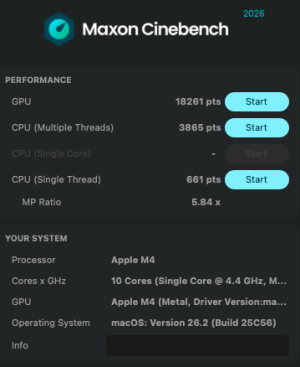
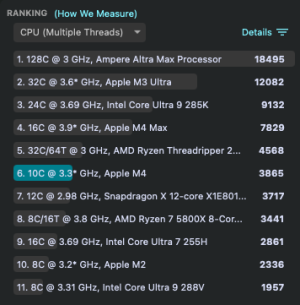
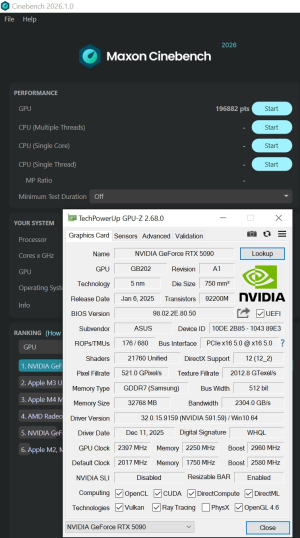
Post your results CPU and GPU too!
 
Last edited:

Jan Olšan

Senior member
Jan 12, 2017
617
1,238
136
I wonder how will ST comparisons between architectures look in this version. Previous versions gave relatively low 1T scores to Zen 4/5 compared to how it stacks for example in Geekbench.
 

Kaluan

Senior member
Jan 4, 2022
517
1,100
106
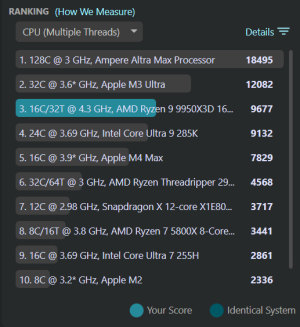
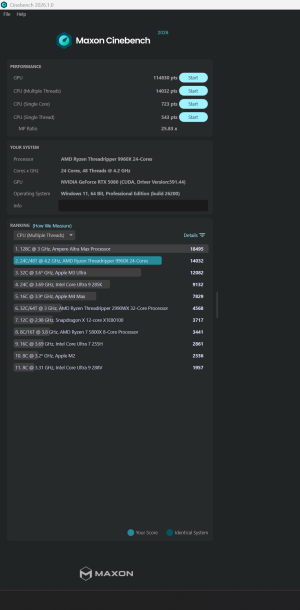
Strange choices for yardstick scores when it comes to AMD. Literally just a single 5 year old midrange, desktop Ryzen and a random TR from 7 years ago. Where as the other chipmaker brands have mainly their latest and fastest shown in the comparison chart and past generations of them.

I've learned to never assume these things are random. There's literally no reason for them not including more Ryzen CPUs, particularly the latest generation.
And don't even get me started on why proper ThreadRippers or EPYCs. Yet we somehow get a Ampere CPU lol, a brand literally no one outside of server space (or some tech junkies like us) know of.
 

poke01

Diamond Member
Mar 8, 2022
4,670
6,011
106
Cinebench is based on the latest Cinema 4D 2026 and Redshift code using updated compilers (Clang V19) and has a minimum runtime activated by default

This is important.

A lot of good points here.
 

Jan Olšan

Senior member
Jan 12, 2017
617
1,238
136
Strange choices for yardstick scores when it comes to AMD. Literally just a single 5 year old midrange, desktop Ryzen and a random TR from 7 years ago. Where as the other chipmaker brands have mainly their latest and fastest shown in the comparison chart and past generations of them.

I've learned to never assume these things are random. There's literally no reason for them not including more Ryzen CPUs, particularly the latest generation.

I'd say it's possible the factor really is what the developers had on hand and with enough control to produce results they felt confident are OK to include. If company assigns them Intel-based PCs and "Apple product" devices, that may be the reason. Still, if they simply don't have much AMD CPUs on hand to test on, that is bad and may mean the code may not have been checked against randomly tripping weaker performance bottlenecks, whereas it was profiled and "trained" on competing CPUs to catch such things and thus potentially improve their relative standing in the benchmark. Can't know easily whether that's the case here.

It seems like the reference value for Snapdragon is very inflated?

View attachment 135800

They could have some developer hardware from Qualcomm that runs at higher performance due to relaxed TDP limits and unconstrained cooling noise, as opposed to laptops where you get lower performance. It's true that it would be kinda misleading if nobody can buy a device where the CPU performs that fast.
 

Jan Olšan

Senior member
Jan 12, 2017
617
1,238
136
That's really a good thing, since this sort of 3D rendering is like one of the most natural SMT usage cases. While the 1T result is probably interesting to people, it's actually kind of synthetic test for this sort of workload, since in practice, the 1C/2T performance is what counts (actually, nothing but MT counts in practice when rendering, but 1C/nT is less academic than 1C/1T for cores with SMT).

I argued with people about it in the past who thought SMT should be ignored when assessing "single core", but that's silly because the effect tends to get quite muddied in MT scores.
 

Abwx

Lifer
Apr 2, 2011
11,964
4,935
136
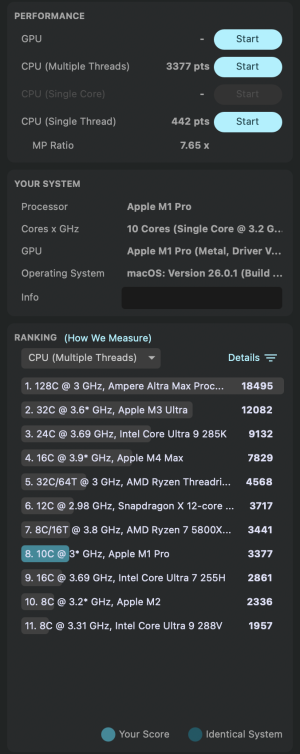
M1 Pro (8+2) @ MacOS 26.0.1
From what I saw from other people, it's a very SMT-friendly test in nT. sometimes the single core/single thread score ratio is as high as ~1.35

It is not, that s the lowest SMT gain for any renderer, Blender, Vray, Corona all have quite higher SMT gains, even 7 Zip, wich is an INT app, is better at 1.44x.
 

poke01

Diamond Member
Mar 8, 2022
4,670
6,011
106
It is not, that s the lowest SMT gain for any renderer, Blender, Vray, Corona all have quite higher SMT gains, even 7 Zip, wich is an INT app, is better at 1.44x.
Is there a rule that SMT gains must be equal between all renderers?

AMD leads in this benchmark regardless if the SMT gain is 35% or 44%.