Did you forget Haswell, Roland00Adress? Intel reduced idle power consumption by 20X. Broadwell consumes 60% less at idle IIRC. The main power consumer at idle is now almost exclusively the screen. IGZO would improve battery life a lot more substantially than another 20X SoC reduction.
I really do not like that marketing term 20x less at Idle for most people do not understand what Intel was talking about with that 20x number. In effect Intel did not improve what I consider to be "idle" power consumption but instead created connected standby, a new "active state" which is between the computer being on and the computer being hibernated. In effect getting a mixture of hibernation and sleep where the computer will wake up so often check the internet for changes and then go back to sleep.
Slides are here from IDF 2012
Do not get me wrong connected standby is awesome, but I like to be talking about my apples and not bringing up oranges when I talk about apples.
----
Intel made tremendous increases in battery life with Haswell but those improvements were not just process node improvements or architecture improvements they were due to 3 reasons. These things can only be done once for the most part so it will be harder to get a another
vast increase in battery life.
First, Intel started making "reference like platforms" where they tried to create a list of 3rd party chips and such and have OEMS try to go for the most energy efficient versions I am talking stuff like motherboard micro controllers and voltage regulators.
Second, Intel integrated the PCH onto the soc with the Y series chips (but not the chips that have tdps of greater than 15w+) this means the PCH was on the best fabs but also the soc has more control over energy states and the ability to shut off inactive parts of the chip.
Third, which is an extension of the second point is that intel created new energy states where the cpu is on but half turned off such as connected standby.
----
My point is that Intel can only do these things once for the most part and they can't improve idle power by a vast amount by doing these things again. It is kind like integrating the memory controller and getting a performance boost, well you can only integrate the memory controller once. From now on it will be harder to get vast improvements of battery life on the cpu/soc level with Intel's big core architecture. That said Intel is promising vast improvements in battery life with sky lake which comes after broadwell as the 14nm tock.
----
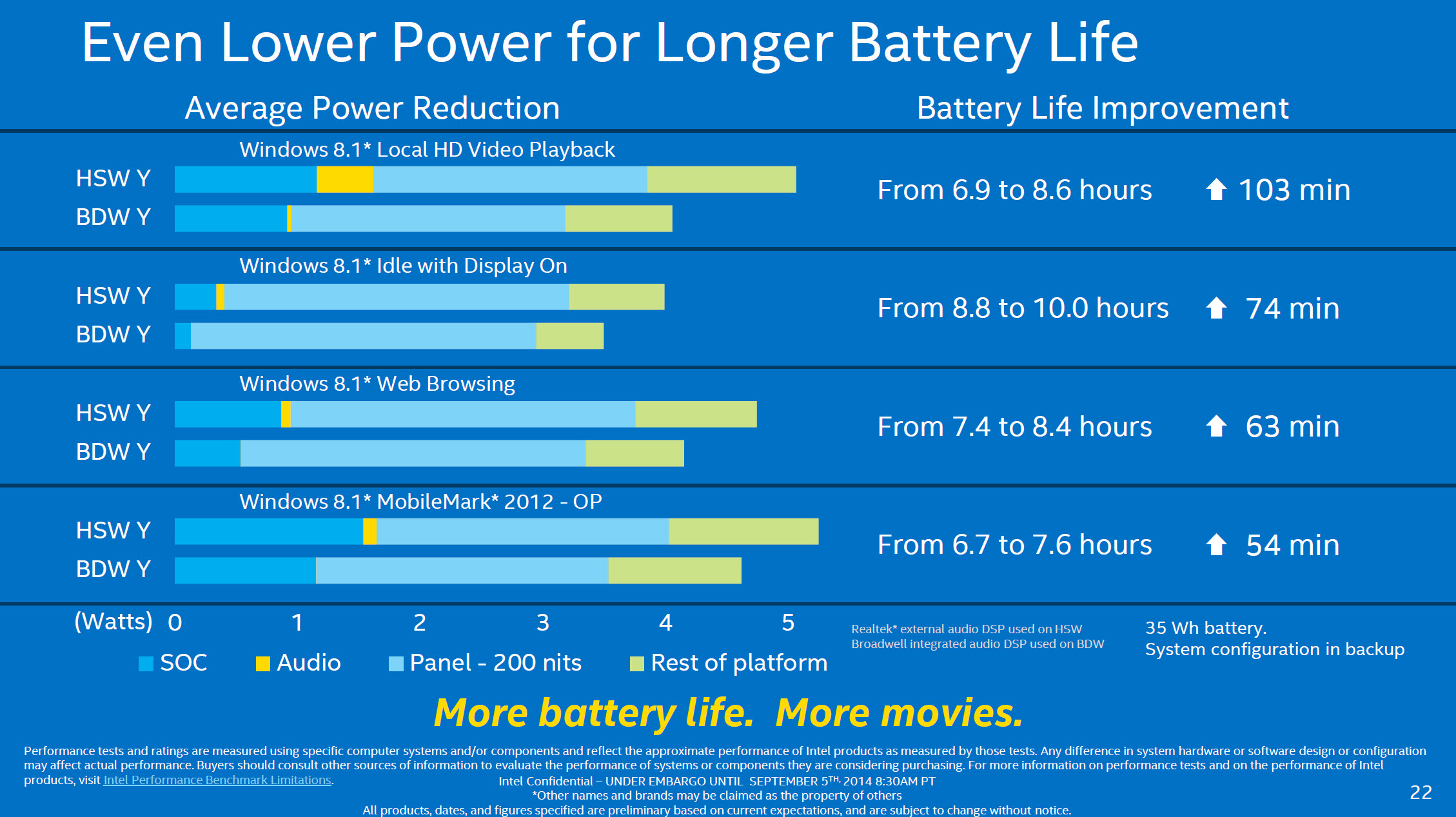
Intel posted a nice slide at this IDF talking about how Intel is increasing battery life as well as other "real world" scenarios with broadwell. I am putting the real world scenario in quotes for I am talking stuff like watching movies instead of things like connected standby.
Intel haswell y vs broadwell y battery life
So according to Intel we will get a 13% to 24% increase in battery life with haswell y vs broadwell core m and a large part of that is changes with the Audio stack and the rest of the platform and some of that minor increase is done by just using a newer foundry process with a more efficient voltage curve. Intel last year was claiming an
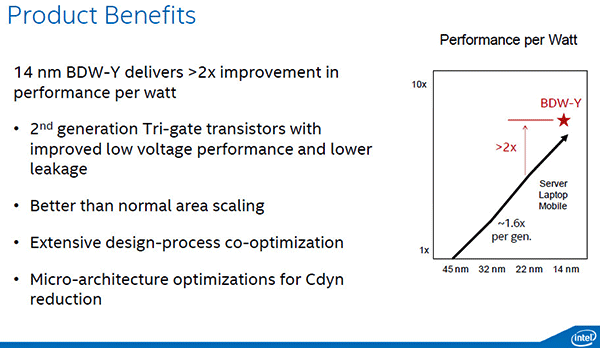
up to 30% lower power with broadwell vs haswell
Link
Edit: I see that you posted the same slide I just did while I was typing up this post so I edited this post so I am linking the slide instead of embedding it into my post.









 Facebook
 Twitter