Broadwell in Tablets... A big deal or not?

Page 3 - Seeking answers? Join the AnandTech community: where nearly half-a-million members share solutions and discuss the latest tech.

positivedoppler

Golden Member
Apr 30, 2012
1,149
256
136
I have no idea what market the 2-1 convertibles are for at this price range. Few students will have the money for it. Businesses for the most part, do not care for convertible. Laptop is for business and it will remain that way for a very long time. I can think of a few niche markets in which convertible are desirable for business where people need to be very mobile and carry charts and picture with them all the time maybe like a doctor.
 

Hulk

Diamond Member
Oct 9, 1999
5,428
4,166
136
Until Broadwell convertibles start to actually hit the shelves we really don't know what the price range is.
 

Roland00Address

Platinum Member
Dec 17, 2008
2,196
260
126

That is the projected price range what actually happens can be higher, less than, or right on the money. No one is an true oracle that knows for sure.

Intel promised very cheap tablets last year but they are only now materializing 6 to 9 months later. Intel also underestimated the ultrabook price range a couple years ago. The reason this happen was Intel was expecting OEMS to have a cheap ultrabook option made out of plastic cases for the cheapest ultrabook option. This did not happen for OEMS only wanted to attach ultrabook termology to the premium looking computers. Consumers do not understand specs they buy off emotional factors such as this number is higher, or that computer looks durable, they figure a laptop is light by picking it up not by looking up the weight in a PDF or website. Same thing with screen size an actual number is useless but seeing it up close or using it for a day and you understand the importance of the size. Price is also an emotional decision since you pay for the computer all at once but you derive the benefits over a long period of time.

Intel thought OEMs could sell the benefits of ultrabook especially if Intel attached their brand power with creating a trademark marketing, OEMs knew customers that did not buy that way and they did not want to sacrifice the importance of appearance for their high end for that degrades the OEMs brand image. You try explaining the benefits of ssds besides just saying its faster or you trying it. Customers can not understand that an i3 or i5 with ssd is better for their needs than an i7. They do not understand that 8 GB of ram on an AMD e1 is useless. They only understand marketing, price, and physical interaction with the product.

We will know later if Intel is good at judging the market right. Intel makes amazing products but its record of judging the market, marketing to customers, and the supply chain is mixed at best.
 
Last edited:

poohbear

Platinum Member
Mar 11, 2003
2,284
5
81
Forget the tablet-laptop convertible, where's the bloody smartphone-convertible???

Intel & MS need to think like this: make a phablet size smartphone powerful enough to use as a desktop. When i get home i plug it into my 27" monitor via mini-hdmi, and use a bluetooth keyboard / mouse. When i go to work i do the same! Have one OS for both devices (hopefully windows 9 will have 1 OS for all devices). Thats it, youve just instantly created a new market & a whole new demand for this phone to replace both ur current phone & the avg consumers aging desktop with windows 7 (perfect excuse to upgrade finally). U can call it a "phoktop" instead of phablet. Ok maybe nobody wants to buy something with "phok" in it, but ur marketing team can take care of that. The rest of the idea is solid as crack!

Boom! Ok MS, thats $50,000 for that advice if any of u are reading this. PM me.
 
Last edited:

Roland00Address

Platinum Member
Dec 17, 2008
2,196
260
126
The apple A series socs use that powerful architecture for a race to sleep. In things like cell phones or consumption tablets dynamic power consumption range is a good thing since battery life is a big deal. Baytrail has a similar goal.

Convertible/Productions tablets have a different need and goals. Dynamic power consumption range is still good but battery life is less important for you have more space for battery, weight is less important, and the software work loading is more demanding. This is not to say battery life or weight is not important but you are buying a $600+ item to get work done not to watch movies or casual internet use.

It is ironic but with core m vs haswell y dynamic tdp range has decreased (dynamic tsp range is not the same as dyanmic power consumption). The minimum power consumption has gone down but just barely, what has improved is now you can do the same amount of work with 4.5 watts instead of 15 watts.

A) Idle power consumption determines battery life.
B) Max TDP determines form factors.
C) Total Soc performance determines the things you can use the device for and help with power consumption since their is a race to sleep and idle power consumption gives better battery life than active soc power consumption.

Apple A series CPUs prioritize A and C. With Core M Intel is prioritizing B and C they also want to improve A as well but there is limits on what you can do with A with a big cpu core architecture within current engineering/foundry limits. Also remember with bigger devices you have more battery space but also other components such as screen power use eat up more of your battery life, on cell phones screens power consumption is a sub watt in power use, on big tablets and laptops screen power is several watts.
 

witeken

Diamond Member
Dec 25, 2013
3,899
193
106
Did you forget Haswell, Roland00Adress? Intel reduced idle power consumption by 20X. Broadwell consumes 60% less at idle IIRC. The main power consumer at idle is now almost exclusively the screen. IGZO would improve battery life a lot more substantially than another 20X SoC reduction.
 

cytg111

Lifer
Mar 17, 2008
26,866
16,137
136
Broadwell in tablets... Maybe these tablets will stop throttling? Less than Haswell?
 

witeken

Diamond Member
Dec 25, 2013
3,899
193
106
That's for connected standby.

Still, ~0.2W is negligible.

Intel-Core-M-Battery-Life-and-Power.jpg
 

Roland00Address

Platinum Member
Dec 17, 2008
2,196
260
126
Did you forget Haswell, Roland00Adress? Intel reduced idle power consumption by 20X. Broadwell consumes 60% less at idle IIRC. The main power consumer at idle is now almost exclusively the screen. IGZO would improve battery life a lot more substantially than another 20X SoC reduction.

I really do not like that marketing term 20x less at Idle for most people do not understand what Intel was talking about with that 20x number. In effect Intel did not improve what I consider to be "idle" power consumption but instead created connected standby, a new "active state" which is between the computer being on and the computer being hibernated. In effect getting a mixture of hibernation and sleep where the computer will wake up so often check the internet for changes and then go back to sleep.

Slides are here from IDF 2012

Do not get me wrong connected standby is awesome, but I like to be talking about my apples and not bringing up oranges when I talk about apples.

----

Intel made tremendous increases in battery life with Haswell but those improvements were not just process node improvements or architecture improvements they were due to 3 reasons. These things can only be done once for the most part so it will be harder to get a another vast increase in battery life.

First, Intel started making "reference like platforms" where they tried to create a list of 3rd party chips and such and have OEMS try to go for the most energy efficient versions I am talking stuff like motherboard micro controllers and voltage regulators.

Second, Intel integrated the PCH onto the soc with the Y series chips (but not the chips that have tdps of greater than 15w+) this means the PCH was on the best fabs but also the soc has more control over energy states and the ability to shut off inactive parts of the chip.

Third, which is an extension of the second point is that intel created new energy states where the cpu is on but half turned off such as connected standby.

----

My point is that Intel can only do these things once for the most part and they can't improve idle power by a vast amount by doing these things again. It is kind like integrating the memory controller and getting a performance boost, well you can only integrate the memory controller once. From now on it will be harder to get vast improvements of battery life on the cpu/soc level with Intel's big core architecture. That said Intel is promising vast improvements in battery life with sky lake which comes after broadwell as the 14nm tock.

----

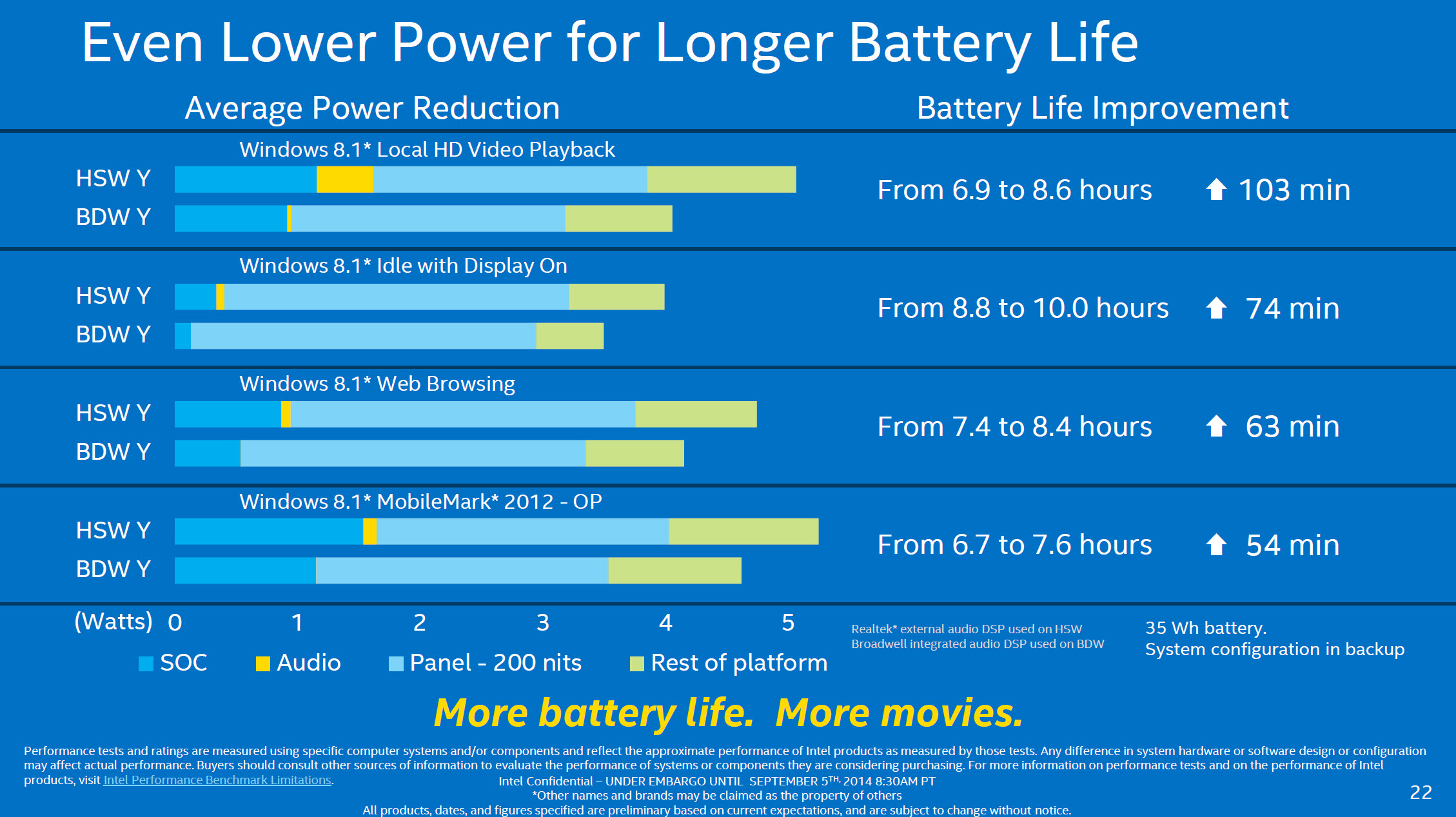
Intel posted a nice slide at this IDF talking about how Intel is increasing battery life as well as other "real world" scenarios with broadwell. I am putting the real world scenario in quotes for I am talking stuff like watching movies instead of things like connected standby.


Intel haswell y vs broadwell y battery life

So according to Intel we will get a 13% to 24% increase in battery life with haswell y vs broadwell core m and a large part of that is changes with the Audio stack and the rest of the platform and some of that minor increase is done by just using a newer foundry process with a more efficient voltage curve. Intel last year was claiming an up to 30% lower power with broadwell vs haswell Link

Edit: I see that you posted the same slide I just did while I was typing up this post so I edited this post so I am linking the slide instead of embedding it into my post.

 
Last edited:

Dufus

Senior member
Sep 20, 2010
675
119
101
Would you really consider a 45 Watt i7 in a laptop? That makes me think of this:
Hey, even that dual core P8400 you have can pull more than 50W when overclocked to 3GHz on both cores. ;)
Until Broadwell convertibles start to actually hit the shelves we really don't know what the price range is.
Lenovo 11.6-inch ThinkPad Helix 2 from $999,
Dell 13.3-inch Latitude 13 7000 starting at $1,199.

http://blog.parts-people.com/2014/09/05/intels-core-m-processors-fanless-game-changers/
 

cbn

Lifer
Mar 27, 2009
12,968
221
106
Forget the tablet-laptop convertible, where's the bloody smartphone-convertible???

Intel & MS need to think like this: make a phablet size smartphone powerful enough to use as a desktop. When i get home i plug it into my 27" monitor via mini-hdmi, and use a bluetooth keyboard / mouse. When i go to work i do the same!

I believe one Haswell core (which, of course, also has hyperthreading making it a two thread processor) has roughly the same die size as four silvermont atom cores.

So if the Big core to atom core relationship stays the same at Broadwell, Skylake, Cannonlake there is the potential for big core to replace atom cores as far as silicon real estate goes in small SOCs.
 

cbn

Lifer
Mar 27, 2009
12,968
221
106
From a yields standpoint, I also think one big core with HT replacing four atom cores starts making more and more sense going forward. (re: As integration and GPU size grow the proportion of the die occupied by each atom core diminishes. Pretty soon, I'd imagine the chance of defects occurring to one of the four atom cores decreases to a point where making dual atom core SKUs isn't necessary outside of artificial product segmentation)
 

Eug

Lifer
Mar 11, 2000
24,182
1,822
126
Hey, even that dual core P8400 you have can pull more than 50W when overclocked to 3GHz on both cores. ;)
Heh. You know what I mean.

BTW, while my P8400 is 25 Watts TDP, but my T8300 is 35 Watts TDP.

I really dislike the latter machine, because not only is the TDP 35 Watts, it also does H.264 decode in software, which means the fan ramps up a lot and loudly.
 

witeken

Diamond Member
Dec 25, 2013
3,899
193
106
So according to Intel we will get a 13% to 24% increase in battery life with haswell y vs broadwell core m and a large part of that is changes with the Audio stack and the rest of the platform and some of that minor increase is done by just using a newer foundry process with a more efficient voltage curve. Intel last year was claiming an up to 30% lower power with broadwell vs haswell Link

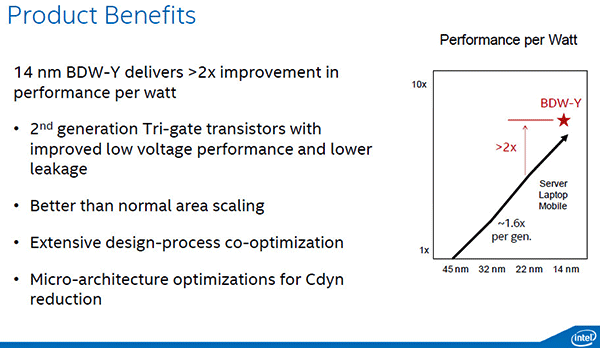
Intel got that 30% with non optimized 14nm test silicon, now they're claiming a 1.6X improvement and >2X with all the changes they made to Broadwell-Y. Intel also claims that idle power consumption has been reduced by 60% on top of what they did with Haswell:

There’s more fine grained power gating, lower chipset power and the CPU cores can transition between power states about 25% quicker than in Ivy Bridge - allowing the power control unit to be more aggressive in selecting lower power modes. We’ve also seen considerable improvements on lowering platform power consumption at the motherboard level as well.
[...]
The other big part of the Haswell power story is what Intel is calling FIVR: Haswell’s Fully Integrated Voltage Regulator.

But you can see the numbers of course, very small compared to screen consumption.
 

Roland00Address

Platinum Member
Dec 17, 2008
2,196
260
126
Intel got that 30% with non optimized 14nm test silicon, now they're claiming a 1.6X improvement and >2X with all the changes they made to Broadwell-Y. Intel also claims that idle power consumption has been reduced by 60% on top of what they did with Haswell:
I would be happy if they actually achieve this, and I am not doubting the theoretical possibility that this is achievable. But that 60% reduction in power consumption on the cpu is probably the best case scenario, and that a 30% reduction or slightly more than 30% is most likely. But until we have devices in hands where we can test the cpu rails directly by tearing up a laptop or tablet and connecting a voltmeter it is just guesswork.
But you can see the numbers of course, very small compared to screen consumption.
Yes, give me IZGO, give me OLED, give me optically bonded glass so you can cut down on the glare and get the same effective brightness/contrast with a weaker backlight allowing me to save power or just have a brighter screen.

Ironically in my opinion the best thing Intel can do is to figure out ways to make the other parts of a laptop/tablet cheaper such as the ram, the flash, the motherboard, and the screen so that the oems have more money to spend on intel socs such as core m and/or atom. They have the best parts now they just need to make the device affordable enough so people are willing to spend the extra money for the best.

If they can't do that, then qualcomm and arm is going to kick their but and intel will shift from a foundry with awesome ip/engineers to a foundry who just simply makes those socs designed by other companies. The first route makes them more profit but they have to win in the marketplace to make that route possible.
 

witeken

Diamond Member
Dec 25, 2013
3,899
193
106
I would be happy if they actually achieve this, and I am not doubting the theoretical possibility that this is achievable. But that 60% reduction in power consumption on the cpu is probably the best case scenario, and that a 30% reduction or slightly more than 30% is most likely. But until we have devices in hands where we can test the cpu rails directly by tearing up a laptop or tablet and connecting a voltmeter it is just guesswork.
Your math is wrong. It isn't a 60% reduction in power, it is a 60% improvement in performance/watt, for which you need a 40% reduction in power. If you are referring to the 60% reduction in idle power consumption, Intel obviously achieved that by doing other tricks as well.

Broadwell-1.png

big_Broadwell-Performance-Per-Watt.png
 

Roland00Address

Platinum Member
Dec 17, 2008
2,196
260
126
Your math is wrong. It isn't a 60% reduction in power, it is a 60% improvement in performance/watt, for which you need a 40% reduction in power. If you are referring to the 60% reduction in idle power consumption, Intel obviously achieved that by doing other tricks as well.

I may be misremembering, I do admit humanity. That said I do not want to continue to go back and forth on this (note I do not think we are arguing). It is my belief that until we have devices in hand we can not be for sure about anything and we are just trusting intel to be accurate with their remarks. I would not be surprised intel is right about all their claims but trust and verify. Going back and forth being confident you are right is just wasted energy, sharing information on the other hand is helpful.

Please continue to post info and slides, I do find it interesting.

That said I am amazed and in awe of what we are seeing in broadwell, the amount of work and engineering intel and its talented engineers have done is remarkable. I want to touch and play with such devices now, just like a mechanic likes to mess with a hot rod's engine. Broadwell may only be a minor improvement in desktops but in these soc with low tdp form factors it appears to be incredible.

I thought sandy and ivy was special, but somehow broadwell is unique in its own way, it may be even more grand in my opinon.