

Besides the fact that Hawaii isn't new (it was introduced in Nov 2013, more than 18 months ago) -
The price/perf aspect is because Hawaii is heavily discounted right now, but that doesn't mean that AMD or the AIBs are making any money off of it - and making money is what companies are all about.
Hawaii is about 25% larger than Tonga, dissipates about 55% more heat (requiring more cooling) / takes 55% more power, and doesn't have the 3rd gen memory compression (hence needs a bigger bus). What all this means is that it costs a lot to build cards around Hawaii.
In essence, the 290/290x are cards designed to compete with top line Nvidia GPUs like the 970/980, but they have to be heavily discounted to do so despite being obviously more expensive to manufacture.
Yes, I know all this. But from an end-user perspective, it's all irrelevant. Buyers don't care how much the cards cost to manufacture (though they do care about the TDP, which is the primary reason why Hawaii has to be so heavily discounted). The point is that if Hawaii is discontinued and the 300 series goes straight from Tonga to Fiji with nothing in between, then AMD cards will be a worse purchase in terms of perf/$ for consumers. Right now you can buy a R9 290 for ~$250 or a R9 290X for ~$300, and these are hard deals to beat.
I also think Tonga as we know it now (R9 285) is just a shadow of what it's capable of. People seem to forget, it isn't just the SPs. It's the 256 bit bus, and the 2GB RAM, that hamstrings Tonga. Even with that, it bests the 384bit / 3GB R9 280.
Besides what we know - full Tonga have at least 50% more RAM and 50% larger bus, along with 15% more SPs - it's also rumored that it can support HBM.
I really think the R9 285 was meant to shake out Tonga from a manufacturing standpoint. It's intentionally crippled by its 256 bit bus and 2GB VRAM. If you look at the benchmarks where it suffers - it suffers because of that. Remove those bottlenecks, and it will be superior to most of AMDs current lineup. And that's what I think the R9 380 / 380x will be - uncrippled Tonga.
I agree that the R9 285 isn't representative of Tonga's full performance, but I think you're exaggerating here. First of all, there is no reason to think that Tonga has a 384-bit bus. That rumor was started by TechReport, and from what I can determine it was based mostly on the fact that Tonga has a higher transistor count than Tahiti. But these extra transistors can easily be explained by the bigger caches required by the new architecture, plus features like FreeSync and TrueAudio that Tahiti lacked (plus the improved UVD block as you mention below). And there's no reason to think it needs a 384-bit bus; the whole point of the improved delta color compression technology was to allow a narrower bus while maintaining the same or higher level of performance, just as Nvidia did with Maxwell.
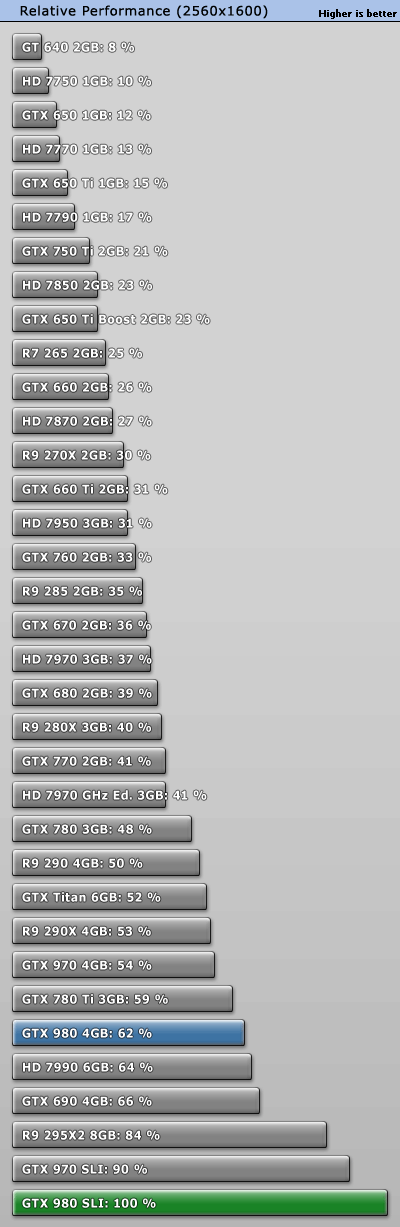
The top-binned, fully-enabled Tonga in the Retina iMac has all 2048 shaders enabled, and a TDP of roughly 125W. It still has a 256-bit bus, as expected. What could we expect a desktop variant of this kind of part to do? Well, GCN scales about as you'd expect with the number of shaders (e.g. R9 290 has 25% more shaders than the R9 280X, and offers about 25% more performance). Since full Tonga has 15% more shaders than the R9 285, we can expect about 15% better performance. This still falls short of the R9 290 by 10%-15% (depending on resolution) and short of the R9 290X by an even greater margin. On the other hand, performance/watt should be considerably better. The R9 285 is probably the worst bin of Tonga wafers; the far higher perf/watt of R9 M295X chips indicates that Tonga is capable of much better. Fitting full Tonga into a single 6-pin connector (150W TDP) seems like a reasonable expectation. In fact, the FirePro W7100 (cut-down Tonga) already does this.
The performance could be improved by upping the core clock rates (R9 285 clocks at 918 MHz), but this would also risk increasing power consumption levels.
We should also expect the full Tonga card to have 4GB of VRAM, just as the Retina iMac's version does. This may improve performance at higher resolutions (the R9 285 reviews show it falling behind above 1080p). Of course, that could have been done by AIBs at any time with existing R9 285 cards if they wanted to. Has anyone benched a FirePro W7100 (8GB)?
Just as a reminder (also, reminder of what 290/290X can't do) :
http://www.anandtech.com/show/8460/amd-radeon-r9-285-review
"With this newest generation of UVD, AMD is finally catching up to NVIDIA and Intel in H.264 decode capabilities. New to UVD is full support for 4K H.264 video, up to level 5.2 (4Kp60). AMD had previously intended to support 4K up to level 5.1 (4Kp30) on the previous version of UVD, but that never panned out and AMD ultimately disabled that feature. "
This is true, and it's definitely a nice addition, but Tonga still lacks fixed-function HEVC decoding. I want that feature for my next card (I'll be doing a new build in a few months) and right now I have exactly one choice: the GTX 960. I was hoping AMD might bring some additional options to the table with regards to this.
Last edited:





 Facebook
 Twitter