[BitsAndChips]390X ready for launch - AMD ironing out drivers - Computex launch

Page 59 - Seeking answers? Join the AnandTech community: where nearly half-a-million members share solutions and discuss the latest tech.

shady28

Platinum Member
Apr 11, 2004
2,520
397
126
...

Your statement is hard to grasp because it leaves no space for R9 290/290X unless you suddenly think R9 290 = 390 and R9 290X = 390X. So what is Fiji exactly, R9 395X2 dual Tonga XT? or is Fiji silicon all made up and it's nothing but Hawaii XT with HBM?


I thought it was obvious from factual information available, but since it's escaped you :

R9 380 = Tonga
R9 380X = Tonga XT

R9 390 and 390X = variations on Fiji

AMD has already stated that they will have all new chips in their lineup. These chips fit perfectly in their market segments. They are also new.

Now might they do Tonga with HBM? Sure.

I also think you underrate Tonga, but that's another topic.

Just like 860M was both a Kepler and a Maxwell GPU, but then 960M is a re-badge of the Maxwell 860M. The OEM market is often completely different from what we get in the retail sector.

So GTX 760 OEM is a GK104
And GTX 760 Retail is a ... wait for it.... wait for it... GK104

Same number of SUs, SPs, and TMUs.

And what's the difference then? Well, one has 1.5GB of memory and the 24 ROPS to support it, the other has 2.0GB of memory and the 32 ROPS to support that.

So the difference between those two cards is.... memory. They have the same freaking GPU. In fact, have no doubt the GPU in the OEM version is 32 ROP capable. It simply isn't connected to the non-existant 512MB of memory it would support.

And on the 860M.. What was it I said in my post about mobile and low end parts? Lets see....

http://forums.anandtech.com/showpost.php?p=37384521&postcount=1341

"Now at the low end and on mobile, they have mixed and matched dissimilar products plenty. "

Care to take another try?

That is to say, find a mid-range OEM card or higher (460,560,660,760,960 or higher Nvidia or AMD R9 series / 7700+ card) that actually has a different GPU than its retail variant?
 

JDG1980

Golden Member
Jul 18, 2013
1,663
570
136
http://www.extremetech.com/gaming/2...tical-details-unanswered/2#comment-2012295982
[Joel Hruska]: Trusted sources in a position to know that I've shown these slides to are saying that they're fake and that there's no plan to launch an 8GB card in Q2 2015.

As far as I'm concerned, this is just another rumor to add to the pile of rumors. Nothing is official yet, except that AMD will be releasing new AIB GPUs in Q2 2015, that they will be the R7/R9 300 series, and that HBM will be deployed somewhere. All that was confirmed from the slides on AMD's official site. Everything else is speculation. Yes, even "friend-of-a-friend" hearsay. For what it's worth, Joel Hruska says the following several messages down:
Joel Hruska said:
Sources, even honest ones, aren't always right -- but I've got reason to trust this one. Until I find out otherwise, I'll hold the 4GB line.
 

JDG1980

Golden Member
Jul 18, 2013
1,663
570
136
I thought it was obvious from factual information available, but since it's escaped you :

R9 380 = Tonga
R9 380X = Tonga XT

R9 390 and 390X = variations on Fiji

AMD has already stated that they will have all new chips in their lineup. These chips fit perfectly in their market segments. They are also new.

Tonga is not a new chip. And removing Hawaii from the lineup would be a massive blow to perf/$ in AMD's lineup. Right now, if you're willing to tolerate the power consumption, there's no better bang for the buck in the GPU market than a R9 290 or R9 290X. If these go away and users have to choose between a ~$229 Tonga and a ~$399 cut-down Fiji, there are far fewer scenarios where going AMD makes sense.
 

JDG1980

Golden Member
Jul 18, 2013
1,663
570
136
Doesn't anyone else find it funny that an "R9" part is using DDR3? Lenovo has the M375 in their Y40 gaming model. I wonder if the Skylake model will end up with it, too....

This is an actual regression from the R9 M275, which was the same Cape Verde GPU but with GDDR5. As things stand, the 300 series (both mobile and desktop) is shaping up to be quite possibly the worst rebrand ever.
 

jpiniero

Lifer
Oct 1, 2010
17,203
7,579
136
This is an actual regression from the R9 M275, which was the same Cape Verde GPU but with GDDR5. As things stand, the 300 series (both mobile and desktop) is shaping up to be quite possibly the worst rebrand ever.

OEMs are demanding lower power consumption cards?
 

JDG1980

Golden Member
Jul 18, 2013
1,663
570
136
Furmark is not reliable. Both companies software throttle for it. The IHV's need to have their cards wee ir as a 2D app and not even shift out of 2D clocks. Kill that program once and for all.

I've heard this said before, but that is not how power limits work on modern video cards. It may have been true once upon a time (back in the Fermi days) but not now. Modern cards (and I use this term loosely; I mean Kepler and GCN onward) throttle on the basis of actual power consumption. If they go over the limit, they're throttled back until the power usage levels off. This means there's no need to specially check for FurMark, and this is no longer done. I just tested this by running FurMark in conjunction with GPU-Z (so it can monitor clocks) - no throttling was observed, since my 7870 never reaches its internal thermal limit (which I think is around 175W). Now, on many other Kepler, Maxwell, and GCN cards, you will see throttling - but the same would be true of any other application that bumped up against the power limit.

No, it isn't. Furmark is not a reliable way to arrive at a GPU's maximum power usage since it is the most worthless synthetic GPU power test invented since no real world program can load the GPU like a power virus can. You continue to deny this and using FurMark to represent at GPU's maximum power usage is amazing despite the entire forum already debating this topic years ago and agreeing that Furmark is indeed a waste of time because it acts as a power virus. How you aren't understanding the basic premise that no real world program can stress 99.9% of every transistor inside a GPU, but Furmark can, is remarkable! Unless someone in the world can design a real world application that PC gamers actually regularly use that can mimic the stress levels of Furmark, Furmark is just a synthetic bench and nothing more and is as far away from reality as it gets.

Do you know of any application that draws more power from the GPU than FurMark? If the answer is no, then by definition, FurMark shows the GPU's maximum power usage. What you're saying is that you don't care, because you don't consider it a "real-world" load. But that's a matter of opinion. I, personally, refuse to build a system that will not be stable under all operating conditions. If you don't test with FurMark, then how do you know that running it won't trip the breaker in your power supply, cause the VRMs to melt down, or set your house on fire? I consider no system stable until it has been tested with Prime95 and FurMark simultaneously for 24 consecutive hours.

Furmark is basically known for destroying GPU's VRM system and AMD/NV do not consider this program worthwhile whatsoever.

If a video card can't survive running FurMark for 24 hours straight then I will return that video card as defective. I haven't had an issue yet, because properly designed modern cards are designed not to exceed their power limit. Some AIBs, like Gigabyte, ignore the power limit and this means that the real power usage of the cards can be much, much higher than it should be. That's not FurMark's fault, it's the AIB's fault for disabling the safety measures that are part of contemporary GPUs.

That driver hack you linked was for older cards. Modern cards just use the normal power limit so this isn't an issue.
 

monstercameron

Diamond Member
Feb 12, 2013
3,818
1
0
AMD releasing a card that is competing with it's own card is kind of lame. AMD can't command the same pricing structure that nVIdia can, their position in the market can't support it. If it's going to cost the same or more than a 980, it needs to demolish it in everything. 100fps vs 150fps @ 1080p isn't going to cut it if that 50% performance advantage drops to 10% at 4k because both cards run into vram limitations.


You do know that there are only 2 ihvs in this multibillion market?

Car analogy time: that is like saying Audi can't price their car at competitive prices compared to Mercedes...the only problem is that the market is absolutely massive.
 

2is

Diamond Member
Apr 8, 2012
4,281
131
106
You do know that there are only 2 ihvs in this multibillion market?

Car analogy time: that is like saying Audi can't price their car at competitive prices compared to Mercedes...the only problem is that the market is absolutely massive.

I know you were trying to make a point, but I don't think it worked... The fact that there are only two means there should be little reason why the market isn't split 50/50. But it isn't, and it's not even close, not only is not even close but the gap isn't narrowing either. So what exactly is your point here?
 

monstercameron

Diamond Member
Feb 12, 2013
3,818
1
0
I know you were trying to make a point, but I don't think it worked... The fact that there are only two means there should be little reason why the market isn't split 50/50. But it isn't, and it's not even close, not only is not even close but the gap isn't narrowing either. So what exactly is your point here?


You already know that gap is due to amd extending the hd 7000 and Rx 2xx series and not introducing new products. Market share goes up and down.

Car analogy time: does Toyota and scion need Equal share to be both highly profitable?
 

2is

Diamond Member
Apr 8, 2012
4,281
131
106
You already know that gap is due to amd extending the hd 7000 and Rx 2xx series and not introducing new products. Market share goes up and down.

Car analogy time: does Toyota and scion need Equal share to be both highly profitable?

Except AMD's market share wasn't at 50% even with the HD7000 series. So again, what is your point? Your analogies aren't working for you either. Maybe it's "time" for you to come up with a good argument.

Oh, and AMD is posting losses, Toyota is the most profitable auto company in the world. so your analogy fails there too. Quite miserably.
 

monstercameron

Diamond Member
Feb 12, 2013
3,818
1
0
Except AMD's market share wasn't at 50% even with the HD7000 series. So again, what is your point? Your analogies aren't working for you either. Maybe it's "time" for you to come up with a good argument.

Oh, and AMD is posting losses, Toyota is the most profitable auto company in the world. so your analogy fails there too. Quite miserably.


Ok, I'm saying that even with a 90-10% market share, advantage nvidia, amd could still price their part competitive or even with a premium and still be profitable. This all depends effective strategies. Just because you are the underdog/niche player doesn't mean you have to be cheap.
 

2is

Diamond Member
Apr 8, 2012
4,281
131
106
Ok, I'm saying that even with a 90-10% market share, advantage nvidia, amd could still price their part competitive or even with a premium and still be profitable. This all depends effective strategies. Just because you are the underdog/niche player doesn't mean you have to be cheap.

What your saying doesn't make sense is what I'm saying. AMD has neither market share nor profitability. A $600 4GB card is an excellent way to continue that trend.
 

shady28

Platinum Member
Apr 11, 2004
2,520
397
126
Tonga is not a new chip. And removing Hawaii from the lineup would be a massive blow to perf/$ in AMD's lineup. Right now, if you're willing to tolerate the power consumption, there's no better bang for the buck in the GPU market than a R9 290 or R9 290X. If these go away and users have to choose between a ~$229 Tonga and a ~$399 cut-down Fiji, there are far fewer scenarios where going AMD makes sense.

Besides the fact that Hawaii isn't new (it was introduced in Nov 2013, more than 18 months ago) -

The price/perf aspect is because Hawaii is heavily discounted right now, but that doesn't mean that AMD or the AIBs are making any money off of it - and making money is what companies are all about.

Hawaii is about 25% larger than Tonga, dissipates about 55% more heat (requiring more cooling) / takes 55% more power, and doesn't have the 3rd gen memory compression (hence needs a bigger bus). What all this means is that it costs a lot to build cards around Hawaii.

In essence, the 290/290x are cards designed to compete with top line Nvidia GPUs like the 970/980, but they have to be heavily discounted to do so despite being obviously more expensive to manufacture.

I also think Tonga as we know it now (R9 285) is just a shadow of what it's capable of. People seem to forget, it isn't just the SPs. It's the 256 bit bus, and the 2GB RAM, that hamstrings Tonga. Even with that, it bests the 384bit / 3GB R9 280.

Besides what we know - full Tonga have at least 50% more RAM and 50% larger bus, along with 15% more SPs - it's also rumored that it can support HBM.

I really think the R9 285 was meant to shake out Tonga from a manufacturing standpoint. It's intentionally crippled by its 256 bit bus and 2GB VRAM. If you look at the benchmarks where it suffers - it suffers because of that. Remove those bottlenecks, and it will be superior to most of AMDs current lineup. And that's what I think the R9 380 / 380x will be - uncrippled Tonga.


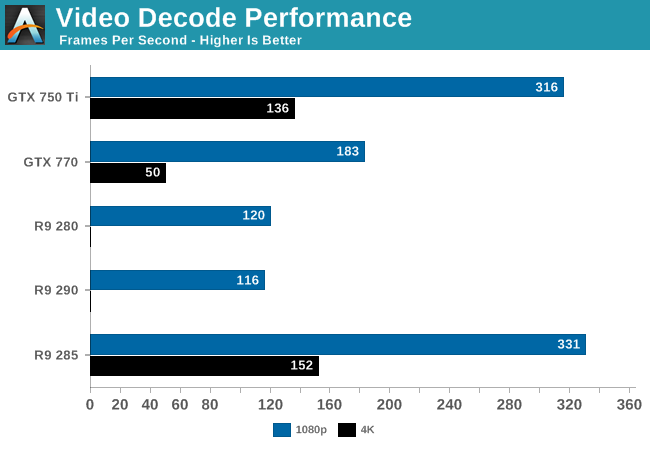
Just as a reminder (also, reminder of what 290/290X can't do) :

http://www.anandtech.com/show/8460/amd-radeon-r9-285-review

"With this newest generation of UVD, AMD is finally catching up to NVIDIA and Intel in H.264 decode capabilities. New to UVD is full support for 4K H.264 video, up to level 5.2 (4Kp60). AMD had previously intended to support 4K up to level 5.1 (4Kp30) on the previous version of UVD, but that never panned out and AMD ultimately disabled that feature. "


67598.png


67599.png


"At the x64 tessellation factor we see the R9 285 spit out 134fps, or equivalent to roughly 1.47B polygons/second. This is as compared to 79fps (869M Polys/sec) for the R9 290, and 68fps (748M Polys/sec) for the R9 280. "

Tessmark_575px.png


67232.png


67234.png
 

krumme

Diamond Member
Oct 9, 2009
5,956
1,596
136
390X NEEDS 8Gb Vram because that is where all the NV better than AMD arguments will be focused to convince us to spend more, irrespective of actual game performance.

Wrong. There will always be a reason nv (and amd to a far smaller degree) is better for those who seeks it. Be it cuda, drivers, ram or gw. Amd can only focus on performance in this battle.

And thats what should matter for us enthusiast. Performance. The rest is bla bla bla.
 

Enigmoid

Platinum Member
Sep 27, 2012
2,907
31
91
I also think Tonga as we know it now (R9 285) is just a shadow of what it's capable of. People seem to forget, it isn't just the SPs. It's the 256 bit bus, and the 2GB RAM, that hamstrings Tonga. Even with that, it bests the 384bit / 3GB R9 280.

Besides what we know - full Tonga have at least 50% more RAM and 50% larger bus, along with 15% more SPs - it's also rumored that it can support HBM.

I really think the R9 285 was meant to shake out Tonga from a manufacturing standpoint. It's intentionally crippled by its 256 bit bus and 2GB VRAM. If you look at the benchmarks where it suffers - it suffers because of that. Remove those bottlenecks, and it will be superior to most of AMDs current lineup. And that's what I think the R9 380 / 380x will be - uncrippled Tonga.

Not sure why everyone believes Tonga is 384 bit. It may be but the evidence is strongly against it.

Tonga with a 384 bit bus would be a fail on so many levels. If it had a 384 (and more ROPs) bit bus it would mean that to date not a single tonga chip had a fully enabled die - a massive fail. One might also question the use of using tonga's memory compression and then equipping the chip with the same 384 bit memory interface as Tahiti with the same number of shaders as Tahiti.

Tonga was likely AMDs attempt at getting the same performance as tahiti with a smaller bus (a la Nvidia style) to reduce costs.
 

Paul98

Diamond Member
Jan 31, 2010
3,732
199
106
Ether AMD really isn't releasing anything new other than the R9 39x series, and just not planning to sell many of the other cards, and just getting ready for major releasaes next year. Heck the R9 270 is going to be faster than the R9 370 which is just stupid.

Or they are changing the naming convention a bit and will have some more decent products in the lineup.

Right now I am expecting the former, hoping for the latter.

I really hope we see a good performance upgrade and a decent price with some good new tech. I would like to upgrade but nothing out right makes me want to.
 
Dec 30, 2004
12,553
2
76
I've heard this said before, but that is not how power limits work on modern video cards. It may have been true once upon a time (back in the Fermi days) but not now. Modern cards (and I use this term loosely; I mean Kepler and GCN onward) throttle on the basis of actual power consumption. If they go over the limit, they're throttled back until the power usage levels off. This means there's no need to specially check for FurMark, and this is no longer done. I just tested this by running FurMark in conjunction with GPU-Z (so it can monitor clocks) - no throttling was observed, since my 7870 never reaches its internal thermal limit (which I think is around 175W). Now, on many other Kepler, Maxwell, and GCN cards, you will see throttling - but the same would be true of any other application that bumped up against the power limit.


Do you know of any application that draws more power from the GPU than FurMark? If the answer is no, then by definition, FurMark shows the GPU's maximum power usage. What you're saying is that you don't care, because you don't consider it a "real-world" load. But that's a matter of opinion. I, personally, refuse to build a system that will not be stable under all operating conditions. If you don't test with FurMark, then how do you know that running it won't trip the breaker in your power supply, cause the VRMs to melt down, or set your house on fire? I consider no system stable until it has been tested with Prime95 and FurMark simultaneously for 24 consecutive hours.


If a video card can't survive running FurMark for 24 hours straight then I will return that video card as defective. I haven't had an issue yet, because properly designed modern cards are designed not to exceed their power limit. Some AIBs, like Gigabyte, ignore the power limit and this means that the real power usage of the cards can be much, much higher than it should be. That's not FurMark's fault, it's the AIB's fault for disabling the safety measures that are part of contemporary GPUs.

That driver hack you linked was for older cards. Modern cards just use the normal power limit so this isn't an issue.

I was able to pass furmark at ~1300mhz core on my 7850 but benchmarks at only ~1150.

It may be max power consumption but it didn't really accomplish anything for me. so I used unigen free valley instead and stopped having issues
 

shady28

Platinum Member
Apr 11, 2004
2,520
397
126
Not sure why everyone believes Tonga is 384 bit. It may be but the evidence is strongly against it.

Tonga with a 384 bit bus would be a fail on so many levels. If it had a 384 (and more ROPs) bit bus it would mean that to date not a single tonga chip had a fully enabled die - a massive fail. One might also question the use of using tonga's memory compression and then equipping the chip with the same 384 bit memory interface as Tahiti with the same number of shaders as Tahiti.

Tonga was likely AMDs attempt at getting the same performance as tahiti with a smaller bus (a la Nvidia style) to reduce costs.

https://www.techpowerup.com/205811/amd-tonga-silicon-features-384-bit-wide-memory-interface.html


"In what could explain the rather large die-size and transistor-count of AMD's "Tonga" silicon, compared to "Tahiti," it turns out that the silicon features a 384-bit wide GDDR5 memory interface, and not the previously thought of 256-bit wide one. The die is placed on a package with pins for just 256-bit, on the Radeon R9 285, but it can be placed on a bigger package, with more pins, to wire out the full width of the memory bus, in future SKUs."


What this means is that AMD's next performance-segment graphics card based on the "Tonga" silicon, could feature 50% more memory bandwidth than the R9 285. The stream processor count is still 2,048, but these are more advanced Graphics CoreNext 1.2 stream processors, compared to first-generation ones on "Tahiti," offering more performance per Watt. The TMU count remains 128, although there's no clarity on the ROP count. Estimates are split between 32 and 48. The R9 285 has 32, and so does "Tahiti."


http://wccftech.com/tonga-xt-hsa-support-384-bit-bus/

"AMD’ s Tonga is a very interesting product. It received a very mild reception and was, in my opinion, mistimed and wrongly portrayed. The Tonga XT has 256 more shader count than the Tonga PRO GPU, which means that AMD is using the age old tactic of holding the good stuff back till it is actually needed. The full fat Tonga XT packs a total of 32 compute unit and six memory controllers. Since each is 64 bits wide, it adds up to a 384 bit interface."
 

LTC8K6

Lifer
Mar 10, 2004
28,520
1,576
126
If you look back at the R9 285 reviews, Tonga had a few promising tricks up it's sleeve.

Comparing the R9 290 (Hawaii), R9 285 (Tonga), and R9 280 (Tahiti) in TessMark at various tessellation factors, we have found that while Tonga trails Hawaii at low tessellation factors – and oddly enough even Tahiti – at high tessellation factors the tables are turned. With x32 and x64 tessellation, the Tonga based R9 285 outperforms both cards in this raw tessellation test, and at x64 in particular completely blows away Hawaii, coming close to doubling its tessellation performance.

it’s worth noting that even our most memory bandwidth-sensitive games hold up well compared to the R9 280, never losing anywhere near the amount of performance that such a memory bandwidth reduction would imply (if they lose performance at all).

http://www.anandtech.com/show/8460/amd-radeon-r9-285-review/3
 

ShintaiDK

Lifer
Apr 22, 2012
20,378
146
106
Tonga is simply bigger due to all the GCN 1.2 improvements. Tonga for example runs in circles around Tahiti in heavy tesselation usage. Tahiti may be smaller and havign 384bit. But its an outdated chip that starts to perform poorly in newer games.

There is no hidden 384bit. Its just a silly rumour.
 

waffleironhead

Diamond Member
Aug 10, 2005
7,123
623
136
This is an actual regression from the R9 M275, which was the same Cape Verde GPU but with GDDR5. As things stand, the 300 series (both mobile and desktop) is shaping up to be quite possibly the worst rebrand ever.

Not really. The r9 m275 in my y40 is not gddr5.