
Arachnotronic
Lifer
- Mar 10, 2006
- 11,715
- 2,012
- 126


I didn't realise McAfee was such a disaster actually. That one alone negates any "overspend" AMD supposedly made on ATI.
Intel must be one of the worst money-wasting corporations in history. Looking at the money they've blown on bad aquisitions (8bn), bribery(6bn), fines(2bn) and other payoffs(1.25bn), 2nd(1.5bn), bad experimental R&D(3.5bn)...it's unbelievable.
That's over 20 billion USD. And AMD is supposed to have overspent on ATI? :thumbsup:
They might be hurting due to putting $8bn into McAfee, that's the point I'm trying to make. That $8bn *could* have been spent elsewhere that would put them in a better position to take on ARM right now. What is McAfee doing for them in this space? Nothing I can tell.
AMD had to suffer years of pain because of the ATI aquisition, nobody denies that - but I don't see what other choice they had. It's not like they didn't try either - the attempted merger with Nvidia is well known. In the end ATI was the big one and AMD had to spend to get it. Intel could have saved themselves so much hassle had they bought ATI out instead, and they'd be in a much stronger position now for it.
Thats the misconception. They didnt need ATI. They just needed a future GPU tech. And with 5-6 years before their first APU. They had plenty of time.

Yup. The end-game is to have easily-accessible fixed-function raster units and the like, and for everything else to just get gobbled up as regular parts of the CPU, and/or general-purpose coprocessors. It may or may not have been cheaper to just buy a company like ATI or Imagination, but it would have only been marginally better in the long run. FI, their IGP shared L3, when AMD's didn't, saving them space and power. They couldn't have done that integrating another GPU, at least not so quickly. They're now merging address spaces, which would have been a n uphill battle (see AMD) with a 3rd-party GPU design to work on. And so on and so forth.SiliconWars,
They could have bought Imagination Technologies for MUCH cheaper. Or the company that ARM bought to get what eventually produced the Mali graphics.
Yeah it's a paper loss.
It doesn't matter, simple fact is AMD needed ATI or they'd be in a similar position to Nvidia, having a prom ticket but no dress.
AMD's weakness at the time also led to an empowerment of Qualcomm who picked up their mobile graphics handset division on the cheap (you might ask why Intel missed the boat a 2nd time btw?)
Now they are the clear leader in phones, exactly where Intel needs to be. Isn't it funny how these things work out?
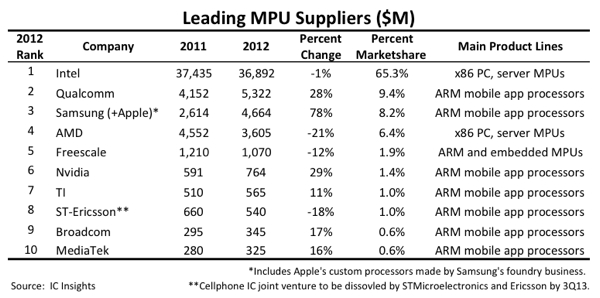
Qualcomm's entire annual CPU/SoC sales come out to ~$6B. Not chump change by any means, but certainly paltry compared to Intel's ~$35B PC chip business and ~$11B server chip business.
What a disastrous move. They could licence the Adreno graphics ip like ARM does and cash on the mobile revolution brought by the Iphone, their problem was that they were focused and transfixed in a big uphill battle against Intel in the classic x86 ruled desktop and server space, Intel shared the same myopic view like AMD, they didnt give a rat about graphics and mobile back then, the Apple contract made them move on it.
What a disastrous move. They could licence the Adreno graphics ip like ARM does and cash on the mobile revolution brought by the Iphone, their problem was that they were focused and transfixed in a big uphill battle against Intel in the classic x86 ruled desktop and server space, Intel shared the same myopic view like AMD, they didnt give a rat about graphics and mobile back then, the Apple contract made them move on it.
In 2012 Qualcomm's QCT division which is responsible for developing and selling it's wireless chipsets including baseband and SOC had a total revenue of $12.1B. Intel's Other Intel Architecture segment which includes essentially all hardware products including netbooks and tablet but not servers, laptops, and desktops in contrast earned $4.3B. In terms of net earnings Qualcomm had $5.3B of net income excluding discontinued operations, while Intel had $11B. So while Intel is clearly a larger company, but Qualcomm has substantial resources and it's no AMD.
They might be hurting due to putting $8bn into McAfee, that's the point I'm trying to make. That $8bn *could* have been spent elsewhere that would put them in a better position to take on ARM right now. What is McAfee doing for them in this space? Nothing I can tell.
AMD had to suffer years of pain because of the ATI aquisition, nobody denies that - but I don't see what other choice they had. It's not like they didn't try either - the attempted merger with Nvidia is well known. In the end ATI was the big one and AMD had to spend to get it. Intel could have saved themselves so much hassle had they bought ATI out instead, and they'd be in a much stronger position now for it.
Yeah it's a paper loss.
What you just stated is actually completely hilarious. AMD created Adreno. If you look carefully, that's an anagram for Radeon, the IP was licensed from AMD years ago.
I guess you misunderstanded. I stated that AMD selling the mobile graphics division and the entire ATI Imageon graphics IP to Qualcomm which was later renamed to Adreno was a bad move in times of need of hard cash and thats not only my personal opinion but shared with hundreds of others.
http://www.eweek.com/c/a/Mobile-and-Wireless/AMD-Sells-Handset-Division-to-Qualcomm-for-65-Million/
You do realize that Qualcomm invested significant R&D dollars to make Adreno what it is today, right?

My understanding is that Intel will still use Imagination GPUs for their Silvermont-based smartphone SoC, Merrifield. If true, that'd mean Intel GPU doesn't scale down enough.


The reason Intel isn't better positioned in the ARM space is not because of a lack of R&D money but because their CEO at the time made a disasterously bad err in calculating the potential TAM, cost per chip, and profit potential per chip for the space when initially approached by Apple.
Nope.
Its only Intel IGPs from here on.
No i dont, got any proof for that because in 3-4 years time since the buyout of AMD/ATI graphics ip i fail to realize what a colossal, as you suggest, improvement Qualcomm with its non existent status in graphics brought to the existing graphics cores, did they hired the entire Imageon engineering team aswell?
That's what I meant by "potential TAM", he definitely underestimated just how much revenue opportunity the smartphone segment represented.The reason Intel isn't better positioned in the ARM space is not because of a lack of R&D money but because their CEO at the time made a disasterously bad err in calculating the potential TAM, cost per chip, and profit potential per chip for the space when initially approached by Apple.
The way I parsed that comment from Otellini was that he thought the market was too small to justify embracing the lower gross margins.
Review of the current Atom in a Samsung Galaxy tab 3 proves how bias Antutu is to Intel:
http://www.gsmarena.com/samsung_galaxy_tab_3_101-review-948p4.php
In all benchmarks it takes a serious beating - sometimes with a factor 3-4!. Sunspider is an exception where its around middle (memory bound), and Antutu it makes a really good showing. LOL.
"Like many of Samsung's midrange offerings, the Samsung Galaxy Tab 3 10.1 is a mixed bag of features. On the one hand, you get the large display and slim design, the great codec support, and rich connectivity features which include an IR-port, while on the other you get a dual-core Intel Atom processor with questionable performance, a 1280 x 800 TFT panel which is hardly the sharpest tool in the shed, and a free ticket to a losing battle you'll be waging with the sub-1GB of user-available RAM."
Personally I bet it had less to do with figuring out how to cash in on smartphones, and had a lot more to do with not wanting to do anything that would bite them in the end by way of cannibalizing their lucrative fat-core x86 products.
They thought they could keep ARM at arms length (heh) and keep milking the profits from the traditional laptop and desktop segments. It was only when they started seeing cracks in that strategy that they got all hot and heavy about getting up in ARM's business.



 Facebook
 Twitter