Bay Trail benchmark appears online, crushes fastest Snapdragon ARM SoC

Page 14 - Seeking answers? Join the AnandTech community: where nearly half-a-million members share solutions and discuss the latest tech.

Idontcare

Elite Member
Oct 10, 1999
21,110
64
91
I didn't realise McAfee was such a disaster actually. That one alone negates any "overspend" AMD supposedly made on ATI.

Intel must be one of the worst money-wasting corporations in history. Looking at the money they've blown on bad aquisitions (8bn), bribery(6bn), fines(2bn) and other payoffs(1.25bn), 2nd(1.5bn), bad experimental R&D(3.5bn)...it's unbelievable.

That's over 20 billion USD. And AMD is supposed to have overspent on ATI? :thumbsup:

I may be wrong on my perception of the situation but it has been my impression that the reason people tend to bring up AMD's ATI purchase is not because of the absolute dollar amount (millions vs billions, etc) but because of the relative dollar amount (relative to AMD's cash, revenue, and market cap) and the opportunity cost (buy ATI or develop a truly kickass Phenom CPU and 65nm process to go along with it) that went into Ruiz essentially betting the farm on the future being fusion.

McAfee may have been an overpriced waste of money but spending that money did not come with the risk of putting the entire company of Intel at risk of default or into a tailspin where they have no choice but to sell of critical IP to Qualcomm, go through rounds and rounds of layoffs year after year, and sell off their fabs.

Intel takes risk, you can't innovate without taking risk, the difference is that Intel takes risk that it can afford whereas AMD takes risks that leave it in a very vulnerable position should things go "tits up" (exclusivity contract and take-or-pay contracts with GloFo is just one example).

And that is why, in my impression of things, the ATI acquisition gets as much visibility and talk-time that it does. There is no question Intel could have probably put their $8B McAfee money to better use elsewhere, but they aren't hurting for having put it into McAfee.

The same can not be said of AMD's decision to buy ATI. The knock-on effects of that decision have had far-reaching effects throughout the cash-starved company for years and years later.

Consider that if AMD had bought $5.4B of INTC on July 24, 2006 instead of buying ATI then their $5.4B investment would be worth $7.4B today.

Instead AMD, including their $5.4B investment into ATI, is worth a measly $2.9B.
 

SiliconWars

Platinum Member
Dec 29, 2012
2,346
0
0
They might be hurting due to putting $8bn into McAfee, that's the point I'm trying to make. That $8bn *could* have been spent elsewhere that would put them in a better position to take on ARM right now. What is McAfee doing for them in this space? Nothing I can tell.

AMD had to suffer years of pain because of the ATI aquisition, nobody denies that - but I don't see what other choice they had. It's not like they didn't try either - the attempted merger with Nvidia is well known. In the end ATI was the big one and AMD had to spend to get it. Intel could have saved themselves so much hassle had they bought ATI out instead, and they'd be in a much stronger position now for it.
 
Mar 10, 2006
11,715
2,012
126
They might be hurting due to putting $8bn into McAfee, that's the point I'm trying to make. That $8bn *could* have been spent elsewhere that would put them in a better position to take on ARM right now. What is McAfee doing for them in this space? Nothing I can tell.

AMD had to suffer years of pain because of the ATI aquisition, nobody denies that - but I don't see what other choice they had. It's not like they didn't try either - the attempted merger with Nvidia is well known. In the end ATI was the big one and AMD had to spend to get it. Intel could have saved themselves so much hassle had they bought ATI out instead, and they'd be in a much stronger position now for it.

SiliconWars,

They could have bought Imagination Technologies for MUCH cheaper. Or the company that ARM bought to get what eventually produced the Mali graphics.
 

grimpr

Golden Member
Aug 21, 2007
1,095
7
81
Thats the misconception. They didnt need ATI. They just needed a future GPU tech. And with 5-6 years before their first APU. They had plenty of time.

Wrong, they not only bought ATI tech and brand but all the graphics intellectual properties with it. Now try to come up with your own graphics tech against the giants, 5 billions cant save you, even Intel licenced alot from both AMD & Nvidia for its Core HD graphics line.
 

Cerb

Elite Member
Aug 26, 2000
17,484
33
86
SiliconWars,

They could have bought Imagination Technologies for MUCH cheaper. Or the company that ARM bought to get what eventually produced the Mali graphics.
Yup. The end-game is to have easily-accessible fixed-function raster units and the like, and for everything else to just get gobbled up as regular parts of the CPU, and/or general-purpose coprocessors. It may or may not have been cheaper to just buy a company like ATI or Imagination, but it would have only been marginally better in the long run. FI, their IGP shared L3, when AMD's didn't, saving them space and power. They couldn't have done that integrating another GPU, at least not so quickly. They're now merging address spaces, which would have been a n uphill battle (see AMD) with a 3rd-party GPU design to work on. And so on and so forth.

They're not blowing away everybody else the way they're going, but they benefit from having control over the designs from beginning to end, and you can bet that features going into IGPs now and in the near future, are based on much longer term goals, as well. For a more tangible example of that sort of thing, their L3 and ring bus were very high bandwidth, to a point that it seemed overkill, to me (if you're going for saving power, why not save on that stuff, too?). But, then they made the IGP use it, with the L3 cache, and then they made it scale back in clock speed separately from the CPUs, to save power (and thus be operate at much lower bandwidth). Well, at that point, it made a ton of sense for it to have such high peak bandwidth.
 

grimpr

Golden Member
Aug 21, 2007
1,095
7
81
Yeah it's a paper loss.

It doesn't matter, simple fact is AMD needed ATI or they'd be in a similar position to Nvidia, having a prom ticket but no dress.

AMD's weakness at the time also led to an empowerment of Qualcomm who picked up their mobile graphics handset division on the cheap (you might ask why Intel missed the boat a 2nd time btw?)

Now they are the clear leader in phones, exactly where Intel needs to be. Isn't it funny how these things work out? :)

What a disastrous move. They could licence the Adreno graphics ip like ARM does and cash on the mobile revolution brought by the Iphone, their problem was that they were focused and transfixed in a big uphill battle against Intel in the classic x86 ruled desktop and server space, Intel shared the same myopic view like AMD, they didnt give a rat about graphics and mobile back then, the Apple contract made them move on it.
 

wlee15

Senior member
Jan 7, 2009
313
31
91
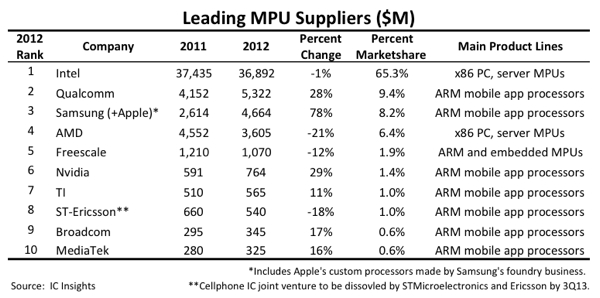
Qualcomm's entire annual CPU/SoC sales come out to ~$6B. Not chump change by any means, but certainly paltry compared to Intel's ~$35B PC chip business and ~$11B server chip business.

In 2012 Qualcomm's QCT division which is responsible for developing and selling it's wireless chipsets including baseband and SOC had a total revenue of $12.1B. Intel's Other Intel Architecture segment which includes essentially all hardware products including netbooks and tablet but not servers, laptops, and desktops in contrast earned $4.3B. In terms of net earnings Qualcomm had $5.3B of net income excluding discontinued operations, while Intel had $11B. So while Intel is clearly a larger company, but Qualcomm has substantial resources and it's no AMD.
 

blackened23

Diamond Member
Jul 26, 2011
8,548
2
0
What a disastrous move. They could licence the Adreno graphics ip like ARM does and cash on the mobile revolution brought by the Iphone, their problem was that they were focused and transfixed in a big uphill battle against Intel in the classic x86 ruled desktop and server space, Intel shared the same myopic view like AMD, they didnt give a rat about graphics and mobile back then, the Apple contract made them move on it.

What you just stated is actually completely hilarious. AMD created Adreno. If you look carefully, that's an anagram for Radeon, the IP was licensed from AMD years ago.

*GOOD GOD*

This thread has just become a dump of an AMD versus Intel fan fight. I don't think i'm interested in perpetuating it any longer (i'm guilty too, I admit). Anyone care to veer this back on topic?
 
Last edited:

wlee15

Senior member
Jan 7, 2009
313
31
91
What a disastrous move. They could licence the Adreno graphics ip like ARM does and cash on the mobile revolution brought by the Iphone, their problem was that they were focused and transfixed in a big uphill battle against Intel in the classic x86 ruled desktop and server space, Intel shared the same myopic view like AMD, they didnt give a rat about graphics and mobile back then, the Apple contract made them move on it.

Imagination Technologies which licenses PowerVR gpus had a operating profit of 28 million pounds in 2012 fiscal year or about $42M at current USD rates, and that's the entire company and not just PowerVR, so I'm sure it would have been the cash cow that you think it might have been.
 
Mar 10, 2006
11,715
2,012
126
In 2012 Qualcomm's QCT division which is responsible for developing and selling it's wireless chipsets including baseband and SOC had a total revenue of $12.1B. Intel's Other Intel Architecture segment which includes essentially all hardware products including netbooks and tablet but not servers, laptops, and desktops in contrast earned $4.3B. In terms of net earnings Qualcomm had $5.3B of net income excluding discontinued operations, while Intel had $11B. So while Intel is clearly a larger company, but Qualcomm has substantial resources and it's no AMD.

No doubt. But most of the "net income" from Qualcomm comes from patent licensing, and NOT chips. The $12.1B of total revenue from QCT isn't just Snapdragons; a lot of that is modems.

I am a Qualcomm shareholder, so don't think that I don't respect the abilities of this powerhouse. That being said, with ~50% apps processor market share + >90% of the LTE baseband market, I do wonder if it's just a matter of time before margins significantly erode on the LTE side of things, as Broadcom indicated at a recent investor conference.
 

Idontcare

Elite Member
Oct 10, 1999
21,110
64
91
They might be hurting due to putting $8bn into McAfee, that's the point I'm trying to make. That $8bn *could* have been spent elsewhere that would put them in a better position to take on ARM right now. What is McAfee doing for them in this space? Nothing I can tell.

AMD had to suffer years of pain because of the ATI aquisition, nobody denies that - but I don't see what other choice they had. It's not like they didn't try either - the attempted merger with Nvidia is well known. In the end ATI was the big one and AMD had to spend to get it. Intel could have saved themselves so much hassle had they bought ATI out instead, and they'd be in a much stronger position now for it.

The $8B in McAfee didn't come at the expense of not having $8B to invest elsewhere though, there is another $8B (and then some) still on hand if Intel really thought more money invested into R&D would make any sense.

The reason Intel isn't better positioned in the ARM space is not because of a lack of R&D money but because their CEO at the time made a disasterously bad err in calculating the potential TAM, cost per chip, and profit potential per chip for the space when initially approached by Apple.

That kind of "failure to compute" is why they are playing catch-up.

Intel has money to lose on misguided projects like Larrabee and McAfee. So does Apple, Microsoft, Qualcomm, Samsung, etc. AMD does not, and they did not.

That is what makes the ATI acquisition uniquely qualified for the persistent level of scrutiny it receives in my opinion. Any company with a healthy balance sheet and a reasonable sane executive team can survive a disastrous investment or two the likes of HP's Autonomy purchase (although that purchase was orchestrated by an admittedly not sane CEO).

But there is no question that AMD's ATI purchase resulted in AMD cutting themselves off at the knees as they pulled back R&D spending across the board and stunted the capabilities of their own future chips (at the time).

There can be no question that both Phenom and Bulldozer would have been markedly more competitive had those development teams not been resource starved because of the ATI purchase, same with fab capacity and node capability at any point in the prevailing 7 years.

Intel's portfolio shows no such weakness attributable to the McAfee purchase. Their portfolio weakness is due to a miscalculation by their CEO at a critical point in the decision tree with Apple. At this time all that the McAfee deal has done is weaken Intel's net assets from an accounting perspective so far as I can tell, no knock-on effects in the other groups within Intel.
 

mrmt

Diamond Member
Aug 18, 2012
3,974
0
76
Yeah it's a paper loss.

The complete transaction? A paper loss? What do you call a paper loss? Do you mind describing what lines did the acquisition change in AMD balance sheet from the acquisition until write down? Because it wasn't a paper loss by any accounting standards, but I really want to see your POV.
 

grimpr

Golden Member
Aug 21, 2007
1,095
7
81
What you just stated is actually completely hilarious. AMD created Adreno. If you look carefully, that's an anagram for Radeon, the IP was licensed from AMD years ago.

I guess you misunderstanded. I stated that AMD selling the mobile graphics division and the entire ATI Imageon graphics IP to Qualcomm which was later renamed to Adreno was a bad move in times of need of hard cash and thats not only my personal opinion but shared with hundreds of others.

http://www.eweek.com/c/a/Mobile-and-Wireless/AMD-Sells-Handset-Division-to-Qualcomm-for-65-Million/
 
Mar 10, 2006
11,715
2,012
126
I guess you misunderstanded. I stated that AMD selling the mobile graphics division and the entire ATI Imageon graphics IP to Qualcomm which was later renamed to Adreno was a bad move in times of need of hard cash and thats not only my personal opinion but shared with hundreds of others.

http://www.eweek.com/c/a/Mobile-and-Wireless/AMD-Sells-Handset-Division-to-Qualcomm-for-65-Million/

You do realize that Qualcomm invested significant R&D dollars to make Adreno what it is today, right?
 

grimpr

Golden Member
Aug 21, 2007
1,095
7
81
You do realize that Qualcomm invested significant R&D dollars to make Adreno what it is today, right?

No i dont, got any proof for that because in 3-4 years time since the buyout of AMD/ATI graphics ip i fail to realize what a colossal, as you suggest, improvement Qualcomm with its non existent status in graphics brought to the existing graphics cores, did they hired the entire Imageon engineering team aswell?
 

ShintaiDK

Lifer
Apr 22, 2012
20,378
146
106
My understanding is that Intel will still use Imagination GPUs for their Silvermont-based smartphone SoC, Merrifield. If true, that'd mean Intel GPU doesn't scale down enough.

Nope.

valley01.png

26860_08_leakedtt_details_on_intel_s_next_gen_atom_tablet_chips_bay_trail_t_and_valley_view_t_full.jpg


Its only Intel IGPs from here on.
 

Vesku

Diamond Member
Aug 25, 2005
3,743
28
86
The reason Intel isn't better positioned in the ARM space is not because of a lack of R&D money but because their CEO at the time made a disasterously bad err in calculating the potential TAM, cost per chip, and profit potential per chip for the space when initially approached by Apple.

The way I parsed that comment from Otellini was that he thought the market was too small to justify embracing the lower gross margins. Combine that with they'd most likely have to expand on their ARM license to meet the iPhone timeline. It's not like he was the only one surprised by the consumer enthusiasm.

Hmm, out of curiosity what was ARMs valuation prior to smartphones taking off? Could that $8 billion have bought Intel the whole ARM boat?

Edit: Well ARM's total revenue in 2006 was 263 million british pounds so I'd say Intel could have just taken over the whole thing. At that small size it probably wouldn't have even raised much in the way of antitrust flags. I'd be a bit hard on myself too if I missed out on an opportunity like that.
 
Last edited:

krumme

Diamond Member
Oct 9, 2009
5,956
1,596
136
Review of the current Atom in a Samsung Galaxy tab 3 proves how bias Antutu is to Intel:
http://www.gsmarena.com/samsung_galaxy_tab_3_101-review-948p4.php

In all benchmarks it takes a serious beating - sometimes with a factor 3-4!. Sunspider is an exception where its around middle (memory bound), and Antutu it makes a really good showing. LOL.

"Like many of Samsung's midrange offerings, the Samsung Galaxy Tab 3 10.1 is a mixed bag of features. On the one hand, you get the large display and slim design, the great codec support, and rich connectivity features which include an IR-port, while on the other you get a dual-core Intel Atom processor with questionable performance, a 1280 x 800 TFT panel which is hardly the sharpest tool in the shed, and a free ticket to a losing battle you'll be waging with the sub-1GB of user-available RAM."
 

wlee15

Senior member
Jan 7, 2009
313
31
91
No i dont, got any proof for that because in 3-4 years time since the buyout of AMD/ATI graphics ip i fail to realize what a colossal, as you suggest, improvement Qualcomm with its non existent status in graphics brought to the existing graphics cores, did they hired the entire Imageon engineering team aswell?

Yes the team went over to Qualcomm. Qualcomm was also previously a Imageon licensee, and had incorporated into their early SOC.
 

Idontcare

Elite Member
Oct 10, 1999
21,110
64
91
The reason Intel isn't better positioned in the ARM space is not because of a lack of R&D money but because their CEO at the time made a disasterously bad err in calculating the potential TAM, cost per chip, and profit potential per chip for the space when initially approached by Apple.

The way I parsed that comment from Otellini was that he thought the market was too small to justify embracing the lower gross margins.
That's what I meant by "potential TAM", he definitely underestimated just how much revenue opportunity the smartphone segment represented.

The thing is if you look at Larrabee where the TAM for discrete GPU cards in x86-based desktops was considerably less, one wonders how they justified dumping a billion into Larrabee but wouldn't take a nibble on the smartphone opportunity.

Personally I bet it had less to do with figuring out how to cash in on smartphones, and had a lot more to do with not wanting to do anything that would bite them in the end by way of cannibalizing their lucrative fat-core x86 products.

They thought they could keep ARM at arms length (heh) and keep milking the profits from the traditional laptop and desktop segments. It was only when they started seeing cracks in that strategy that they got all hot and heavy about getting up in ARM's business.
 
Mar 10, 2006
11,715
2,012
126
Review of the current Atom in a Samsung Galaxy tab 3 proves how bias Antutu is to Intel:
http://www.gsmarena.com/samsung_galaxy_tab_3_101-review-948p4.php

In all benchmarks it takes a serious beating - sometimes with a factor 3-4!. Sunspider is an exception where its around middle (memory bound), and Antutu it makes a really good showing. LOL.

"Like many of Samsung's midrange offerings, the Samsung Galaxy Tab 3 10.1 is a mixed bag of features. On the one hand, you get the large display and slim design, the great codec support, and rich connectivity features which include an IR-port, while on the other you get a dual-core Intel Atom processor with questionable performance, a 1280 x 800 TFT panel which is hardly the sharpest tool in the shed, and a free ticket to a losing battle you'll be waging with the sub-1GB of user-available RAM."

Yeah, what do you expect from an ancient processor core? Clover Trail/Clover Trail+ are merely stopgaps for Bay Trail which will be out this year. It is likely that Intel sold these chips to Samsung at a significant discount just to clear out whatever inventory they had and/or gain some publicity.

The old Atom is a piece of poo, and it's time to put a bullet in this dog's head.
 

Vesku

Diamond Member
Aug 25, 2005
3,743
28
86
You missed krumme's main point that the "piece of poo" looks good if you only judge by Antutu. Which is the same benchmark people are basing their Bay Trail comments on in this thread.

Personally I bet it had less to do with figuring out how to cash in on smartphones, and had a lot more to do with not wanting to do anything that would bite them in the end by way of cannibalizing their lucrative fat-core x86 products.

They thought they could keep ARM at arms length (heh) and keep milking the profits from the traditional laptop and desktop segments. It was only when they started seeing cracks in that strategy that they got all hot and heavy about getting up in ARM's business.

My bet as well but throw in some x86 "pride" (investment, knowledge base, etc.) in the less tangible sense. If they did as detailed of an assessment as is implied the most realistic proposals would be to buy and improve upon ARM or perhaps MIPS to deliver a 1W or less package for 2007. I'm not exactly sure when Intel became serious with their push into smartphones but I'd imagine it's been at least 3-4 years and they still haven't quite delivered.
 
Last edited: