• We’re currently investigating an issue related to the forum theme and styling that is impacting page layout and visual formatting. The problem has been identified, and we are actively working on a resolution. There is no impact to user data or functionality, this is strictly a front-end display issue. We’ll post an update once the fix has been deployed. Thanks for your patience while we get this sorted.

Bare-die testing: A delidded 3770k, an H100, and 9 different TIMs

Page 17 - Seeking answers? Join the AnandTech community: where nearly half-a-million members share solutions and discuss the latest tech.
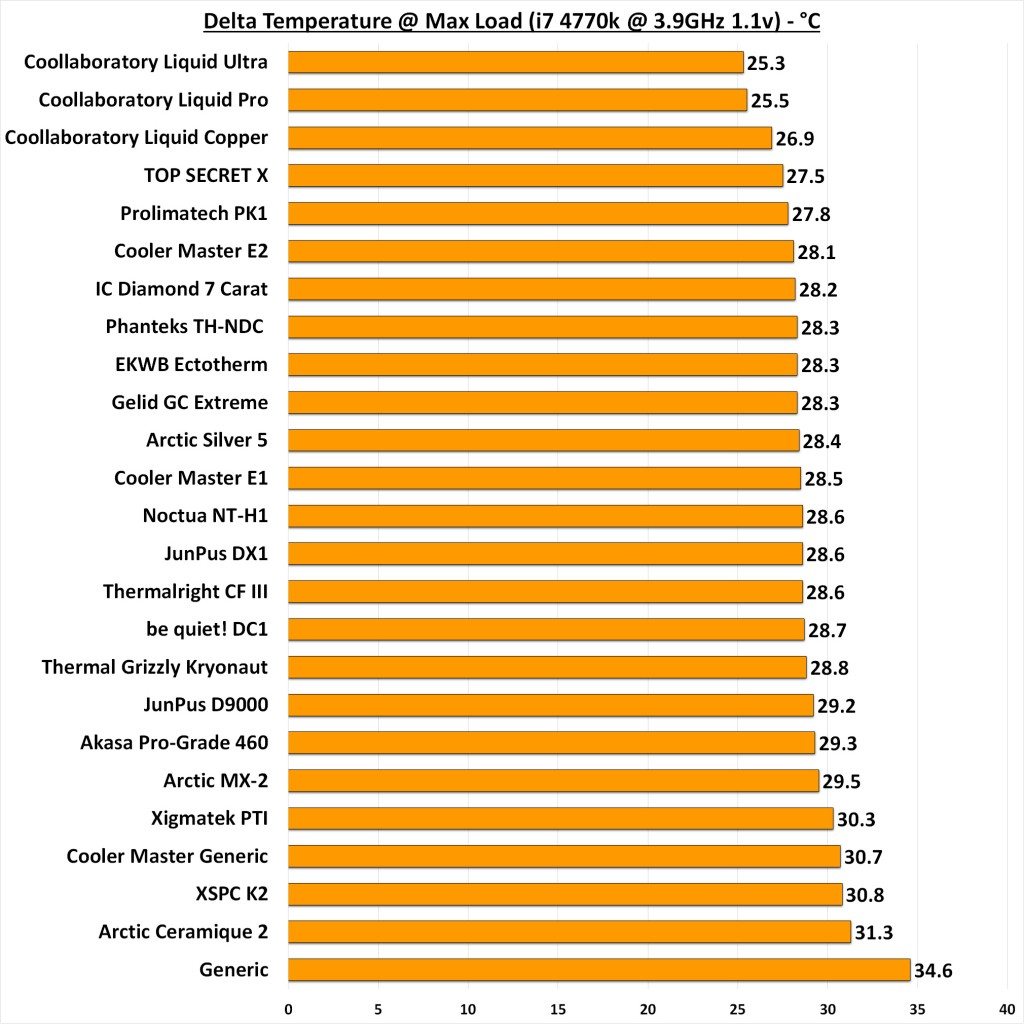
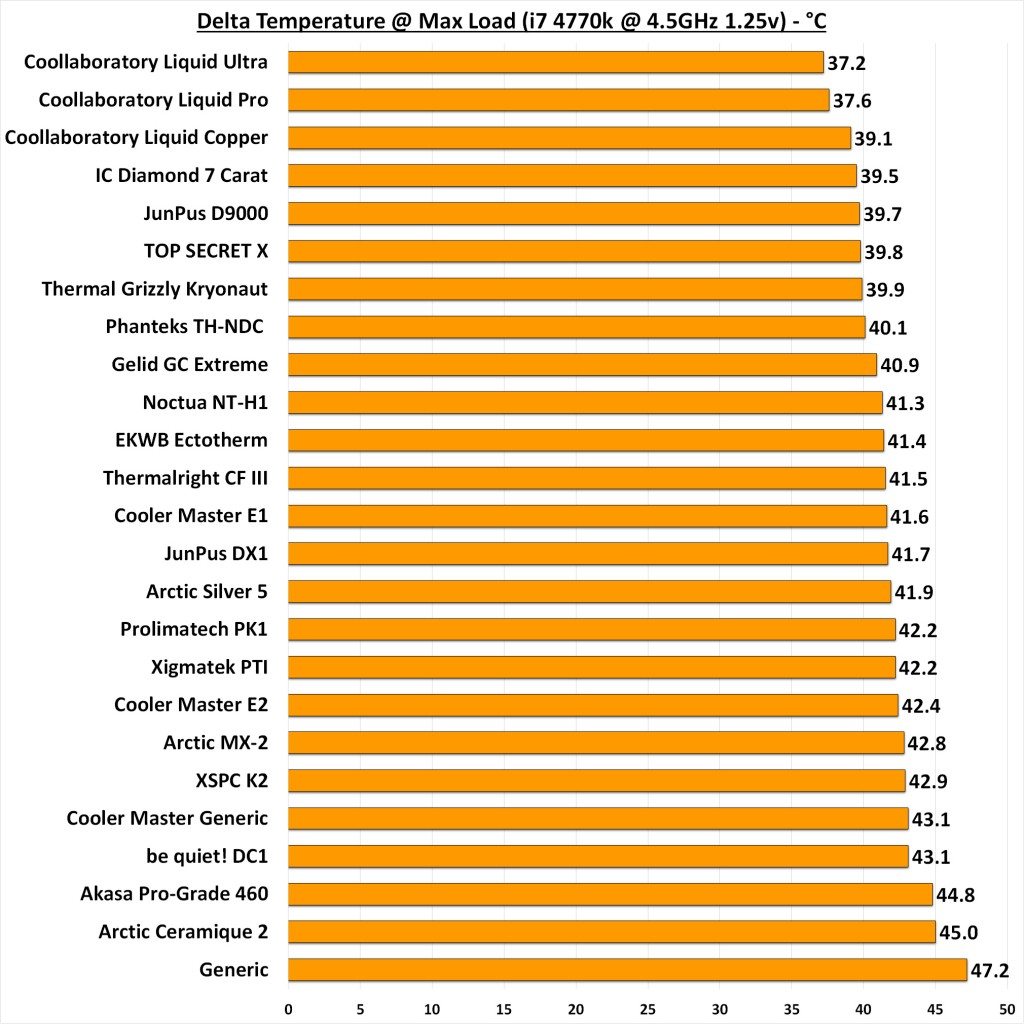
Does it worth to spend 15 € for a 5.5g syringe of Thermal Grizzly Kryonaut?

Tim_test_update1.png


Probably it could be even more than 1°C difference from the Noctua NT-H1, at least 3°C I would like to hope.

nice graph
It's prolly worth it, the price seems comparable to others.
test it for us and let us know 🙂
I've always used AS5 myself without problems.
 
I've been using kyronaut as TIM1 on my Haswell for several months and the performance has only improved.

Much better than NT-H1 on the watercooled GPU as well (8 C rise vs 10 C rise).

Thanks for posting your experience. Unfortunately I'm not going to spend all that money just for 2°C difference for now, but who knows in future. I'd like to have temperature comparisons after 3 weeks, which are more significant in my opinion, since you never know how a new TIM performs over time. 🙂
 
Thanks for posting your experience. Unfortunately I'm not going to spend all that money just for 2°C difference for now, but who knows in future. I'd like to have temperature comparisons after 3 weeks, which are more significant in my opinion, since you never know how a new TIM performs over time. 🙂

Well, just saying that going from +10C to +8C is a 20% decrease in temperature rise. Scale as appropriate for your actual temperature rise in your machine...
 
Just out of curiousity, i'd like to see someone compare a thermal pad like Fujipoly to the pastes.
They claim 11.0 W/mK
 
If anything this topic should have shown that there is a difference between testing well, and reality. More liquid (less viscous) pastes might test better, because they spread thinner, but they likely can pump out and dry out easier.
These so called real-life testing conditions, aren't really scientific, because nobody can replicate them, not all information is shared or known: like the distance between plates, or the volume and mass of paste used.
Also long term testing isn't something that most testers bother with, even though one could return to the same PC every year so after cleaning it to record temperature creep over time.
Absolute physical parameters that would provide a real point of comparison are never tested i.e. thermal conductivity, viscosity (both hot and cold) and others.

 
. . . Absolute physical parameters that would provide a real point of comparison are never tested i.e. thermal conductivity, viscosity (both hot and cold) and others.

Most of us are not able to test such things. The long-term retesting makes sense.
 
Just out of curiousity, i'd like to see someone compare a thermal pad like Fujipoly to the pastes.
They claim 11.0 W/mK

I took a look around for that stuff. The one place I saw selling it (FrozenCPU . . . I'd have serious reservations about them right now) was claiming 17.0 W/mK and thickness of .5mm

If there's anything that's gonna kill the Fujipoly it'll be that thickness. Bondline thickness for a lot of pastes can go below .5mm, with the thickness of stuff like CLU being indescribably tiny.
 
That's a pretty useful tool. Albeit, not very economical at 90 euros.

The guy needs find some machine shop that can mass produce these. Also, I what material is it made from? Some composite or metal? If the latter, I hope the cpu seating surface is non conductive.
 
That's a pretty useful tool. Albeit, not very economical at 90 euros.

The guy needs find some machine shop that can mass produce these. Also, I what material is it made from? Some composite or metal? If the latter, I hope the cpu seating surface is non conductive.

He could probably get the costs way down if he had 10,000 made up in China. Chances are the socket and CPU shape would be obsolete way before he sold that many though.
 
In that case, make the side adjustable so they can fit any size cpu. The rest of the delidding process is the same.
 
I've just applied thermal paste on a 2670QM. I'm just worried: looking at temperatures, it seems there was not noticeable improvement from stock TIM. Maybe the line method was wrong in this case where there is not such a big pressure from heatsink and the die is wider than desktop processors? Probably the TIM didn't reach the corners, but I'm not going to disassembly everything again, too much hassle.
 
You might be in a situation where the limitation is the heatpipe and fan, and the TIM can only do so much. Many laptops are like that. But it would have been prudent to do one test mount followed by disassembly to check for full coverage of the TIM, followed by the actual mount.
 

Probably not a huge market for it I would imagine though...

He could probably get the costs way down if he had 10,000 made up in China. Chances are the socket and CPU shape would be obsolete way before he sold that many though.

You think someone would actually ever sell 10,000 delidding fixtures, which is basically what they are ? Yeah, even if there was a way to standardize the thing or make it adjustable, which would also be doable, I doubt many would really move.
 
Last edited:
You think someone would actually ever sell 10,000 delidding fixtures, which is basically what they are ? Yeah, even if there was a way to standardize the thing or make it adjustable, which would also be doable, I doubt many would really move.

No, I don't. That was the point, he could mass produce them to get costs down and make them cheaper, but even if he did so he'd never be able to sell them all.
 
As was mentioned on the Overclock.Net thread about this, Massdrop or something similar would be ideal, since he would know exactly how many to build and could therefore lower the price as much as is practical.

I'd definitely be interested if it got down to the $30-$40 range. Maybe as much as $60 if it could be adjusted for different sockets.
 
Back
Top