What about them? Nobody is going to consider buying an I3 for rendering work.
Nobody is rendering in CB. Single thread mode in particular!


What about them? Nobody is going to consider buying an I3 for rendering work.

CB is a bench for maxon's cinema 4d which is a 3d rendering suit.
because those are public domain,amateur softwares,they are great tools but they lack the programming skills of an established company.
.
No matter how crappy cinema 4d is it can make better use of cores.Using inferior software (cinema 4d) to measure which CPU is superior seems like not the wise idea.
Reads like "it is easier to bribe the company than to bribe some pesky enthusiast".
But hey, your opinion is just as valid as mine and everones else. :thumbsup:
...for rendering or DC scenarios.That s not the point wich is that there are people here who consider that if the i3 is better in CB ST and the FX better in CB MT then the result is a tie....

Yeah, which is why people are saying Sandy Bridge IPC for Zen. Something like an 8 core Zen with a 3-3.2 Ghz base really would not be that bad for games given that games are starting to use 6 threads pretty effectively. Zen's appeal beyond gamers is really limited though.
...for rendering or DC scenarios.
And you are right it's not a tie and the FX are in a big lead.
But there are also people here who consider that if the FX is better in CB MT and the i3 is better in CB ST then the result is a tie.... for gaming
For modern, relevant video codecs (HEVC, VP9) current AMD CPUs are basically useless. Any currently available AMD CPU going against Intel CPUs in X265 is a pure blood bath.
On their website the x265 HD Benchmark people have ranked CPUs,and an FX8300 CPU is similar clock to clock to an Ivy Bridge Core i7. It looks like you need a 4.8GHZ FX8300 series CPU to match something like a Core i7 4790K,running at 4.0GHZ to 4.4GHZ it appears.x265 HD Benchmark is a benchmark that measures how fast your computer can encode HD (1080p) video in the new H.265 / HEVC format.

Given that an 8320E costs $90 at Micro Center and can be overclocked to that speed I'm not sure it's really such a bloodbath.It looks like you need a 4.8GHZ FX8300 series CPU to match something like a Core i7 4790K,running at 4.0GHZ to 4.4GHZ it appears.
There is no "architecture bias" in Cinebench. Cinebench R11.5 uses MMX, SSE and SSE2 instructions and R15 uses MMX, SSE, SSE2 and SSE3.
AMD CPUs have inferior FPU performance compared to Intel and that's the only reason why they perform bad in Cinebench.
They perform just as bad or even worse in open-source FP heavy application / benchmarks (C-Ray, Rodinia Euler CFD, X265, VP9, etc). In X265 Skylake is around 90% faster than Excavator due the comprehensive AVX2 support. Skylake gets around 30% boost from AVX2 alone, whereas Excavator gets additional performance penalty of 2-5%.
You are discussing the bias, then, by showing that a dichotomy exists.Pov-Ray is integer, X264 is integer, 7-Zip (LZMA) is integer. That's the reason why 15h can keep up even remotely in these tests.

I'm not sure, but when I looked at the code, I think I saw scalar SSE ops in te 64b version. The code also used integer division a lot. Plotting the CPU-Z score/GHz/core did show some nice generational increases between uarchs.Very thanks, dresdenboy. Looks like I misunderstand, the x64 version of CPUZ is executing SIMD instead of pure integer, and using VC++. This is still a bench which is fair enough between different vendors and architecture.
I wonder if x32 version which use both x86 & x87 result is any differ than x64. (x32 ver is a kind of bench similar to superpi though......)
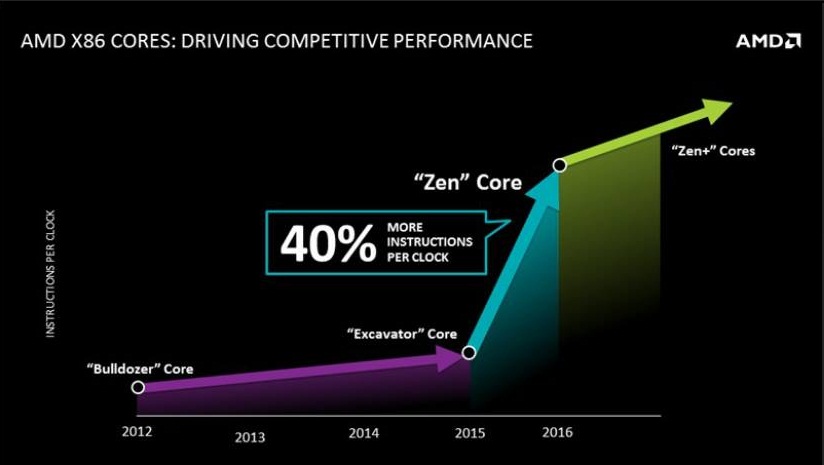
Or lets face it 40% could be best case for a cherry picked benchmark.

I'm assuming that AMD is actually interested in competing. Lisa Su has said, on an earnings conference call, that Zen is on track for "greater than 40% IPC uplift". This is a statement to stockholders, where it would be illegal to flat-out lie. Putting together the existing public statements and filtering them with common sense and what we know about the Zen architecture so far from Dresdenboy's analysis and others, it seems reasonable that we'll be seeing more than 40% IPC improvements in FPU-heavy applications, and less in integer-heavy applications where BD already does acceptably well.
AMD needs at least Sandy Bridge-level IPC to compete, and they know it. Creating a hype train and letting down customers again like they did with Bulldozer is a ticket to bankruptcy, and they know that too. They are betting the company on Zen, and if it's not at least reasonably competitive, they're finished.

Yep, we already see datacenters selling out of old hardware that Zen may actually match if they are lucky.
SB performance, IB performance/watt perhaps.
And we are back to a gaming CPU that requires OC to be relevant.
For modern, relevant video codecs (HEVC, VP9) current AMD CPUs are basically useless. Any currently available AMD CPU going against Intel CPUs in X265 is a pure blood bath.
Pov-Ray is integer, X264 is integer, 7-Zip (LZMA) is integer. That's the reason why 15h can keep up even remotely in these tests.
She said "greater than 40% IPC uplift" in reference to their prior generation server architecture, which was Piledriver.
Interesting how subtle the manipulation on AMD's part is.

What about them? Nobody is going to consider buying an I3 for rendering work.
Actually not really any manipulation happening,if you look at both of the charts/graphs.
They said 40% over Exacavator and over 40% versus Piledriver.
Last time I checked that is factually correct,since Excavator is faster than Piledriver.
I think if the IPC is close to sandy bridge the clock better be closer to 4GHz than 3GHz and 6+ threads to make it really interesting for gaming (with competitive pricing)
Yeah it's very factual them not showing you any numbers(difference between bull and exc) on this graph so you can't figure out if they mean single or multi core,40% faster core or 40% when the whole CPU is working.
The suspected more pipelines plus smt plus targeted server market sure seems to point towards the second case.
And we don't have any solid information yet on what clock speeds will be like. AMD has historically cranked them up as high as they reasonably can.





 Facebook
 Twitter