• We’re currently investigating an issue related to the forum theme and styling that is impacting page layout and visual formatting. The problem has been identified, and we are actively working on a resolution. There is no impact to user data or functionality, this is strictly a front-end display issue. We’ll post an update once the fix has been deployed. Thanks for your patience while we get this sorted.

Discussion Arrow Lake Builder's thread

Page 11 - Seeking answers? Join the AnandTech community: where nearly half-a-million members share solutions and discuss the latest tech.
The 8% increase of Geekbench score makes me think it goes beyond code layout opimizations.
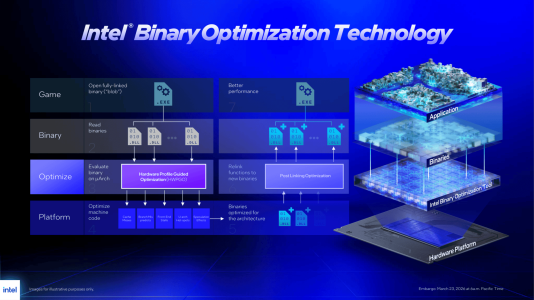
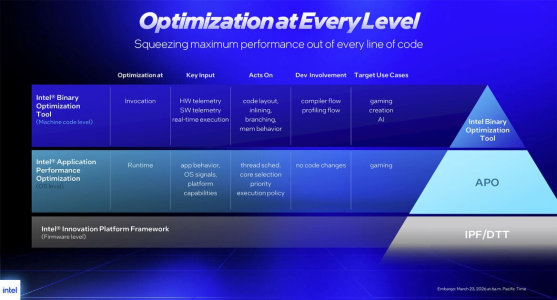
Would you say it's BOLD on steroids? Their own marketing says this:1774279941268.png

BOLT says it focuses on layout optimization only, but they were able to demonstrate 10% gains in clang compilation speed on top of PGO+LTO mix.

That's 22.61 seconds (or 12%) faster compared to the PGO+LTO build.Notice that we are measuring an improvement of the total build time, which includes the time spent in the linker.Compilation time improvements for individual files differ, and speedups over 15% are not uncommon.If we run BOLT on a Clang binary compiled without PGO+LTO (in which case the build is finished in 253.32 seconds),the gains we see are over 50 seconds (25%),but, as expected, the result is still slower than PGO+LTO+BOLT build.

Of course, I might have fixated myself on BOLT similarities but really feels to me, Intel must have at least partially used that seeing their own compiler is fork of LLVM/clang and it META developed BOLT with Intel CPU's in mind back in the day😉
 
The 8% increase of Geekbench score makes me think it goes beyond code layout opimizations. And I wouldn't be surprised if these 8% are close to the upper bound of what we'll see with that tool (yes, I'm implying a non-negligible amount of time has been dedicated to Geekbench in particular, and likely some other benchmarks).
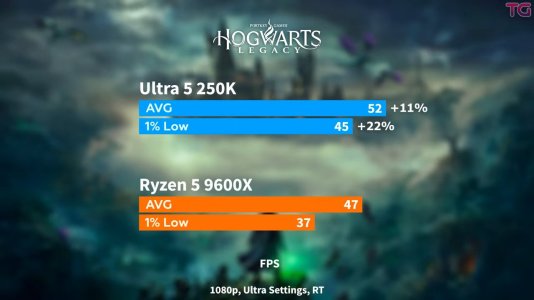
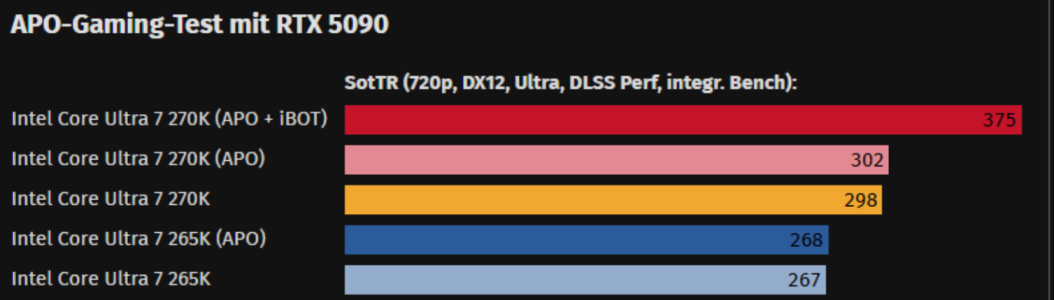
Well there is 25% FPS increase in SOTR
1774282101208.png
 
Well there is 25% FPS increase in SOTR
That much performance increase needs to be investigated. Is it really due to code optimization or does SotTR have threads that stubbornly stick to E-cores which is getting fixed by APO+iBOT? The easiest way I can think of is to disable the E-cores and see if the perf improvement still holds to the same degree.
 
Would you say it's BOLD on steroids? Their own marketing says this:View attachment 140552

BOLT says it focuses on layout optimization only, but they were able to demonstrate 10% gains in clang compilation speed on top of PGO+LTO mix.


Of course, I might have fixated myself on BOLT similarities but really feels to me, Intel must have at least partially used that seeing their own compiler is fork of LLVM/clang and it META developed BOLT with Intel CPU's in mind back in the day😉
I agree the slide certainly makes it look like it's similar to what BOLT does. The clang improvements would certainly improve the GB subtest, but many of them are too small to show that 8% increase on the score. My guess (and I insist, it's only that: a guess) is that they went further, be that for valid optimizations that will benefit many programs or some more targetted ones to shine on some selected benchmarks. Time will tell 🙂
 
That much performance increase needs to be investigated.
The GB score is an average of tests that might also see high variance between vanilla binaries and BOT.

In fact, let's quickly search the Techpowerup scores in the GB database and see if they pop up... bingo?

The memory kits used for the two tests are different, yet both ST and MT scores match.
 
Some good information here regarding iBOT
The same generic stuff that's mentioned elsewhere. The video in the other thread, basically make it sound like BOLT (I know, I know, I got stuck) but they underline their are optimizing binary layout. I also wonder which generation of Intel CPU was supposed to get branch hints back? I guess they could filp the hint bits based on the profiling data in addition😉

I just wonder why the press is making it sound as if the tool is actively "in real time" monitoring the running application and improving it's performance when the slides tell a different story, with them most likely supplying optimized binaries for those 12 programs. (which makes sense since they have to do the profiling in their lab). I mean it can inject dlls at runtime into the original game process if the .exe itself is not rewritten, but that would be enough to trigger anti-cheat software.
 
It looks like soon enough we'll have plenty of drama with that Binary Optimization Tool:
Have no fear, drama is here!

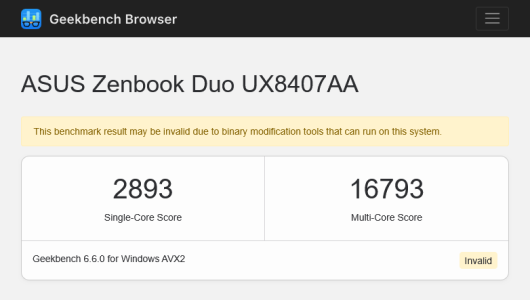
All results from CPUs that support iBOT have been market as invalid (including the one submission from macOS). This includes supported Panther Lake CPUs like the 386H.

1774414773083.png

I think Intel did a good job at introducing this tool in a way that is acceptable for consumers but they failed to gauge the impact it would have on Geekbench.

Very curious to see what happens next, my guess is Intel will retract the iBOT profile for GB and all current ARL and PTL scores from supported CPUs will stay invalid or be deleted from the database.
 
I think Intel did a good job at introducing this tool in a way that is acceptable for consumers but they failed to gauge the impact it would have on Geekbench.

Very curious to see what happens next, my guess is Intel will retract the iBOT profile for GB and all current ARL and PTL scores from supported CPUs will stay invalid or be deleted from the database.
I'm very curious of how Intel achieved that speedup on GB. Did they cheat like they did with ICC targetting Antutu with unrealistic optimizations back in the Atom days or targetting SPEC which forced them to remove 2600 results from their DB? Or are there some valid things Primate Labs should pick?

Edit: for reference here's the post I made back then showing how icc cheated on Antutu: https://forums.anandtech.com/threads/antutu-and-intel.2330027/post-35295057
The whole thread by Exophase is worth a read.
 
Last edited:
I'm very curious of how Intel achieved that speedup on GB. Did they cheat like they did with ICC targetting Antutu with unrealistic optimizations back in the Atom days or targetting SPEC which forced them to remove 2600 results from their DB? Or are there some valid things Primate Labs should pick?
Same but it's a black box right now also this might result in valid benchmarks marked invalid.

Anyway Intel did a nice job of not screwing with this one that can cause end user issue by enabling it everywhere.
 
I do hope people understand that Intel have just pulled a Radeon.
They are effectively offering their flagship for $300, unless NVL bLLC is competitive with Z6X3D in gaming, then the reference point for consumers will be ARL+.
NVL will be worse perf/$ without question, though people will now expect a NVL refresh a year later with similar perf/$ for a more expensive part, and this is just talking 1 tile, 2 tile is oof.

This is the exact trap ATi/AMD fell for with the 4870, except they actually had the best uArch but didn't go big enough.
They finally went big enough with 290X which came with the associated ASP hike but by that time Radeon was already viewed as the value brand and thus consumers were not willing to spend that kinda money on a Radeon.

Here Intel is making a psuedo 4870 right before trying to build a 5870x2 and expecting people to pay accordingly, but now the value perspective of Intel has change sharply, they are ceding the high end ASPs to AMD for the first time ever in client CPU even if only for a year.

This is different to when AMD scaled core counts heavily with Ryzen early on, back then MT perf was a genuine limitation for many customers, especially at the lower end where 2 cores was still common.

Now core counts are very healthy for current workloads, scaling them 2x again means very little to most consumers.
Memory bandwidth is the biggest issue now.

People expecting AMD to react pricing wise with any of their parts is foolish unless sales absolutely tank, they have the halo part and thus objectively inferior parts lower down the stack will continue to beat Intel in sales.

I know this because NV has done this for over a decade because they have the fastest part up top.
You play to win or you pick up value scraps and have that be your reputation.

Intel is the Bulldozer now, only took 15 years for the tables to completely flip.
 
I do hope people understand that Intel have just pulled a Radeon.
They are effectively offering their flagship for $300, unless NVL bLLC is competitive with Z6X3D in gaming, then the reference point for consumers will be ARL+.
NVL will be worse perf/$ without question, though people will now expect a NVL refresh a year later with similar perf/$ for a more expensive part, and this is just talking 1 tile, 2 tile is oof.
They are spending lots on bLLC if it doesn't pan out it's going to cost a lot
 
I do hope people understand that Intel have just pulled a Radeon.
They are effectively offering their flagship for $300, unless NVL bLLC is competitive with Z6X3D in gaming, then the reference point for consumers will be ARL+.
NVL will be worse perf/$ without question, though people will now expect a NVL refresh a year later with similar perf/$ for a more expensive part, and this is just talking 1 tile, 2 tile is oof.

This is the exact trap ATi/AMD fell for with the 4870, except they actually had the best uArch but didn't go big enough.
They finally went big enough with 290X which came with the associated ASP hike but by that time Radeon was already viewed as the value brand and thus consumers were not willing to spend that kinda money on a Radeon.

Here Intel is making a psuedo 4870 right before trying to build a 5870x2 and expecting people to pay accordingly, but now the value perspective of Intel has change sharply, they are ceding the high end ASPs to AMD for the first time ever in client CPU even if only for a year.

This is different to when AMD scaled core counts heavily with Ryzen early on, back then MT perf was a genuine limitation for many customers, especially at the lower end where 2 cores was still common.

Now core counts are very healthy for current workloads, scaling them 2x again means very little to most consumers.
Memory bandwidth is the biggest issue now.

People expecting AMD to react pricing wise with any of their parts is foolish unless sales absolutely tank, they have the halo part and thus objectively inferior parts lower down the stack will continue to beat Intel in sales.

I know this because NV has done this for over a decade because they have the fastest part up top.
You play to win or you pick up value scraps and have that be your reputation.

Intel is the Bulldozer now, only took 15 years for the tables to completely flip.
This is only for DIY though. Intel still has mindshare in laptop and business.

NV owns both DIY and laptop and enterprise.
 
Back
Top