• We’re currently investigating an issue related to the forum theme and styling that is impacting page layout and visual formatting. The problem has been identified, and we are actively working on a resolution. There is no impact to user data or functionality, this is strictly a front-end display issue. We’ll post an update once the fix has been deployed. Thanks for your patience while we get this sorted.

Discussion ARM Cortex/Neoverse IP + SoCs (no custom cores) Discussion

Page 2 - Seeking answers? Join the AnandTech community: where nearly half-a-million members share solutions and discuss the latest tech.
They still have an architectural license for ARM as far as I'm aware. It makes sense that they'd want to keep ARM independent though. In terms of "best for AMD", I'd rank the outcomes like this:

  1. AMD remains part of the x86 duopoly, and ARM servers don't really penetrate the mainstream outside of hyperscalers
  2. AMD competes as an ARM server CPU provider in an open and vibrant ARM market
  3. AMD has to compete in a market dominated by a hostile ARM controlled by e.g. Nvidia
This investment is a hedge so that if (1) doesn't work out, they get outcome (2) instead of (3).
Precisely. AMD have also clearly stated that they don't mind making ARM processors for clients if they ask for it. At the end of the day, AMD is happy and willing to make semi-custom parts for anyone who asks, regardless if it's x86 or ARM. If someone reaches out to them to ask for a custom ARM core, they'd do it.
 
Screenshot_20230927_231934_YouTube.jpg
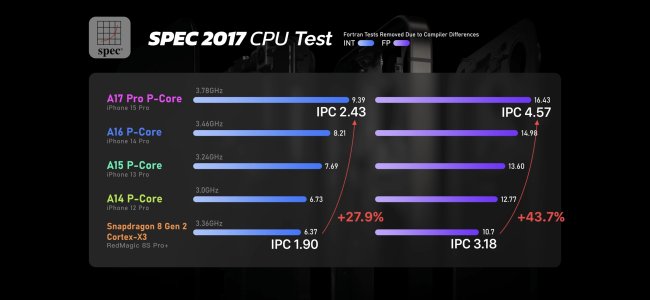
Apple A17-P has a 30%+ lead in IPC over the ARM Cortex X3.

How long will it take for ARM to close this gap, if they ever will?
 
Last edited:
We won't even see it in action till SD8 Gen 3 next year, and given IPC can change based on cache configuration we can't take ARM numbers as a given without knowing Qualcomm's choices there.
Interesting point. How big will the IPC gain be from a bigger cache? I really wonder sometimes what would happen if ARM'S cores aren't starved like they are.

Also I presume the size of the SLC also has an effect on CPU IPC then?
 
Interesting point. How big will the IPC gain be from a bigger cache? I really wonder sometimes what would happen if ARM'S cores aren't starved like they are.

Also I presume the size of the SLC also has an effect on CPU IPC then?
Can't be sure, ARM usually give only one set of figures which I would presume to be the ideal configuration.

Size, speed and latency of the cache would affect CPU µArch IPC yes, though not equally across all workloads as the Ryzen X3D benches show.
 
View attachment 86384
Apple A17-P has a 30%+ lead in IPC over the ARM Cortex X3.

How long will it take for ARM to close this gap, if they ever will?
I don't see the attachment... Did it unlink?

As for how long will it take for ARM to close the gap, judging by how Apple's so called crack CPU design team seems to have lost a bunch of talent, I'd say not too long. If Apple is only able to muster meager low single digit IPC gains from here on out, I think ARM can catch up in 3 generations.
 
I don't see the attachment... Did it unlink?

As for how long will it take for ARM to close the gap, judging by how Apple's so called crack CPU design team seems to have lost a bunch of talent, I'd say not too long. If Apple is only able to muster meager low single digit IPC gains from here on out, I think ARM can catch up in 3 generations.
Apple Silicon team lost CPU talent but they have been hiring a lot of GPU engineers from ex Nvidia. Their focus seems to turned to GPU and AI/NPU.

I would say the next lot Apple silicon will focus on GPU/Ray tracing and NPU.

So in saying that by X6 ARM should catch if Apple maintains it's current pace for cpus
 
We won't even see it in action till SD8 Gen 3 next year, and given IPC can change based on cache configuration we can't take ARM numbers as a given without knowing Qualcomm's choices there.
ARM should partner with the Raspberry Pi foundation and put out a demo SBC each generation that contains their latest and greatest. Quite often their licensees drop the ball when it comes to performance and efficiency, ESPECIALLY QUALCOMM.
 
chrome_screenshot_1695934430450.pngchrome_screenshot_1695934397239.png
3 years of the Cortex-X core program and what has ARM achieved?

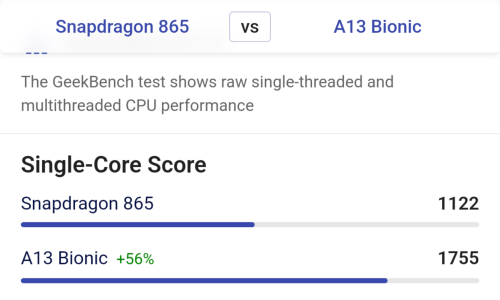
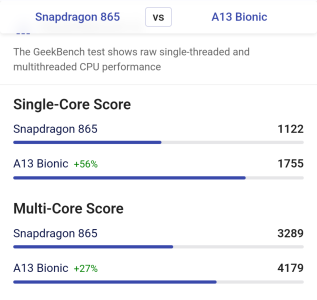
Apple A13 is about 50% faster than the SD865, which had a Cortex A77 prime core.

Then ARM introduced the Cortex X series to improve single-core performance and catch upto Apple.

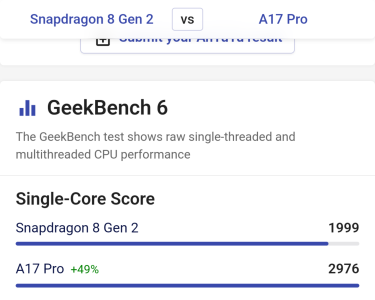
3 years later, it's SD8G2 vs A17Pro. The gap is still the same- the Apple still retains a 50% lead!

And that with an asterisk too- the listed score for the 8G2 seems to be a generous one from a good bin, because as seen in reviews most 8G2 phones are doing 1800-1900 points.

 

Attachments

  • chrome_screenshot_1695934430450.png
    chrome_screenshot_1695934430450.png
    373 KB · Views: 7
View attachment 86447View attachment 86448
3 years of the Cortex-X core program and what has ARM achieved?

Apple A13 is about 50% faster than the SD865, which had a Cortex A77 prime core.

Then ARM introduced the Cortex X series to improve single-core performance and catch upto Apple.

3 years later, it's SD8G2 vs A17Pro. The gap is still the same- the Apple still retains a 50% lead!

And that with an asterisk too- the listed score for the 8G2 seems to be a generous one from a good bin, because as seen in reviews most 8G2 phones are doing 1800-1900 points.
Hence why I said it would take ARM three generations to catch up to Apple, assuming Apple doesn't improve their P cores all too much. It would amount to ~15% IPC gains per year.
 
View attachment 86447View attachment 86448
3 years of the Cortex-X core program and what has ARM achieved?

Apple A13 is about 50% faster than the SD865, which had a Cortex A77 prime core.

Then ARM introduced the Cortex X series to improve single-core performance and catch upto Apple.

3 years later, it's SD8G2 vs A17Pro. The gap is still the same- the Apple still retains a 50% lead!

And that with an asterisk too- the listed score for the 8G2 seems to be a generous one from a good bin, because as seen in reviews most 8G2 phones are doing 1800-1900 points.
SD 8 Gen 2 is from last year, 8 Gen 3 will be released less than a month, that will be fair comparison with A16.

Difference between 8 Gen 2 and A15 wasn't much, Arm did close a gape, and X4 will have around 15% IPC + clock speed bump difference will be even smaller this year. If trend continue by next year Arm core may match Bionic one.
 
Not super relevant, but interesting disclosure about Arm's IPO's "cornerstone investors" was released today (in alphabetical order)
  1. AMD
  2. Apple
  3. Cadence
  4. Google
  5. Intel
  6. MediaTek
  7. NVIDIA
  8. Samsung
  9. Synopsys
  10. TSMC
Conspicuously, no Microsoft nor Amazon. AMD is the most curious one: beyond RDNA2 in Samsung's smartphone SoCs, what business does AMD have with Arm beyond some Xilinx stuff?
All AMD Zen chips, Stoney Ridge, Bristol Ridge, and Carrizo have ARM Cortex A5 "TrustZone" cores present. It varies in location but is always there.

Zen 1, EPYC 7001, Stoney, Bristol, and all Zen APU's had the A5 present on the main die. For a 4 die 7601, there are 4x Cortex A5's present.
Zen 2, 3, and 4 CPU's have an A5 present on the I/O die.
EPYC 7002,7003,7005, Sienna, and Bergamo have A5's on the I/O die.

Beema/Mullins in 2014 also had a PSP but it wasn't enabled on consumer products (Source). AMD has been on the TrustZone train for over a decade.
 
Last edited:
SD 8 Gen 2 is from last year, 8 Gen 3 will be released less than a month, that will be fair comparison with A16.
A17 you mean?

Difference between 8 Gen 2 and A15 wasn't much, Arm did close a gape, and X4 will have around 15% IPC + clock speed bump difference will be even smaller this year. If trend continue by next year Arm core may match Bionic one.
No chance. The gap is too huge to be closed by a 15% IPC gain.

In Geebench SC, SD8G2 scores 1900. A17 Pro does 2900. 15% IPC and some clock boost on top can't cover that gap.
 
A17 you mean?


No chance. The gap is too huge to be closed by a 15% IPC gain.

In Geebench SC, SD8G2 scores 1900. A17 Pro does 2900. 15% IPC and some clock boost on top can't cover that gap.
Yes A17,

We don't know how much frequency Sd 8 gen 3 will have but early 3.3Ghz score from geekbench 6 is around 2200, there was rumor of 8 gen 3 variant with 3.7ghz. So 2300-2500 single core this generation is doable.
 
3 years of the Cortex-X core program and what has ARM achieved?

Apple A13 is about 50% faster than the SD865, which had a Cortex A77 prime core.

Then ARM introduced the Cortex X series to improve single-core performance and catch upto Apple.

3 years later, it's SD8G2 vs A17Pro. The gap is still the same- the Apple still retains a 50% lead!

And that with an asterisk too- the listed score for the 8G2 seems to be a generous one from a good bin, because as seen in reviews most 8G2 phones are doing 1800-1900 points.

That comparison is not fair.

Snapdragon 865 was released in 2019 (november 15) vs 2019 (september 10) for apple's A13.


Snapdragon 8 gen 2 was released 2022 (november 15) vs 2023 (september 26) for apple's A17.

For a more accurate comparison you need to wait until november for the Snapdragon 8 gen 3.

I'm estimating 2200-2300 score (IPC + high freq increase), that would means the A17 is 'just' 28-30% faster.

Apple does not retain its perf advantages, apple cores are stagnant.
 
ARM should partner with the Raspberry Pi foundation and put out a demo SBC each generation that contains their latest and greatest. Quite often their licensees drop the ball when it comes to performance and efficiency, ESPECIALLY QUALCOMM.

That sounds great, but Raspberry Pi SBCs still rely on SoCs produced by other ARM licensees. The Pi 4 uses a Broadcom chip. Unless Broadcom (or someone else) shows an interest in supplying a run of SoCs for those demo boards then it's not gonna happen.
 
That sounds great, but Raspberry Pi SBCs still rely on SoCs produced by other ARM licensees. The Pi 4 uses a Broadcom chip. Unless Broadcom (or someone else) shows an interest in supplying a run of SoCs for those demo boards then it's not gonna happen.
RPi5 also uses a Broadcom SoC with their homegrown VideoCore GPU that basically no one else actually uses but RPi at this point.
 
RPi5 also uses a Broadcom SoC with their homegrown VideoCore GPU that basically no one else actually uses but RPi at this point.
What this really means is: if someone wanted Raspberry Pi SBCs with something like an SoC with X4 cores on it, Broadcom would first have to agree to produce and provide those SoCs at a price that made sense. And in turn the Pi Foundation would have to agree to lay out the cash for a run of boards with those SBCs even if the margins were thin-to-none. Those stars haven't lined up yet.
 
What this really means is: if someone wanted Raspberry Pi SBCs with something like an SoC with X4 cores on it, Broadcom would first have to agree to produce and provide those SoCs at a price that made sense. And in turn the Pi Foundation would have to agree to lay out the cash for a run of boards with those SBCs even if the margins were thin-to-none. Those stars haven't lined up yet.
True.

I'm halfway hoping that with so many SoC designers leaving ARM Mali that they will lower the licensing price to the point that RPi6's SoC could have it considering all the work that is currently going into the Panfrost and PanVK drivers is making current gen GPUs accessible for OSS.
 
I'm halfway hoping that with so many SoC designers leaving ARM Mali

Funny you should mention that:

 
Funny you should mention that:

Lol no wonder they have been so supportive of the Panfrost driver recently! 😅
 
Yes A17,

We don't know how much frequency Sd 8 gen 3 will have but early 3.3Ghz score from geekbench 6 is around 2200, there was rumor of 8 gen 3 variant with 3.7ghz. So 2300-2500 single core this generation is doable.
With 0% IPC gain that’s what you’d get, about 2500. But the IPC gain on Geekbench should be about 9-12% last I checked. The gains on GB usually outweigh their spec gains with Arm or did before. At any rate they could absolutely close the gap to like ~ 200 points with a similar clockspeed as Apple.
 
Back
Top