• We’re currently investigating an issue related to the forum theme and styling that is impacting page layout and visual formatting. The problem has been identified, and we are actively working on a resolution. There is no impact to user data or functionality, this is strictly a front-end display issue. We’ll post an update once the fix has been deployed. Thanks for your patience while we get this sorted.

Discussion Apple Silicon SoC thread

Page 475 - Seeking answers? Join the AnandTech community: where nearly half-a-million members share solutions and discuss the latest tech.

Eug

Lifer
M1
5 nm
Unified memory architecture - LP-DDR4
16 billion transistors

8-core CPU

4 high-performance cores
192 KB instruction cache
128 KB data cache
Shared 12 MB L2 cache

4 high-efficiency cores
128 KB instruction cache
64 KB data cache
Shared 4 MB L2 cache
(Apple claims the 4 high-effiency cores alone perform like a dual-core Intel MacBook Air)

8-core iGPU (but there is a 7-core variant, likely with one inactive core)
128 execution units
Up to 24576 concurrent threads
2.6 Teraflops
82 Gigatexels/s
41 gigapixels/s

16-core neural engine
Secure Enclave
USB 4

Products:
$999 ($899 edu) 13" MacBook Air (fanless) - 18 hour video playback battery life
$699 Mac mini (with fan)
$1299 ($1199 edu) 13" MacBook Pro (with fan) - 20 hour video playback battery life

Memory options 8 GB and 16 GB. No 32 GB option (unless you go Intel).

It should be noted that the M1 chip in these three Macs is the same (aside from GPU core number). Basically, Apple is taking the same approach which these chips as they do the iPhones and iPads. Just one SKU (excluding the X variants), which is the same across all iDevices (aside from maybe slight clock speed differences occasionally).

EDIT:

Screen-Shot-2021-10-18-at-1.20.47-PM.jpg

M1 Pro 8-core CPU (6+2), 14-core GPU
M1 Pro 10-core CPU (8+2), 14-core GPU
M1 Pro 10-core CPU (8+2), 16-core GPU
M1 Max 10-core CPU (8+2), 24-core GPU
M1 Max 10-core CPU (8+2), 32-core GPU

M1 Pro and M1 Max discussion here:


M1 Ultra discussion here:


M2 discussion here:


Second Generation 5 nm
Unified memory architecture - LPDDR5, up to 24 GB and 100 GB/s
20 billion transistors

8-core CPU

4 high-performance cores
192 KB instruction cache
128 KB data cache
Shared 16 MB L2 cache

4 high-efficiency cores
128 KB instruction cache
64 KB data cache
Shared 4 MB L2 cache

10-core iGPU (but there is an 8-core variant)
3.6 Teraflops

16-core neural engine
Secure Enclave
USB 4

Hardware acceleration for 8K h.264, h.264, ProRes

M3 Family discussion here:


M4 Family discussion here:


M5 Family discussion here:

 
Last edited:

Mobilesyrup said:
For most of my time using the MacBook Neo, the RAM wasn’t a big issue. Common tasks like browsing the web and writing documents were fast and fluid, and as I mentioned above, I could even edit images in Photoshop with minimal issues. But if you put all that together, you’ll start to feel it.

At one point in my testing, I had a handful of apps open, including Safari with a bunch of tabs, Photoshop, two Microsoft Word documents, and Notion — pretty typical for my usual workflow. Even with just those four apps open, I could feel the sluggishness in Safari while jumping between tabs and editing a story. Granted, Photoshop is a bit of a memory hog, and when I closed it down, performance got noticeably better across the board.
 
I stand by my original take that the next version will be something that can up the game, and be truly compelling in that customer segment. A19 Pro with 12GB would be a huge winner.

But I do think this will still sell quite well.
 
Last edited:
64 bit processor are not that weak, the issue is the optimization... is not that optimized, guess I'll wait for the Neo 2, it might come fixxed
Yeah exactly. The memory packaging (on top of the CPU die) is the reason why it throttles.
it’s a 64-bit SoC. It will choke it’s not meant for anything remotely other than a SIMPLE one task at a time.
I often see similar claims on hardware reddit (getting considerable upvotes) probably from people who have only owned PCs quite recently. E.g. you can't multitask at all with single channel RAM or below 8 cores.

Once upon a time you could multitask (not perfectly but it was absolutely doable) on a single core cpus with 266 MT/s SDR (2.1 GB/s bandwidth) on slow HDDs.

Let's compare the peak bandwidth of some average systems from yesteryear:

Processor / EraRelease YearMemory TypeInterface WidthTransfer RatePeak Bandwidth
Athlon XP 2100+2002DDR64-bit (Single)266 MT/s2.1 GB/s
Athlon 642004DDR128-bit (Dual)400 MT/s6.4 GB/s
Core 2 Duo2006-2008DDR2128-bit (Dual)800 MT/s12.8 GB/s
Sandy Bridge2011DDR3128-bit (Dual)1600 MT/s25.6 GB/s
Ryzen 5 3600X2019DDR4128-bit (Dual)3200 MT/s51.2 GB/s
Apple A18 SoC2024LPDDR5X64-bit7500 MT/s60.0 GB/s

This 64bit SoC has around the same memory bandwidth that an average Zen 2/Zen 3 rig has. Those still multitask just fine.

Should you use this 8GB laptop for any serious power-user stuff? Absolutely not! Actually using 4+ electron apps for a while would absolutely cause issues on it down the line. But claiming that this can only do "a single thing at a time" is absolutely hyperbole

The memory interface has tons of bandwidth even at 64bit width. If anything, the memory capacity is the problem and 12GB would solve most of it for average joes.
 
Three ports for casuals under the sky,

Six cores for vibe coders in their home studio,

8 GB for mortal users doomed to die,

One Macbook, for students on the go,

In the land of Apple, where the markups lie,

One Macbook to rule them all, one Macbook to find them,

One device to sync them all, and in the ecosystem to bind them,

In the land of Apple, where the markups lie.


Inspired by the signature poem of the Lord of the Rings.
 
in all seriousness, it throttles because the RAM is on top of the package.

Another reason why the A20 Pro is moving away from this method of packaging
Even if A19 Pro throttles somewhat, it should still be a big improvement, not just because of the 12 GB RAM or incremental CPU speed boost, but also because of the massive increase in GPU (and AI) performance. I also wonder if they’d adopt a vapor chamber design for the new 2027 (?) A19 Pro Neo.

Also, storage speed may improve. Tests show the storage speed of the 512 GB A18 Pro Neo are roughly similar to the 256 GB, which I guess makes sense since it’s just a single NAND chip. However, in the past, 512 GB iPhones were supposedly usually faster than 256 GB iPhones, and apparently the 512 GB A19 Pro’s storage speed is significantly faster than the 256 GB A19 Pro's.


Testing revealed that the 17 256GB, 17 Pro 256GB, and 17 Promax 256GB all use slow flash memory (with AnTuTu scores of 90,000-100,000 points), while the 512GB and 1TB models use high-speed flash memory (around 150,000 points). The 17 Promax 2TB model hasn't been tested, but it's definitely high-speed.
 
Last edited:
The plot thickens:
Hopefully this rumor is incorrect. Won’t take much longer before we see the CADs to verify it. If true though, it makes my decision to wait for next year more satisfying.
 
The Macbook Neo upends the years long tradition of $600 laptops having washed out, low resolution, low brightness displays that looked like they came from an ATM.

While this is true and the Neo does have a good screen, there have been a lot of advances in displays in the last half decade. It won't be too long before the Neo display is viewed in the same way. If they're still using the same display by the third generation reviewers will start complaining about it.
 
I'm setting up my old iPhone 12 Pro Max for my kid to use. It's on iOS 26.3.1 and I had completely wiped it a while back so it's no longer indexing. Battery is good (as it was replaced not too long ago).

It's quite noticeably laggy, more so than I had remembered from last year. I'm not sure if it's due to the 6 GB RAM or the A14 or both. Or maybe it's because owning a 17 Pro with A19 Pro and 12 GB RAM for a while has really skewed my perception of performance on these phones.
 
Is it possible it's related to iOS 26? That wasn't a factor a year ago.
Yeah, that was my first thought as well. iOS 26 is definitely more resource intensive, though 26.3.1 is supposed to be better. I think the situation will improve with 27, since they’re going bug hunting and optimizing more for performance.

On 26.0 and 26.1, even on my 16 Pro Max I noticed some hitching here and there.

With Low Power Mode enabled still I see a decent amount of lag, more than iOS 18.
 
Is it possible it's related to iOS 26? That wasn't a factor a year ago.
Yeah, that was my first thought as well. iOS 26 is definitely more resource intensive, though 26.3.1 is supposed to be better. I think the situation will improve with 27, since they’re going bug hunting and optimizing more for performance.

On 26.0 and 26.1, even on my 16 Pro Max I noticed some hitching here and there.

With Low Power Mode enabled still I see a decent amount of lag, more than iOS 18.
I remember iOS 26.0 feeling laggy on the 12 Pro Max, more so than iOS 18, but this feels worse than I originally remember from September. I haven't used the 12 Pro Max at all since 26.0, since I had upgraded to a 17 Pro by then. The light stutteriness with some actions stands out. I do wonder if it's partially the ProMotion I now have on the 17 Pro that alters the perception, but I don't think that's it, as I don't mind 60 Hz at all on my Macs.

On other note, if even my phone now has 12 GB RAM, it just seems odd to buy a Mac with less RAM.
 
To be fair, I am expecting the A20 going to 2+6 core Config
Or 2P+2M+2E. Or 2P+4M.
Truth is none of us know!

None of us predicted the M core, which should make us a little humble about predictions of this sort - best we can do is throw out possibilities that seem interesting.

An additional wrinkle is that going forward A Pro chips will service both phones and macBook Neo. Which will exert a little bit of pressure to boost their capabilities...
Maybe A chips will stay as 2P+4E, while A Pro will move up 2P+4M?
Or E line stops being developed, but A chips are 2P+2M?
 
To be fair, I am expecting the A20 going to 2+6 core Config

Not sure if its always been you, but I've seen people predicting that here every year since I created my account here six years ago and it keeps not happening.

Now that they have a third core type available to them I could see them changing from 2P4E but I'd be willing to bet heavily that change is not to 2P6E.
 
Or E line stops being developed, but A chips are 2P+2M?

There will always be plenty of role for a more efficient core. We haven't yet seen detailed comparison of M cores with E cores power/performance wise, but you can be sure the increase in performance is dwarfed by the increase in power.

Don't they use the E cores for the watch? Plus there have been rumors about Apple developing other wearable stuff like the stupid "AI pin" idea others are pursuing that will have minimal space for a battery and demand the most efficient cores possible.
 
Not sure if its always been you, but I've seen people predicting that here every year since I created my account here six years ago and it keeps not happening.

Now that they have a third core type available to them I could see them changing from 2P4E but I'd be willing to bet heavily that change is not to 2P6E.
Not me this time, but seeing the Apple situation, I tought that 2P4E has reached the limit, so expecting 2P6E in a future, just like the SD8 Elite.
 
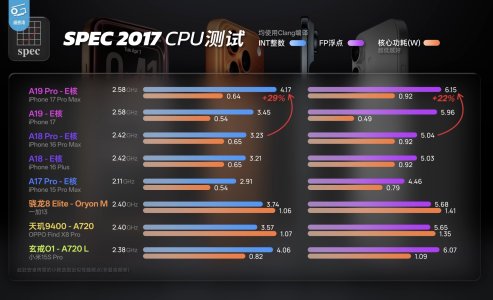
The current e-cores are quite strong compared to the previous version. There was a huge improvement, at no cost to power draw.
1773256479030.jpeg
I wouldn’t be surprised if they keep the same core config, but get a frequency increase for the E’s; which should allow for similar power draw because of the node change to N2.
The old P (new S) is due for a significant upgrade.

I doubt they will put the M cores in the A20 Pro. Unless it can scale to low power very well.
I'm confused. What is M core? Middle?

I thought the terms Apple uses are now E, P (which is the new core), and S.
In this context yes, M = the new P.

They should’ve named the new performance core “balanced”, since it sits in between the low end and the high end.
 
Back
Top