• We’re currently investigating an issue related to the forum theme and styling that is impacting page layout and visual formatting. The problem has been identified, and we are actively working on a resolution. There is no impact to user data or functionality, this is strictly a front-end display issue. We’ll post an update once the fix has been deployed. Thanks for your patience while we get this sorted.

Discussion AMD SoC Halo series GPU discussion

Page 19 - Seeking answers? Join the AnandTech community: where nearly half-a-million members share solutions and discuss the latest tech.
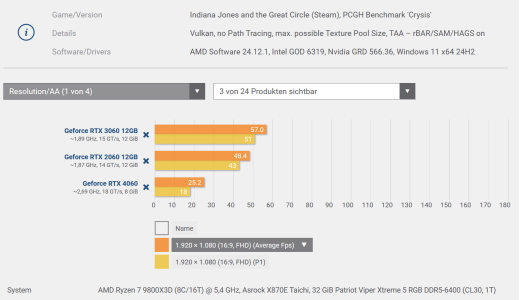
Those two Indiana Jones graphs are at two different graphical presets. Different graphics settings affect the average and minimum FPS that a GPU can achieve.

You can also see how much better the RX 6700XT 12GB is compared to the 4060 Ti 8GB. At 70W the Strix Halo's iGPU should perform above the 6700XT by the way, perhaps even better at 1080p considering the higher clocks and lower bandwidth demands:

1739903706385.png


8GB VRAM is killing all the potential in these GPUs.

It's really embarrassing that even the 7 year-old RTX 2060 12GB massively outperforms the RTX 4060.
1739915789423.png


Unless of course you reduce the quality settings on the RTX 4060 8GB / 4060 Ti 8GB / RTX 4070m 8GB / RTX 5070m 8GB.
Which you don't have to do for Strix Halo because it can access up to a whopping 24GB out of 32GB system RAM.


Nope, these have IFOPs.
Ok crazy hypotesis #2:
IOD + 1x VCached and lower clocked CCD.


I've seen this when Intel had their Iris Pro.
To be fair, the Iris Pro wasn't really a midrange replacement either, as every mid-end dGPU at the time would run circles around it. Despite the eDRAM, the Iris Pro would have been similar in performance to today's Hawk and Strix Point. I guess Kaby Lake G could have been that with the FrankenVega and HBM2, though that was a much less integrated solution that Strix Halo.


No I don’t think it’s odd. Gamers are constantly trying to game on hardware not designed for gaming and willing to spend large amounts of extra money to do it, for reasons I don’t fully grasp.
Gamers aren't the ones who decided the first product with Strix Halo would be the Republic of Gamers Flow Z13. Asus did.

Gamers also didn't create this slide with gaming performance to announce Strix Halo:
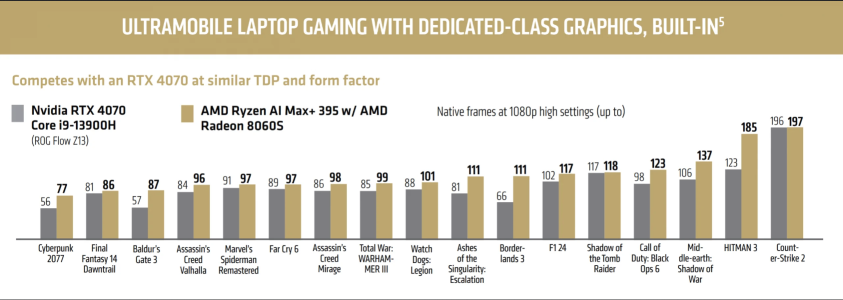
1739918603145.png

That would be AMD, the company who developed the chip.


It’s pretty obvious from the reviews, if not the very idea itself, that the Flow Z13 can’t fully handle Strix Halo.
Looks like it handles Strix Halo pretty great, considering the glowing reviews.


Plus, it costs more the dGPU alternatives that will give similar or even better framerates.
It costs $800 less than the Republic of Gamers Flow Z13 with a RTX 4070 8GB.
 
Last edited:
Last edited:
It also has a much bigger battery to compensate. . .

To give a better understanding of what screen the 16” MacBook has, it has a display that consists of 7,720,704 pixels vs the 13”ASUS’s 4,096,000 pixels and it’s a bigger mini-led display to boot which is more power hungry than 13” LCD.
It has ~88% more pixels to display.

It also doesn’t throttle, the 16” will run at the full performance for the duration of the test.
Meanwhile, the ASUS will score ~1000 points when unplugged.

——
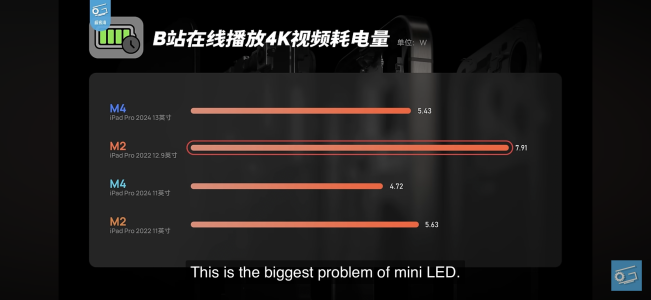
Here is a good indication of the increase in power consumption that comes with display size, resolution and panel type.
This was tested at 300nits.

IMG_1691.png
Now imagine a 16” mini-led display at 150nits near 8 million pixels. For as long as 1hr while running Cinebench.

EDIT: the rated figures are watts, lower is better.
 
Last edited:
To give a better understanding of what screen the 16” MacBook has, it has a display that consists of 7,720,704 pixels vs the 13”ASUS’s 4,096,000 pixels and it’s a bigger mini-led display to boot which is more power hungry than 13” LCD.
It has ~88% more pixels to display.
it's a much slower, more efficient panel that's impossible to look at in motion without vomiting.
ehhh dragon range is server uncore, really bad comparison point tbf.
 
it's a much slower, more efficient panel that's impossible to look at in motion without vomiting.
Yeah that’s not the point I’m trying to make, I’m not talking about response times, it’s 43ms (ewwww). It’s also not an efficient as OLED or LCD.

I’m talking about resolution, the 16” powers more pixels. Read my post again, this time look the picture I posted too.
 
It’s also not an efficient as OLED or LCD.
a) it is an LCD
b) OLEDs are a whole lot less efficient at any reasonable APL. they just look better on pretty much every level
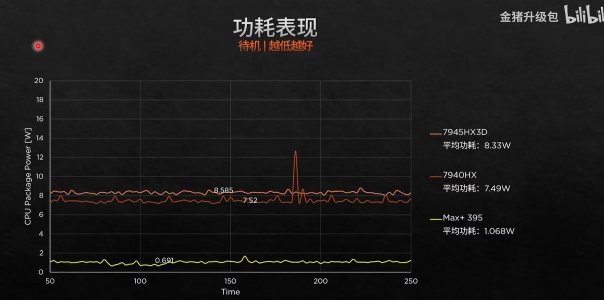
I wasn't making the comparison, was just posting for the Halo measurement. They could have chosen better, but I guess drama sells.
I guess it proves a point that advanced packaging really works.
 
All I’m saying is more pixels = more battery used. That’s why we see the difference between the 14” and 16”. But despite the larger battery, the performance advantage when unplugged on the 16” is greater than the increase in battery capacity over the ASUS.
 
To give a better understanding of what screen the 16” MacBook has, it has a display that consists of 7,720,704 pixels vs the 13”ASUS’s 4,096,000 pixels and it’s a bigger mini-led display to boot which is more power hungry than 13” LCD.
It has ~88% more pixels to display.

It also doesn’t throttle, the 16” will run at the full performance for the duration of the test.
Meanwhile, the ASUS will score ~1000 points when unplugged.

——
Here is a good indication of the increase in power consumption that comes with display size, resolution and panel type.
This was tested at 300nits.

View attachment 117560
Now imagine a 16” mini-led display at 150nits near 8 million pixels. For as long as 1hr while running Cinebench.

EDIT: the rated figures are watts, lower is better.

My comparison was at full load for each example in relation to the ROG Flo, so are you saying the screen on the two inch larger MacBook drew enough additional power to increase the system power consumption by over 40% when the CPUs were fully loaded?
 
Last edited:
My comparison was at full load in relation to the ROG Flo, so are you saying the screen on the two inch larger MacBook drew enough additional power to increase the system power consumption by over 40% when the CPUs were fully loaded?
Well, when the 14" macbook with the same SoC and a simliar battery size beat the Strix Halo I would say yes.

Also why do you ignore the resolution difference? Thats the biggest
Apple aggressively VRRs down to 24Hz and does other power tricks.
Just Josh tests at 60Hz and its a fixed 60hz.
 
very very different panels and platforms.
Yes I know.

@Hitman928
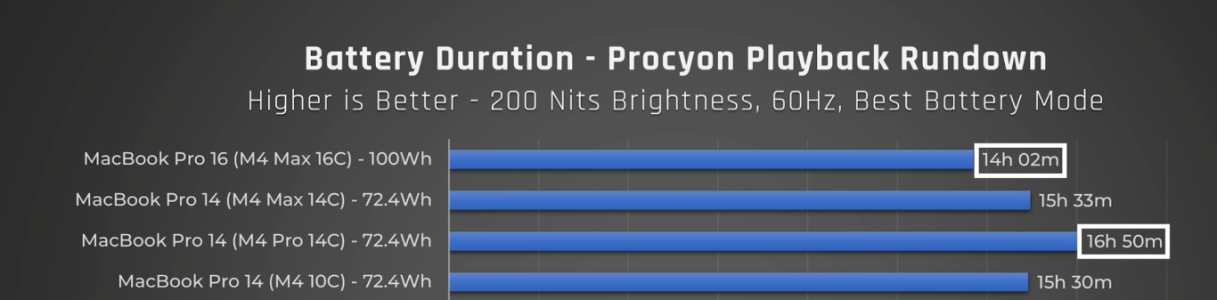
I know its crazy to say that 2" can make a huge difference and it does matter. I will compare the same platform and same panel to show that massive difference 2" makes and an increase in resolution does to battery life.
1739924906955.png

This test basically use the encoders and the difference is drastic. 1hr 30m more on the 14" M4 Max with a 72Wh battery and yes the 14" M4 Max has 2 less P cores but playing back a video should barely use them when compared to the larger 16" M4 Max with a 100Wh battery.
 
Back
Top