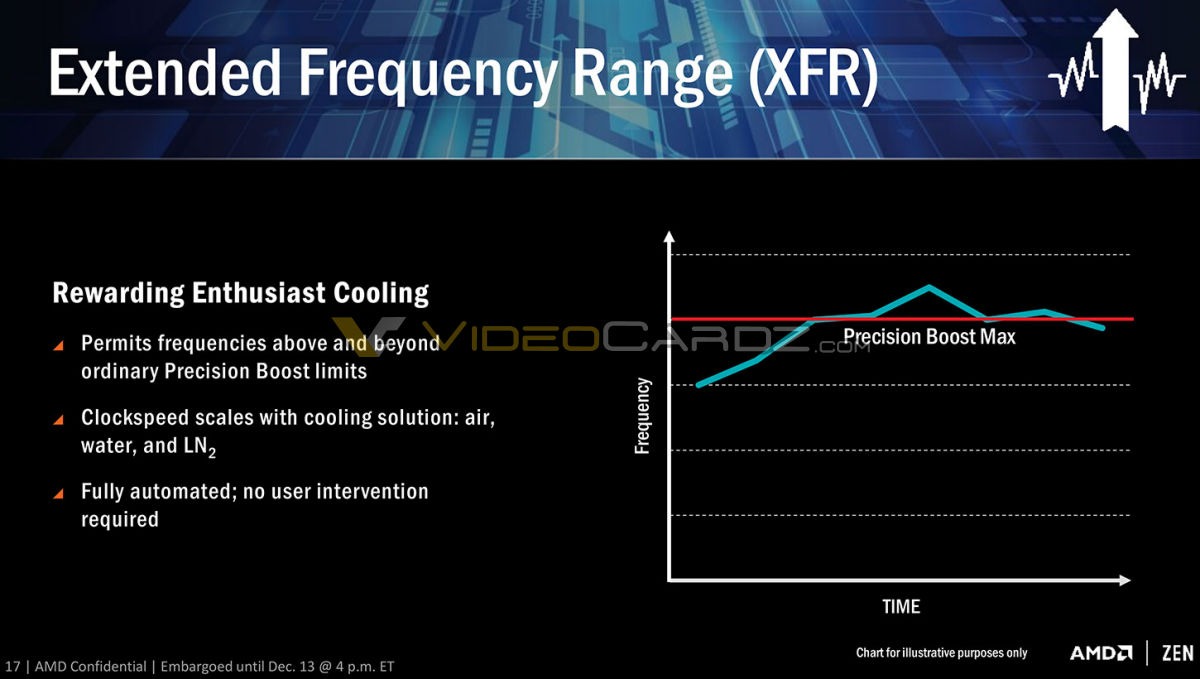
Why would each line be 1GHz?
Because they are four. But you are right. Maybe each line is 500MHz and Zen will clock at 2Ghz max turbo...

Why would each line be 1GHz?

Don't be obtuse. 3.4GHz+ clearly means 3.4GHz or higher, which means the base clock is 3.4GHz.
It is not clear if this presumed OC of 4.3Ghz was on all core, but since it was benchmarkable and not a suicide run, we can assume that at least on turbomax with 1 core 4.3Ghz was reachable by that EARLY ES OF 6 MONTHS AGO. Given that and the 3.4+ GHz mark, the graph let me suppose that each line is 1Ghz and the peak is 4.5 Ghz, but maybe AMD cheated with scale and origin to fool all of us...We seem to have it on "good authority" that it will OC ~4.3Ghz. Is your 3.8Ghz your personal guestimate or you know something from the actual real world testing?

Furthemore, given the degree of countering views on the matter in this thread, the only thing clear about it is that it is anything but clear!!!

We seem to have it on "good authority" that it will OC ~4.3Ghz. Is your 3.8Ghz your personal guestimate or you know something from the actual real world testing?
... but "3.4GHz+" means minimum 3.4GHz, anything else would be absurd.
You have to search for some tests. You can see it even in this test. Important is, you cannot compare the IPC when one CPU does include edram and the other doesn't. Games are not necessarily cache dependent, they are memory and highly IPC dependent as well. Obviously you are really clueless if you ask such questions.

Because they are four. But you are right. Maybe each line is 500MHz and Zen will clock at 2Ghz max turbo...
Nothing. But we spent months counting pixels on the graph of Orochi vs Zen.What makes you think that the graph starts at zero?
Nothing. But we spent months counting pixels on the graph of Orochi vs Zen.
Let's add an IF to my considerations, then...
The origin could also not be zero. But since they said 3.4GHz+i suppose that the lowest point is 3.4GHz...
But anyway you are right: the lowest point lays on the third row. If i am correct, the minimum clock is 3Ghz, so there is something wrong in the interpretation of this graph.

I think the whole point of the graph is to just show that clocks can go above the precision boost frequency max for some period of time. I don't think we should read any more into it than that, either way.

If it goes above it, then it must not have been the max...I think the whole point of the graph is to just show that clocks can go above the precision boost frequency max for some period of time. I don't think we should read any more into it than that, either way.
I take it as the Precision Max number with XFR taking it higher.Don't be obtuse. 3.4GHz+ clearly means 3.4GHz or higher, which means the base clock is 3.4GHz.

If it goes above it, then it must not have been the max...
This concept seems odd to me. If it can clock higher, then just say what it can clock to with the a stock cooler and then we can figure out that better coolers will give us a little more.
This is to go above TDP, thermally allowing of course. They obviously can't let it go that high in their 95W stated TDP. T
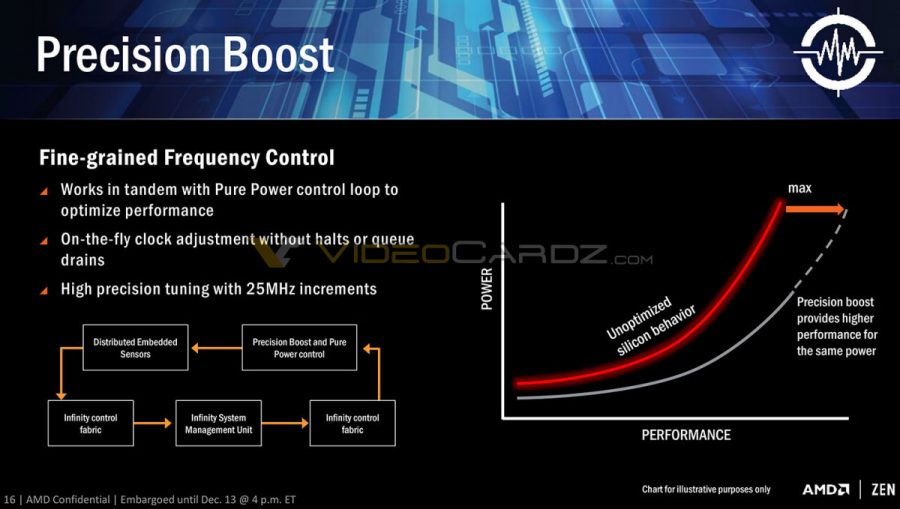
If it goes above it, then it must not have been the max...
This concept seems odd to me. If it can clock higher, then just say what it can clock to with the a stock cooler and then we can figure out that better coolers will give us a little more.
I think each tic on the chart is a different lucky charm. + lucky charms above clock per time.
95watts is for little girls, we don't buy manly heat skins, AIO, full loops to put a girly 95watts through it.... be a MAN!
does it IPC does it clock, if you care about anything else then your not a MAN!
95watts is for little girls, we don't buy manly heat skins, AIO, full loops to put a girly 95watts through it.... be a MAN! [WHOOO!]
does it IPC does it clock, if you care about anything else then your not a MAN! [WHOOO!]
Huh?