• We’re currently investigating an issue related to the forum theme and styling that is impacting page layout and visual formatting. The problem has been identified, and we are actively working on a resolution. There is no impact to user data or functionality, this is strictly a front-end display issue. We’ll post an update once the fix has been deployed. Thanks for your patience while we get this sorted.

Question AMD Rembrandt/Zen 3+ APU Speculation and Discussion

Page 65 - Seeking answers? Join the AnandTech community: where nearly half-a-million members share solutions and discuss the latest tech.

izaic3

Member
Alright, so we've had some leaks so far. I don't know if any of it's been confirmed yet, as it's pretty early, but here is what I've surmised so far (massive grain of salt of course):

If if turns out to have RDNA 2 and 12 CU, I could see iGPU performance potentially almost doubling over Cezanne.

If I've made any mistakes or gotten anything wrong, please let me know. I'd also love to hear more knowledgeable people weigh in on their expectations.
 
Last edited:
Performance at 45 watts and above. Some of the margins are pretty significant - like 20 or 30 percent inf favor of the 12700H.
 
the big upshot for rembrandt is the igpu.
Performance at 45 watts and above. Some of the margins are pretty significant - like 20 or 30 percent inf favor of the 12700H.
how noticeable would these differences be irl without benchmarks though? the true strength of rembrandt is in it's igpu so buying a laptop with a dgpu greatly diminishes it's value making the 6800U the true gem of the series. it's a real shame that they are thusfar impossible to purchase at a reasonable price.
 
Really depends on what you're using the laptop for. If you're not gaming, does the iGPU matter beyond beyond being able to drive the display and maybe including an appropriate hardware decoder for the most common video formats.

If you're getting something that's more on the high-end, and it makes sense to determine what gets you the best performance for that dollar.
 
As expected, Rembrandt doesn't look too good against the 12700H in the 45+ W range.
Honestly worthless video to me. Then again I consider the H series from both AMD and Intel worthless and as some know prefer U series any day. Anything above the sweet spot are ineffcient power suckers, and the efficiency sweet spot is significantly below what HUB's chart shows, something like ~15W for Rembrandt and ~25W for Alder Lake.

Just to give you a picture of what differences in efficiency we are talking about there, the M1 Pro quoted in there is only half as efficient as the base M1 (as such I'd naturally always pick the latter).
 
Rembrandt's target was always the light and thin notebooks market relying only on integrated GPU and high battery life, not the gaming/desktop replacement. In that regard, I think it will be superior to Alder Lake derivatives (the U variant will go against a 2P+8E model). High end gaming is owned by ADL now but this is more a niche market. A market thet AMD will address anyway next year with the 45-55+W "mobile" CPUs derivative from Zen4.
 
Honestly worthless video to me. Then again I consider the H series from both AMD and Intel worthless and as some know prefer U series any day. Anything above the sweet spot are ineffcient power suckers, and the efficiency sweet spot is significantly below what HUB's chart shows, something like ~15W for Rembrandt and ~25W for Alder Lake.

Just to give you a picture of what differences in efficiency we are talking about there, the M1 Pro quoted in there is only half as efficient as the base M1 (as such I'd naturally always pick the latter).
I mean sure, but the video is still relevent even if only for that small, what, 20% of the laptop market where gaming laptops sit? Something like that anyway. Rembrandt isn't particularly good if you want a laptop for gaming/heavier MT workloads primarily where battery life isn't a concern
 
I mean sure, but the video is still relevent even if only for that small, what, 20% of the laptop market where gaming laptops sit? Something like that anyway. Rembrandt isn't particularly good if you want a laptop for gaming/heavier MT workloads primarily where battery life isn't a concern
Well yes, it's relevant to the form factor that's often "mobile" only in name and for an audience that expects closer to desktop performance rather than usable battery life. Which is why the expected Raphael-H/Dragon Range for that market makes perfect sense and could be considered overdue going by reaction videos like this one.
 
Well yes, it's relevant to the form factor that's often "mobile" only in name and for an audience that expects closer to desktop performance rather than usable battery life. Which is why the expected Raphael-H/Dragon Range for that market makes perfect sense and could be considered overdue going by reaction videos like this one.
Even with Dragon Range I suspect there's going to be mid-range and lower tier gaming laptops where Intel will have an edge tbh. Idk, I see Dragon Range as a -HX replacement rather than a standard -H laptop replacement.
 
Even with Dragon Range I suspect there's going to be mid-range and lower tier gaming laptops where Intel will have an edge tbh. Idk, I see Dragon Range as a -HX replacement rather than a standard -H laptop replacement.
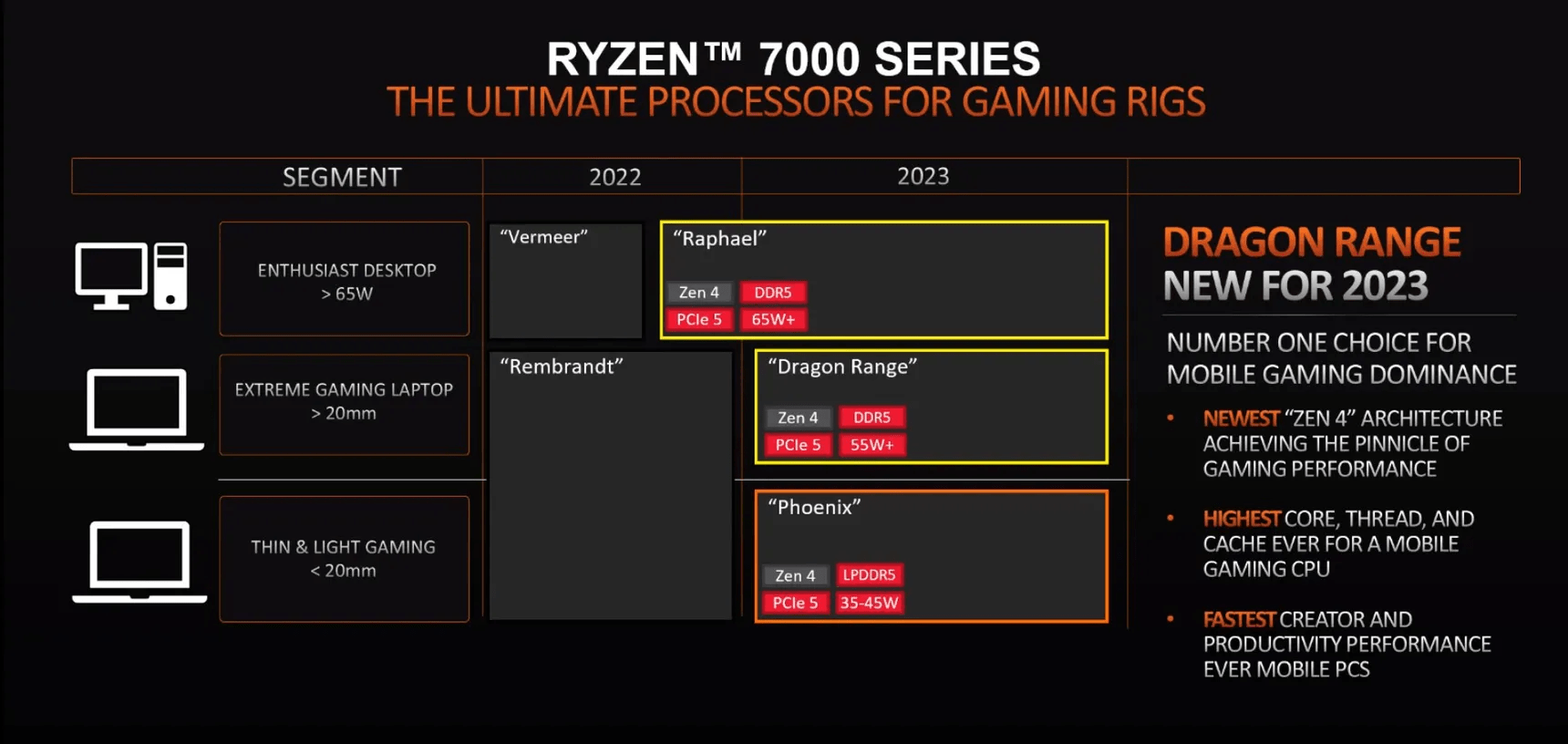
Hm, I'd personally expect Dragon Range to be able to cover 45W, possibly even as low as 35W as well. But I see that the slide Ian posted back when Dragon Range was revealed denominated Dragon Range as "55W+" so I can see where you come from. Then again Phoenix (without Point back then) was listed as "35-45W" which makes me think these refer values to peak usage, not TDP. If it's the latter the slide completely missed the U series (which still can make sense due to the slide's focus on "gaming rigs").

AMD-Dragon-Range-1651733553-0-0.jpg


In any case the efficiency and performance scaling with those will be interesting. I have high expectation of the new IOD.
 
Rembrandt isn't particularly good if you want a laptop for gaming/heavier MT workloads primarily where battery life isn't a concern
depends on the games. not everyone plays modern FPS games above 1080p. if they are actually ever available at reasonable prices, rembrandt U laptops will be more than adequate for the majority of casual gamers who play tbs/rpg/rts.
 
is it surprised the 8c16t efficiency curve worse than a 6+8(14c20t) one? no. and the title of HardwareUnbox is biased if you ask me.
 
Just curious, how much is a couple of days..?.

05/31/2022
Our test system for the new AMD Ryzen 7 6800U is the Asus Zenbook S 13 .

The full review of the Asus Zenbook S 13 will be published in a couple of days.

 
Just curious, how much is a couple of days..?.


Maybe the day after AT's review of 5800X3D?
 
Honestly worthless video to me. Then again I consider the H series from both AMD and Intel worthless and as some know prefer U series any day. Anything above the sweet spot are ineffcient power suckers, and the efficiency sweet spot is significantly below what HUB's chart shows, something like ~15W for Rembrandt and ~25W for Alder Lake.

Just to give you a picture of what differences in efficiency we are talking about there, the M1 Pro quoted in there is only half as efficient as the base M1 (as such I'd naturally always pick the latter).

That's a fair assessment if the only thing you care about is performance per watt. However, if you're a professional your boss cares about your work efficiency and the amount of work you can get done per hour is far more important. An employee costs more per hour than the small amount of extra electricity to run a notebook chip above the peak of its efficiency curve.
 
That's a fair assessment if the only thing you care about is performance per watt. However, if you're a professional your boss cares about your work efficiency and the amount of work you can get done per hour is far more important. An employee costs more per hour than the small amount of extra electricity to run a notebook chip above the peak of its efficiency curve.
That use case is much much better served by a form factor not restricted by limited airflow and cooling though. Performance per watt is an integral part of making a mobile form factor mobile, these products are just abusive in multiple ways.
 
That use case is much much better served by a form factor not restricted by limited airflow and cooling though.

In a stationary office, sure. But you can't exactly lug a tower with monitor and peripherals around with you, if you need something portable. Well, you could. But it'd be a pain in the proverbial backside.

Remember lanparties?
 
Performance per watt as an end itself instead of a means to an end can lead to bad design choices. The real question that needs answering is how long do you need to be able to run without plugging in to a wall. If it's no more than a few hours at a time, chasing a PPW figure to get 12 hour battery life isn't useful to anyone who doesn't need 12 hours away from the wall. There are certainly use cases that will demand that, but not all products need to deliver that kind of battery life guarantee and those users will gladly trade more performance against something they don't need.
 
Performance per watt as an end itself instead of a means to an end can lead to bad design choices. The real question that needs answering is how long do you need to be able to run without plugging in to a wall. If it's no more than a few hours at a time, chasing a PPW figure to get 12 hour battery life isn't useful to anyone who doesn't need 12 hours away from the wall. There are certainly use cases that will demand that, but not all products need to deliver that kind of battery life guarantee and those users will gladly trade more performance against something they don't need.
For what it's worth, chasing perf/W as an end itself isn't a bad thing when you are operating in the case of a power or thermal constrained environment, if only because having the best perf/W potentially translates to better performance outright. Sure, two laptops might have a battery life of 3 hours, and that might be enough for a user who only stays 3 hours away from a plug, but if one of those laptops offers better performance than the other, it likely also has better perf/W and likely can also have better battery life at the same performance.
 
For what it's worth, chasing perf/W as an end itself isn't a bad thing when you are operating in the case of a power or thermal constrained environment, if only because having the best perf/W potentially translates to better performance outright.

Not necessarily though. Alder Lake can be pushed harder than Zen 3. The performance per watt goes down the toilet, but it scraped out enough wins on benchmarks for Intel to go down that road.

I think that outside of the server market, few buyers really care about performance per watt. Sure you can put it on a bar graph, but it's just one of many graphs and if all the others have higher bars basic human nature kicks in and people tend towards the "winner".

Anyone who really cares about it (instead of just paying lip service to it) probably should be looking for an ARM solution anyways. I've got an M1 MBP and frankly it blows both AMD and Intel completely out of the water when it comes to performance per watt.
 
At last I am seeing a deal for U series laptop. Very good if you want one with good specs and build/screen quality.

still quite high end but great to see that it is igp only. hopefully a sign that lower priced units are on the horizion.
 
Doesn't have USB4/TB4 at that price, and Lenovo charging ports are prone to breaking. Besides that, ThinkPads are no longer worth the premium. Also, Lenovo's lead times in my country are atrocious, so it's a pass from me.
 
Back
Top