Raven's CCX design always has 4MB L3.
Zeppelin = 8MB per CCX.
Raven = 4MB per CCX.
It's a huge die even without the additional 4MB of L3.
Do you know the die size?

Raven's CCX design always has 4MB L3.
Zeppelin = 8MB per CCX.
Raven = 4MB per CCX.
It's a huge die even without the additional 4MB of L3.

Do you know the die size?

Do you know the die size?
lol!Yes?
Im estimating 200mm2 to 240mm2
Closer to 240 than 200

Or maybe full fat 8c/16t? That would be interesting....

65 watt cpu laptop...price, battery life, does it throttle, etc.?Yes only in your dreams, 8/16 Raven Ridge APU with 2000 VEGA GCN GPU cores.😀
If you need "Mobile 8/16 CPU", well Asus has a very good gaming tool for you needs.😎

It has to be AM4, right, or is there a mobile socket for Ryzen 7 I don't know about?
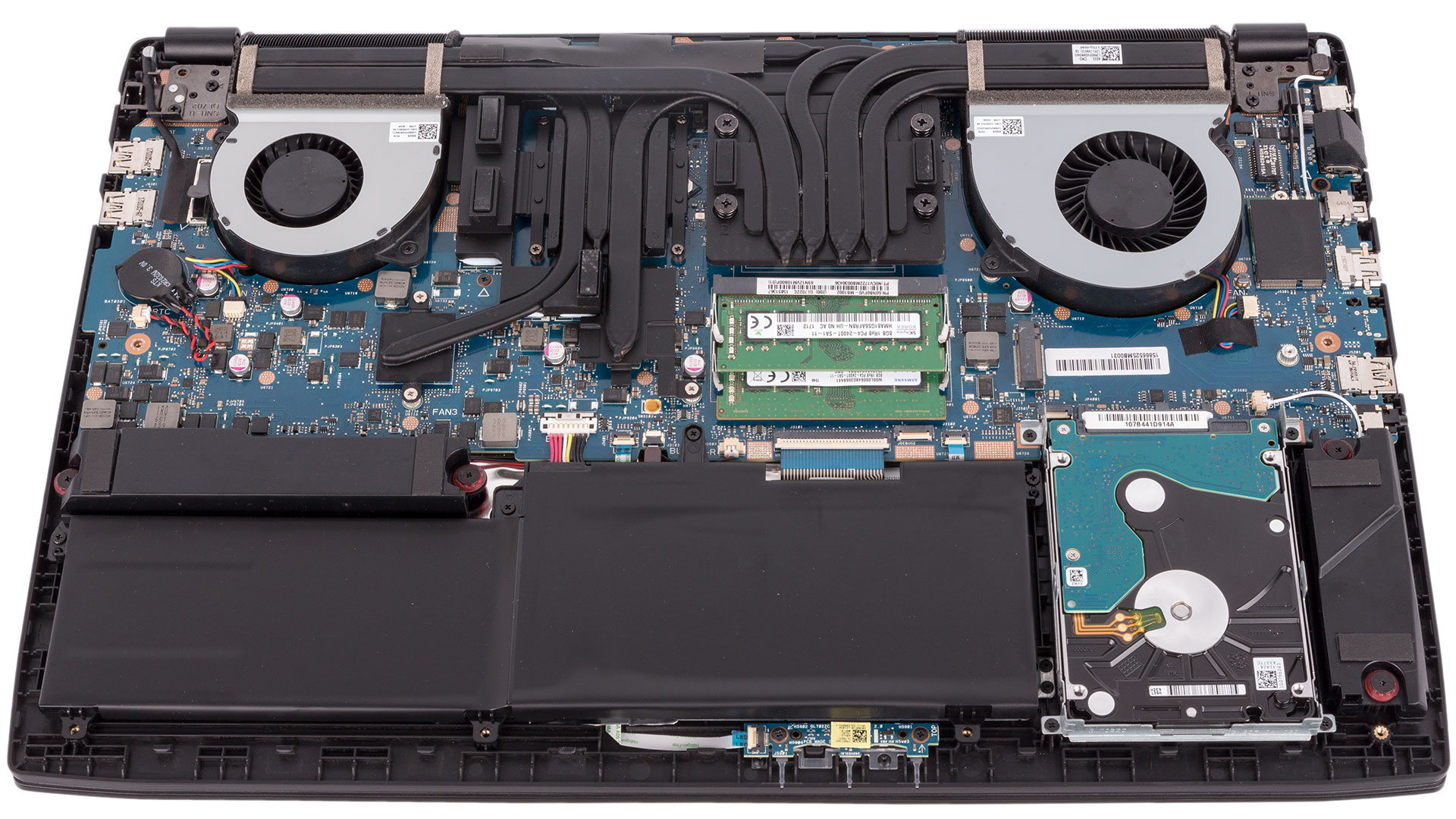

Yeah, I'm not sure how they are going to fit the battery in there:Its AM4, but the dGPU (RX580) is a mobile design.
Pretty amazing in that it has 154W worth of processosing in the form of a CPU (65W) and dGPU (est. 89W).
Do you know the size of it, since you say it isn't huge?
I don't know if you are trying to be difficult for difficulty sake but sure. The die size is roughly a 192mm, The CCX's take up about half of that. So 96mm. Then you look at the L3 Cache. It's about 2/3 the size the CPU's. Which makes it something close to 38mm for the L3.. Cutting that in half would save you roughly 19mm for the two CCX's. Cutting that in half for 4MB would make it roughly 9.5mm^2, on a 200mm die, saved. It's not very scientific and its probably off but look at the die and see for yourself. It's not insignificant but it's also not that large. Not worth redesigning the CCX on top of developing the new die. Me I would call 5% a small amount when talking about how much not having to change the CCX would save.
Larger than Zeppelin! Integrated PCH + very large iGPU?

Don't worry about the battery... worry about the cooling (noise) : i see a lot of "heat pipe" but very little "heat sink".Yeah, I'm not sure how they are going to fit the battery in there:
I thought you were talking about the cache. The 4MB would be about 4% of those die sizes.TN/RL = 240.41mm² (32nm)
KV/GV = 244.29mm² (28nm)
CZ/BR = 246.39mm² (28nm)
I already said it's TN/KV/CZ ish in size 😉


I think when people talk of the APU's they think of them as the Pentium or Celeron of AMD's lineup. I don't think AMD sees it that way. It's not targeted at that market. Its targeted a a market that isn't impacted by core count that sees value in discreet level GPU in a single package market.The other reason why AMD use lesser L3 cache is to not directly threaten their current sku (R5 1400).
IIRC, AMD once explained that part of CCX's L3 cache are not connected directly to L2 cache. If AMD manage to cut the less important 4MB cache, I think the performance impact won't be severe enough to notice.
I've got an i5-7200U laptop and it's only 2.5GHz, but can turbo higher if that's what you mean. For most desktop tasks, it runs much slower than 2.5GHz. I was only referring to base clocks with my 2GHz comment, which is a bit low. Most 4C/8T Intel mobile chips have base clocks between 2.2-2.7GHz, with turbo/single core clocks over 3GHz. If AMD's highest tier Ryzen 4C/8T runs at a 2.2GHz base and 3.xGHz turbo/XFR/whatever combined with its better graphics, then that's going to be impressive if it undercuts Intel prices the way desktop Ryzen did.Current "mainstream" laptops are not clocked close to 2 GHz. Intel Core i5-7200U: 3.1 GHz. Intel Core i5-8250U: 3.4 GHz (sustained: no good data so far). It can fail if it is not given enough power; please no 15 W.
I've got an i5-7200U laptop and it's only 2.5GHz, but can turbo higher if that's what you mean. For most desktop tasks, it runs much slower than 2.5GHz. I was only referring to base clocks with my 2GHz comment, which is a bit low. Most 4C/8T Intel mobile chips have base clocks between 2.2-2.7GHz, with turbo/single core clocks over 3GHz. If AMD's highest tier Ryzen 4C/8T runs at a 2.2GHz base and 3.xGHz turbo/XFR/whatever combined with its better graphics, then that's going to be impressive if it undercuts Intel prices the way desktop Ryzen did.
For most desktop tasks, it runs much slower than 2.5GHz.
Raven's CCX design always has 4MB L3.
Zeppelin = 8MB per CCX.
Raven = 4MB per CCX.
It's a huge die even without the additional 4MB of L3.
TN/KV/CZ ish, on half the node size.

Raven Ridge seems to be around 210 - 220 sq mm. I doubt its as big as 240 sq mm.
http://www.bitsandchips.it/52-english-news/7622-rumor-two-versions-of-raven-ridge-under-development
https://techreport.com/forums/viewtopic.php?t=119682


