
-
We’re currently investigating an issue related to the forum theme and styling that is impacting page layout and visual formatting. The problem has been identified, and we are actively working on a resolution. There is no impact to user data or functionality, this is strictly a front-end display issue. We’ll post an update once the fix has been deployed. Thanks for your patience while we get this sorted.
You are using an out of date browser. It may not display this or other websites correctly.
You should upgrade or use an alternative browser.
You should upgrade or use an alternative browser.
AMD is for freedom! (Socketed Kabini / AM1, versus Broadwell+ BGA)
Page 2 - Seeking answers? Join the AnandTech community: where nearly half-a-million members share solutions and discuss the latest tech.

VirtualLarry
No Lifer
Where did you hear the BGA-only nonsense?You're one of the known AMD fanboys here, so you're gonna need to back up statements like this...
http://www.pcper.com/reviews/Processors/Intels-Broadwell-Goes-BGA-Only-Implications-Future-Desktops
I'm hardly a "known AMD fanboy". I own just as many Intel desktops and laptops as AMD ones. I'm just not a fan of "evil business practices", and taking away consumer freedoms, like interchangable CPUs, and bus-clock overclocking, and gimping CPU instruction sets.

frozentundra123456
Lifer
http://www.pcper.com/reviews/Processors/Intels-Broadwell-Goes-BGA-Only-Implications-Future-Desktops
I'm hardly a "known AMD fanboy". I own just as many Intel desktops and laptops as AMD ones. I'm just not a fan of "evil business practices", and taking away consumer freedoms, like interchangable CPUs, and bus-clock overclocking, and gimping CPU instruction sets.
A speculative article from 2012. In any case I don't think this is definitely confirmed. Broadwell also I believe will have very limited desktop applications, so I don't think it is in any way indicative that all Intel desktop processors are becoming soldered.
http://www.pcper.com/reviews/Processors/Intels-Broadwell-Goes-BGA-Only-Implications-Future-Desktops
I'm hardly a "known AMD fanboy". I own just as many Intel desktops and laptops as AMD ones. I'm just not a fan of "evil business practices", and taking away consumer freedoms, like interchangable CPUs, and bus-clock overclocking, and gimping CPU instruction sets.
Intel reversed course (on Broadwell being BGA only) and has said that they will continue to sell socketed CPUs "for the forseeable future". OTOH, it will likely be far more limited in scope compared to today's processors.

GreenChile
Member
Wow! Taking a false rumor from 2012 and using it to spread FUD in 2014. Not sure what to make of your "hardly a known fanboy" claim.
Try doing a little more modern research in the future please. A simple Google search for Broadwell socket brings up many articles which disprove your BGA only claim.
http://wccftech.com/intel-broadwell-k-series-desktop-processors-launch-q4-2014-lga-1150-socket/
or
http://www.extremetech.com/computing/170291-intels-14nm-broadwell-gpu-takes-shape-indicates-major-improvements-over-haswell
Try doing a little more modern research in the future please. A simple Google search for Broadwell socket brings up many articles which disprove your BGA only claim.
http://wccftech.com/intel-broadwell-k-series-desktop-processors-launch-q4-2014-lga-1150-socket/
or
http://www.extremetech.com/computing/170291-intels-14nm-broadwell-gpu-takes-shape-indicates-major-improvements-over-haswell
Broadwell should also see the introduction of motherboards with soldered-on chips (BGA) rather than socketed (LGA). LGA Broadwell chips should still be available, though the timeline for their availability may be considerably different. BGA can reduce power consumption yet further, at the expense of upgradeability but in the case of tablets and smartphones, which Broadwell will target, weight, thickness, and battery life are far more important.
VirtualLarry
No Lifer
Yeah, Intel got flack for no-LGA Broadwell, so they threw the enthusiasts a bone with Broadwell-K. Note the "-K", being an enthusiast-class CPU.
I have not seen anything definite from Intel, that they are NOT going to use BGA for mainstream Broadwell CPUs.
The very fact that mainstream Broadwell (to this point) IS going to be BGA-only, should tell you of Intel's future intentions, combined with their experimentation with software-upgradable CPUs. The writing's on the wall.
Plus, I believe I suggested that it would take three generations of desktop CPUs to phase out LGA entirely. Skylake is the last CPU on the roadmap to be LGA-based. Everything afterwards will likely be BGA. Unless there is a revolt, and Intel changes their plans again, like they did with Broadwell-K, after there was much rancor in the enthusiast community over their plans for BGA-only Broadwell.
I have not seen anything definite from Intel, that they are NOT going to use BGA for mainstream Broadwell CPUs.
The very fact that mainstream Broadwell (to this point) IS going to be BGA-only, should tell you of Intel's future intentions, combined with their experimentation with software-upgradable CPUs. The writing's on the wall.
Plus, I believe I suggested that it would take three generations of desktop CPUs to phase out LGA entirely. Skylake is the last CPU on the roadmap to be LGA-based. Everything afterwards will likely be BGA. Unless there is a revolt, and Intel changes their plans again, like they did with Broadwell-K, after there was much rancor in the enthusiast community over their plans for BGA-only Broadwell.
GreenChile
Member
Yeah, Intel got flack for no-LGA Broadwell, so they threw the enthusiasts a bone with Broadwell-K. Note the "-K", being an enthusiast-class CPU.
I have not seen anything definite from Intel, that they are NOT going to use BGA for mainstream Broadwell CPUs.
The very fact that mainstream Broadwell (to this point) IS going to be BGA-only, should tell you of Intel's future intentions, combined with their experimentation with software-upgradable CPUs. The writing's on the wall.
Plus, I believe I suggested that it would take three generations of desktop CPUs to phase out LGA entirely. Skylake is the last CPU on the roadmap to be LGA-based. Everything afterwards will likely be BGA. Unless there is a revolt, and Intel changes their plans again, like they did with Broadwell-K, after there was much rancor in the enthusiast community over their plans for BGA-only Broadwell.
Oh please! the -K has for generations represented the unlocked versions of chips for Intel. Is the 4570K not a mainstream CPU? I get the impression you don't know what the Broadwell-K version even is. Let me throw you a bone. http://www.techspot.com/news/54763-report-details-intel-broadwell-k-cpus-iris-pro-graphics-included.html
Edit: Roadmap showing LGA is on the mainstream LGA 1150 socket. http://vr-zone.com/articles/intels-broadwell-k-launching-end-2014-according-new-roadmap/60966.html
What evidence do you have that LGA was not always on the roadmap for Broadwell? As far as I know the desktop version of Broadwell has always been planned as LGA.
http://en.wikipedia.org/wiki/Broadwell_(microarchitecture)
You're displaying a classic fanboy defense when presented with facts that conflict with your previous statements. You are twisting the facts with lies and presenting your own opinion of what Intel plans to do as known facts. You have no evidence that Intel has ever or will ever go to a BGA only model. Please stop the insanity!
Last edited:

VirtualLarry
No Lifer
Oh please! the -K has for generations represented the unlocked versions of chips for Intel. Is the 4570K not a mainstream CPU? I get the impression you don't know what the Broadwell-K version even is. Let me throw you a bone. http://www.techspot.com/news/54763-report-details-intel-broadwell-k-cpus-iris-pro-graphics-included.html
Edit: Roadmap showing LGA is on the mainstream LGA 1150 socket. http://vr-zone.com/articles/intels-broadwell-k-launching-end-2014-according-new-roadmap/60966.html
What evidence do you have that LGA was not always on the roadmap for Broadwell? As far as I know the desktop version of Broadwell has always been planned as LGA.
You have no evidence that Intel has ever or will ever go to a BGA only model. Please stop the insanity!
None of those roadmaps show non-K Broadwell SKUs are going to appear as LGA. There were articles back when this was supposedly "rumor" quoting mobo makers that Intel was planning on moving to a BGA model for their desktop CPUs.
Or is your opinion that PCPER prints "lies" too?
VirtualLarry
No Lifer
Oh, and another thing, why would they move the southbridge into Broadwell, if they always intended for it to be LGA? All of Intel's LGA sockets have an ancilliary chipset, which has a southbridge in it. It would be senseless of Intel to put SATA and USB ports onto the CPU, just to have them disabled, and use the system chipsets ports. Why waste all that R&D effort? Unless, of course, Broadwell was designed as more of a SoC (hint, it was) than a CPU, and SoCs are intended to be BGA.What evidence do you have that LGA was not always on the roadmap for Broadwell? As far as I know the desktop version of Broadwell has always been planned as LGA.
http://en.wikipedia.org/wiki/Broadwell_(microarchitecture)
Edit: For further clarification, apparently I remembered slightly incorrectly. The southbridge isn't (yet) in the CPU die, but rather, it's on-package.
http://www.techpowerup.com/164176/14-nm-broadwell-a-true-system-on-chip-soc.html
Last edited:
GreenChile
Member
None of those roadmaps show non-K Broadwell SKUs are going to appear as LGA. There were articles back when this was supposedly "rumor" quoting mobo makers that Intel was planning on moving to a BGA model for their desktop CPUs.
Or is your opinion that PCPER prints "lies" too?
The article you posted a link to at pcper does not state unequivocally that LGA was dead. It was reporting on a rumor at the time from that came from a leak at a mobo maker. It was not printing lies, it was printing rumor. You referring to that piece as evidence of the end to LGA is what I am referring to as a lie since we now know that Intel will release mainstream and enthusiast Broadwell on LGA.
VirtualLarry
No Lifer
You referring to that piece as evidence of the end to LGA is what I am referring to as a lie since we now know that Intel will release mainstream and enthusiast Broadwell on LGA.
We do? I have yet to see a roadmap suggesting non-K Broadwell will be anything but BGA.
All of your links specifically referenced Broadwell-K. I guess we'll see, when new roadmaps come out, or these chips get released at the end of the year.
Btw, I recall roadmaps suggesting Skylake would be LGA, and I have never disputed that. But post-Skylake, I expect every mainsteam Intel SoC (as further integration happens, they won't be just CPUs anymore) will be BGA.
Server-derived chips (Broadwell-E, etc.) will most likely stay LGA.
GreenChile
Member
Oh, and another thing, why would they move the southbridge into Broadwell, if they always intended for it to be LGA? All of Intel's LGA sockets have an ancilliary chipset, which has a southbridge in it. It would be senseless of Intel to put SATA and USB ports onto the CPU, just to have them disabled, and use the system chipsets ports. Why waste all that R&D effort? Unless, of course, Broadwell was designed as more of a SoC (hint, it was) than a CPU, and SoCs are intended to be BGA.
So let me get this straight. We've gone from Broadwell+ will be BGA only, to Broadwell LGA will be offered only on enthusiast platforms, to Broadwell was designed primarily for the mobile lineup so this means it wasn't intended for LGA. Do you see how your story is falling apart?
Just admit that you were wrong about the BGA only assumption and we can end this now.
VirtualLarry
No Lifer
Way to deflect the point that Broadwell (non-K Broadwell) is a SoC. Let's face facts, Intel is on a path to higher levels of integration. They are also focusing on low-power and mobile first, and desktop last. LGA is eventually going to go away, with the rest of the desktop market, for mainstream consumers. Those of us who want interchangable CPUs, will be forced onto the -E platform, most likely. (Or to AMD.)
With Intel planning on removing support for external PCI-E lanes from the CPU (again, for mainstream consumer platforms), once everything (GPU, CPU, I/O) becomes integrated, there's no need for LGA.
We have NVidia's lawsuit to thank for the continued existence of PCI-E lanes on Intel platforms. Intel pledged (to the FTC), to continue to support PCI-E expansion lanes for like 5 or 10 years. Once that time period is up, expect discrete GPUs to die off completely (for mainstream consumers). And Intel will own their entire PC platform to themselves.
With Intel planning on removing support for external PCI-E lanes from the CPU (again, for mainstream consumer platforms), once everything (GPU, CPU, I/O) becomes integrated, there's no need for LGA.
We have NVidia's lawsuit to thank for the continued existence of PCI-E lanes on Intel platforms. Intel pledged (to the FTC), to continue to support PCI-E expansion lanes for like 5 or 10 years. Once that time period is up, expect discrete GPUs to die off completely (for mainstream consumers). And Intel will own their entire PC platform to themselves.

Vesku
Diamond Member
That is because so far all Kabini APUs were Embedded and thus priced higher. Those AM1 APUs and motherboards are made for the retail only market and they cost lower.
OK, well the Celeron 1037U is in a lot of budget soldered mini-itx boards which means well below its listed price. For whatever reason AMD really tripped up on the first round of Kabini, perhaps they had already shifted production to this socketed initiative?
VirtualLarry
No Lifer
Reported for no source.
PCPer isn't a source?
Edit: How about this one, which was referenced by the wikipedia article on Broadwell:
http://www.techpowerup.com/177817/intel-haswell-and-broadwell-silicon-variants-detailed.html
Again, it's from 2012, but it mentions both a Desktop LGA Broadwell (now known to be Broadwell-K), as well as the fact that mainstream consumer variants will indeed, be all BGA.
Last and most interestingly, it's reported that Intel will indeed have an LGA1150 desktop processor based on its "Broadwell" 5th generation Core architecture, which makes perfect sense, given that Broadwell is essentially die-shrunk Haswell micro-architecture. Its silicon lineup is charted out much in the same way as Haswell. (Comment: This is Broadwell-K.)
What's even more interesting, and reinforces the "desktop BGA apocalypto" theory, is the fact that there won't be a dual-core Broadwell processor in the LGA1150 package. So most entry- thru mainstream chips, which are dual-core, will be built in the BGA package. So for anyone with less than say $200 to spend on motherboard+CPU, motherboards with CPUs hardwired will be sold in the markets (much like graphics cards).
Last edited:

NTMBK
Lifer
Broadwell was never BGA only. However it was never to be desktop originally. Only Xeons and mobile.
Its amazing how much FUD we have to see here. Even after Skylake a year ago confirmed to be LGA as well.
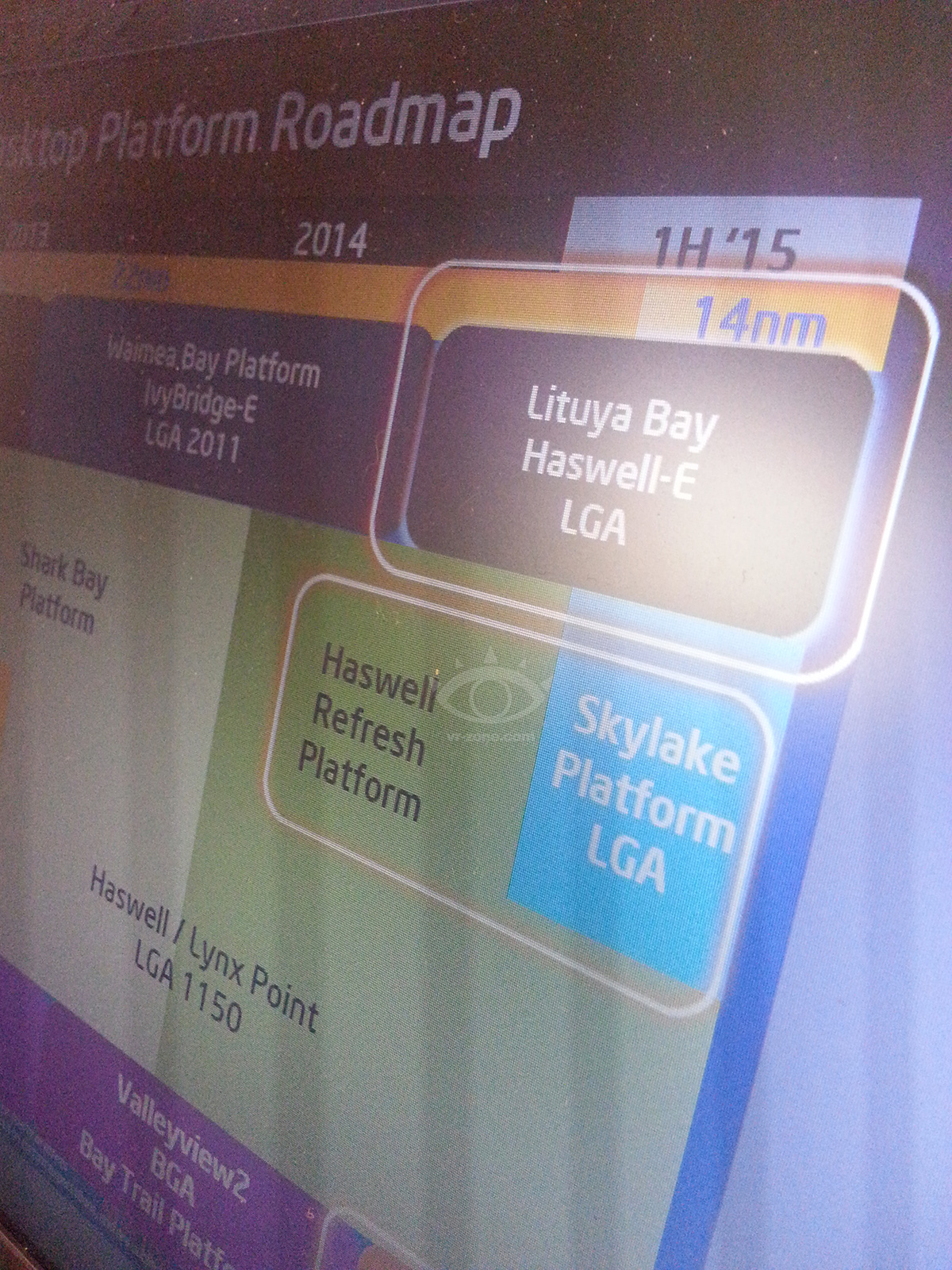
Speculation: this is just a new twist on the tick-tock model. Tocks get a full blown desktop release, and ticks do not. Hence Skylake gets a full LGA lineup, but I suspect that Cannonlake will not. Of course recently process shrinks have improved performance/W, but not increased clock speeds, so ticks are not that useful on the desktop (but very useful in servers and mobile).

ShintaiDK
Lifer
Speculation: this is just a new twist on the tick-tock model. Tocks get a full blown desktop release, and ticks do not. Hence Skylake gets a full LGA lineup, but I suspect that Cannonlake will not. Of course recently process shrinks have improved performance/W, but not increased clock speeds, so ticks are not that useful on the desktop (but very useful in servers and mobile).
There is nothing to speculate on as such. (Mobile) Atoms simply got more important than desktops. And the limited capacity initially of a new process node goes to mobile, server and atom, with desktop later. Unlike the past with mobile, server and desktop with atom later.
The shrinks is just as useful as ever for the desktop. They are just moved down in priority.
Speculation: this is just a new twist on the tick-tock model. Tocks get a full blown desktop release, and ticks do not. Hence Skylake gets a full LGA lineup, but I suspect that Cannonlake will not. Of course recently process shrinks have improved performance/W, but not increased clock speeds, so ticks are not that useful on the desktop (but very useful in servers and mobile).
The die shrink might not be useful from a performance POV, but they *are* useful from economic perspective (e.g., Intel's bottom line) because it allows either smaller dies or more transistor budget for areas where Intel is still lagging, like iGPU.
The reasons for desktops moving to the backburner are probably more tied to Atom becoming a very high volume product that *needs* a bleeding edge node than with die shrinks losing its usefulness to desktop processors.

Insert_Nickname
Diamond Member
Oh, and another thing, why would they move the southbridge into Broadwell, if they always intended for it to be LGA? All of Intel's LGA sockets have an ancilliary chipset, which has a southbridge in it. It would be senseless of Intel to put SATA and USB ports onto the CPU, just to have them disabled, and use the system chipsets ports. Why waste all that R&D effort? Unless, of course, Broadwell was designed as more of a SoC (hint, it was) than a CPU, and SoCs are intended to be BGA.
There are likely going to be different versions of the Broadwell architecture, just as there is with Haswell. Haswell already covers everything from SoC's to the -K series (and soon HEDT too)...
Different chips, sharing the same core, for different needs. 🙂
There is nothing to speculate on as such. (Mobile) Atoms simply got more important than desktops. And the limited capacity initially of a new process node goes to mobile, server and atom, with desktop later. Unlike the past with mobile, server and desktop with atom later.
The shrinks is just as useful as ever for the desktop. They are just moved down in priority.
In this case I find myself in agreement with Shintai.
http://www.pcper.com/reviews/Processors/Intels-Broadwell-Goes-BGA-Only-Implications-Future-Desktops
I'm hardly a "known AMD fanboy". I own just as many Intel desktops and laptops as AMD ones. I'm just not a fan of "evil business practices", and taking away consumer freedoms, like interchangable CPUs, and bus-clock overclocking, and gimping CPU instruction sets.
The TDP part reveals that this is from when we thought that Broadwell would be laptop-only.

MongGrel
Lifer
+1There are only two scenarios in the AMD/Intel business.
1. AMD goes out of business too soon, Intel screws everyone over.
2. AMD lasts long enough for intel to get cocky and start soldering stuff like this, AMD makes a move and gets competitive again.
But 1 more maybe....
Last edited:
TRENDING THREADS
-
 Discussion Zen 5 Speculation (EPYC Turin and Strix Point/Granite Ridge - Ryzen 9000)
- Started by DisEnchantment
- Replies: 25K
-
Discussion Intel Meteor, Arrow, Lunar & Panther Lakes + WCL Discussion Threads
- Started by Tigerick
- Replies: 25K
-
 Discussion Intel current and future Lakes & Rapids thread
- Started by TheF34RChannel
- Replies: 24K
-

-
