AMD: Frame pacing driver set for July 31st release

Page 2 - Seeking answers? Join the AnandTech community: where nearly half-a-million members share solutions and discuss the latest tech.

Vesku

Diamond Member
Aug 25, 2005
3,743
28
86
Thats pretty awesome. This should boost people's confidence in going crossfire. What I can't understand is why Nvidia hasen't been blasting this out in the open as a marketing strategy...or did I just miss it?

Yes, you missed Nvidia providing FCAT hardware to review sites.
 

24601

Golden Member
Jun 10, 2007
1,683
40
86
Nvidia knows it's going to get fixed, and I'm sure they don't want to end up with their foot in their mouth if AMD ends up doing a better job than Nvidia at minimizing frame latency.

Considering Nvidia has hardware frame synchronization, it's highly unlikely AMD will equal or best them at it.
 

jpeyton

Moderator in SFF, Notebooks, Pre-Built/Barebones
Moderator
Aug 23, 2003
25,375
142
116
CrossFired 7900 series owner; very much looking forward to these drivers.

I'll be honest though; running the newest 13.6 beta, I'm happy with the performance.
 

moonbogg

Lifer
Jan 8, 2011
10,734
3,454
136
Considering Nvidia has hardware frame synchronization, it's highly unlikely AMD will equal or best them at it.

Do all their recent cards have it? Wondering if my 670s have that. I always thought SLI worked really nicely and maybe this is why I always liked it. Would be nice for AMD to get a good fix though and up the pressure even more regarding multi GPU.
 

psolord

Platinum Member
Sep 16, 2009
2,142
1,265
136
That's good news really.

Still I am not facing any problems with my 7950s, for my gaming tastes.

I found another game that stutters even with vsync in single gpu mode, Saints Row the Third, but I fixed it like I fixed the other two. By enabling MSI Afterburner's framerate limiter to 60fps. Presto! Everything is smooth as butter.

So since this solution works so far, in both single and dual gpu modes, I am fine personally. It's just a mouse click really.
 

24601

Golden Member
Jun 10, 2007
1,683
40
86
Do all their recent cards have it? Wondering if my 670s have that. I always thought SLI worked really nicely and maybe this is why I always liked it. Would be nice for AMD to get a good fix though and up the pressure even more regarding multi GPU.

Yes, all their cards have had it since their 4xx series.

It was one of the big touted features when the 480 launched.
 

boxleitnerb

Platinum Member
Nov 1, 2011
2,605
6
81
Hardware frame metering was implemented starting with Kepler. Fermi still had only software frame metering.

@topic:
Excellent. Now I'm one step closer to consider CrossFire. If they would only open the profiles for editing (and make it easy!), then...
 

Leadbox

Senior member
Oct 25, 2010
744
63
91
Hardware frame metering was implemented starting with Kepler. Fermi still had only software frame metering.

@topic:
Excellent. Now I'm one step closer to consider CrossFire. If they would only open the profiles for editing (and make it easy!), then...

When you say hardware frame metering, do you mean there're actual transistors on the gpu that they could point to and say they're frame metering or does it mean the algorithm or software is taking it's cue to essentially realign gpu 2's alternate frame between gpu 1's frames?
Anyone care to try and explain how it might work in hardware, cause I think it's all software:confused:
 

boxleitnerb

Platinum Member
Nov 1, 2011
2,605
6
81
I suppose. This obviously is a closely guarded secret by Nvidia. But they explicitly stated that there are efforts in hardware with Kepler. What exactly those efforts are, I don't know.
 

Black Octagon

Golden Member
Dec 10, 2012
1,410
2
81
I suppose. This obviously is a closely guarded secret by Nvidia. But they explicitly stated that there are efforts in hardware with Kepler. What exactly those efforts are, I don't know.

I only ever read this as being confirmed on the 690, and not the Kepler range as a whole...I seem to remember seeing microstutter comparison graphs that showed the 690 as being smoother than 2 680s...but I could be wrong
 

Zanovar

Diamond Member
Jan 21, 2011
3,446
232
106
Great news,hope it helps the folks with cfx,hell i may even get 2 8970/50 cards myself.maybe not.
 

24601

Golden Member
Jun 10, 2007
1,683
40
86
I only ever read this as being confirmed on the 690, and not the Kepler range as a whole...I seem to remember seeing microstutter comparison graphs that showed the 690 as being smoother than 2 680s...but I could be wrong

Its an anomaly from the fact that 2 680s are more powerful than 1 690, therefore the CPU bottleneck is exacerbated.

Same reason Titan has more frame variance than 660.
 

boxleitnerb

Platinum Member
Nov 1, 2011
2,605
6
81
Two 680 and a 690 are basically equally fast. I also remember these graphs, but I also remember reading about HW frame metering on all Kepler GPUs. In addition, I was told that not the same implementation of HW frame metering is used on all GPUs. There might be differences that affect effectiveness, but it might still all be in hardware in some manner.
 

Leadbox

Senior member
Oct 25, 2010
744
63
91
Bah! It's all software
The 690 runs tighter than 2 680 in SLi because it doesn't have to communicate via the bridge or pci bus, something we will no doubt see between the 7990 and 2 7970 in Xfire
 

Zanovar

Diamond Member
Jan 21, 2011
3,446
232
106
Bah! It's all software
The 690 runs tighter than 2 680 in SLi because it doesn't have to communicate via the bridge or pci bus, something we will no doubt see between the 7990 and 2 7970 in Xfire

:(,i thought the 690 had some magic other keplers didnt have?:p
 

BallaTheFeared

Diamond Member
Nov 15, 2010
8,115
0
71
This better not result in massive input lag times.

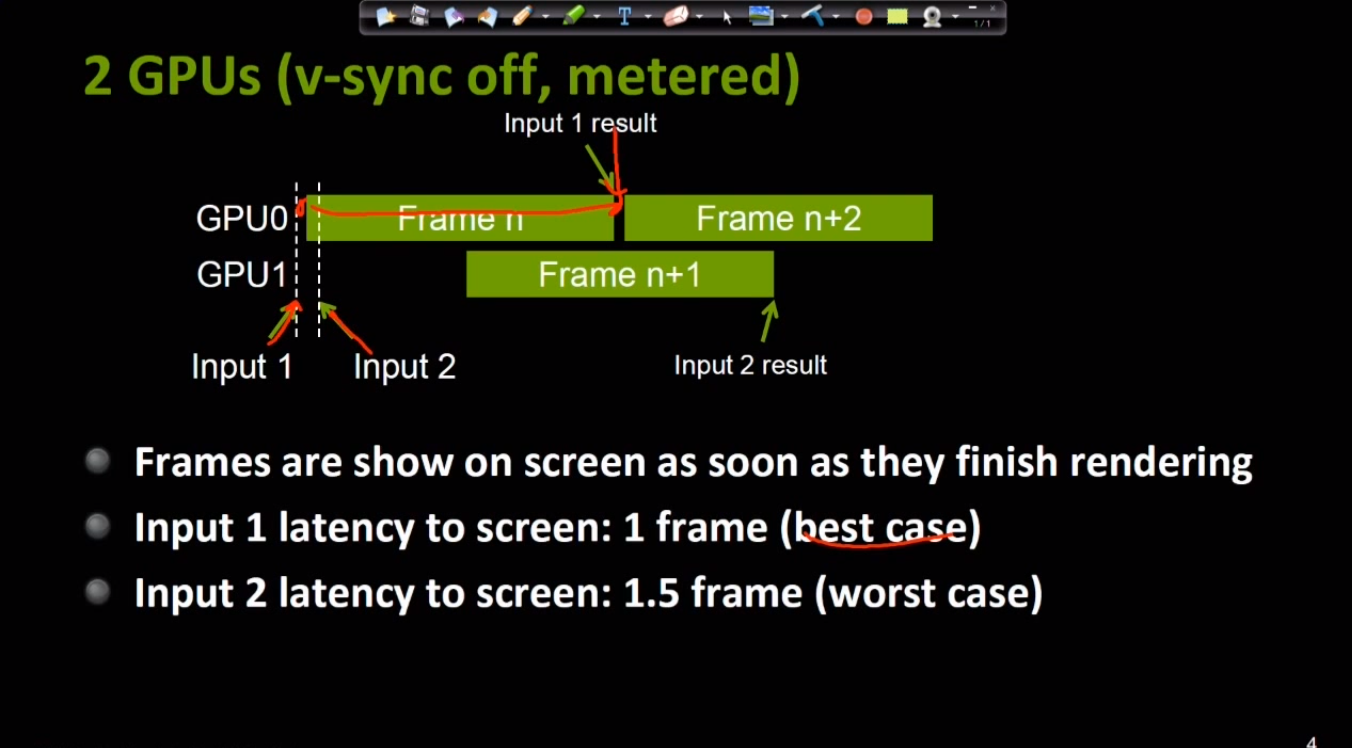
According to nVidia their frame pacing actually reduces input lag!

9099159543_c3367fa812_o.png


Hopefully AMDs does the same!
 

24601

Golden Member
Jun 10, 2007
1,683
40
86
According to nVidia their frame pacing actually reduces input lag!

9099159543_c3367fa812_o.png


Hopefully AMDs does the same!

I think they mean "usable" input lag.

As in input to display change of a significant part of the screen.

Micro-stutter technically gives 0 added input lag if you set context queue and maximum per-rendered frames to 0, however, those frames are effectively not displayed to the end user, due to how monitor signaling works.

1/100th or 10/100th of the screen being drawn before a new frame being sent doesn't give usable context feedback back to the user.
 

wand3r3r

Diamond Member
May 16, 2008
3,180
0
0
The 690 has hardware frame metering and is the only card that does.

All other NV cards have software metering in SLI. There is no magic circuitry in single gpu cards, but they did say there is something on the 690 board to align the frames.
 

Black Octagon

Golden Member
Dec 10, 2012
1,410
2
81
The 690 has hardware frame metering and is the only card that does.

All other NV cards have software metering in SLI. There is no magic circuitry in single gpu cards, but they did say there is something on the 690 board to align the frames.

That is exactly what I had understood
 

bystander36

Diamond Member
Apr 1, 2013
5,154
132
106
The way it is written hear, I think all their cards have hardware frame metering. There is no reason it has to only be on the 690.

http://techreport.com/review/21516/inside-the-second-a-new-look-at-game-benchmarking/11
In fact, in a bit of a shocking revelation, Petersen told us Nvidia has "lots of hardware" in its GPUs aimed at trying to fix multi-GPU stuttering. The basic technology, known as frame metering, dynamically tracks the average interval between frames.

It did say GPUs, not a specific GPU.