• We’re currently investigating an issue related to the forum theme and styling that is impacting page layout and visual formatting. The problem has been identified, and we are actively working on a resolution. There is no impact to user data or functionality, this is strictly a front-end display issue. We’ll post an update once the fix has been deployed. Thanks for your patience while we get this sorted.

AMD Carrizo Pre-release thread

Page 26 - Seeking answers? Join the AnandTech community: where nearly half-a-million members share solutions and discuss the latest tech.
Re-checked Agners guide and the discrepancy you list would be due to the more versatile memory pipeline Jag has. That'd definitely help both SIMD and Int performance.

Apologies, been awhile since I checked 🙂

You re welcome, and no apologies needed, we all make such little innaccurate estimation from time to time.
As for A. Fog nice link for the whole of us, indeed i downloaded most of his PDFs some times ago..🙂


You could have used a better Atom, even if you stick to the name. And the Beema is alsmost twice the TDP.
http://ark.intel.com/products/family/29035/Intel-Atom-Processor#@All

Not that it changes much. However its not exactly impressive either unfortunately. 2 snails in a snailrace for the recycling yard.

Twice the power doesnt buy you that much perfs actualy, grossly it s a square root law function, that is 2x the power allow you 40% more perfs with a same CPU, not that much given the resulting perf/watt trade.

At half the power a Beema, or whatever CPU, would have 30% lower perfs, and of course 40% better perf/watt.
 
Last edited:
Godavari Sample Defenition and schedule

2rpd6iv.jpg


Source (chinese.vr-zone.com)
 
I can't make any sense of Godavari....the Athlon is called 870K but is clocked lower than the 860K.

How does that even add up?!?!? If the refresh solely gains performance on clocks...then the 870K shouldn't exist.

Either the entire picture is just some false hype...or at least the 870K is a mistake on that list. (860K already clocks at 3.7 -> 4.1)
 
Last edited:
I can't make any sense of Godavari....the Athlon is called 870K but is clocked lower than the 860K.

How does that even add up?!?!? If the refresh solely gains performance on clocks...then the 870K shouldn't exist.

Either the entire picture is just some false hype...or at least the 870K is a mistake on that list. (860K already clocks at 3.7 -> 4.1)

I wouldnt say either. Refreshes don't always play well with existing naming schemes...

The Vishera refresh pretty much gutted any existing naming schemes, adding "E"'s everywhere and weirdly positioned SKUs.
 
I can't make any sense of Godavari....the Athlon is called 870K but is clocked lower than the 860K.

How does that even add up?!?!? If the refresh solely gains performance on clocks...then the 870K shouldn't exist.

Either the entire picture is just some false hype...or at least the 870K is a mistake on that list. (860K already clocks at 3.7 -> 4.1)

I dont think that AMD will replace the current line with lower performing parts...
 
I dont think that AMD will replace the current line with lower performing parts...

Well...then that picture must be wrong..which makes me question its' legitimacy even more.

If Godavari truly is a pure refresh made in the exact same process and only gains performance from clocks...then the 870K can not exist in that form.
 
Well...then that picture must be wrong..which makes me question its' legitimacy even more.

If Godavari truly is a pure refresh made in the exact same process and only gains performance from clocks...then the 870K can not exist in that form.

Actualy if we except the top binned SKU about all other replacements have lower frequencies that the parts they are supposed to replace, so either the frequencies are wrong or they fixed a few issues that helped improve IPC, otherwise almost all thoses SKUs would not make sense.
 
Actualy if we except the top binned SKU about all other replacements have lower frequencies that the parts they are supposed to replace, so either the frequencies are wrong or they fixed a few issues that helped improve IPC, otherwise almost all thoses SKUs would not make sense.

Well the top of the line APU has a higher GPU Clock and slightly higher CPU clock.

I still don't see how this won't turn into even worse throttling..but hey...that's none of AMDs business *cough*

But yea...if the AMD 8K has 4.1 boost...then the 870K should also have 4.1 boost...cuz..y'know...Athlons are just the same thing without graphics.


That said...what does the "No stacks planned for Athlon no-GPU parts" mean?
 
Last edited:
Eh?

Kaveri beats Richland
FX 300 beats FX 100
R9 Flagship beats HD flagship.

So at least they haven't done it recently. 😵

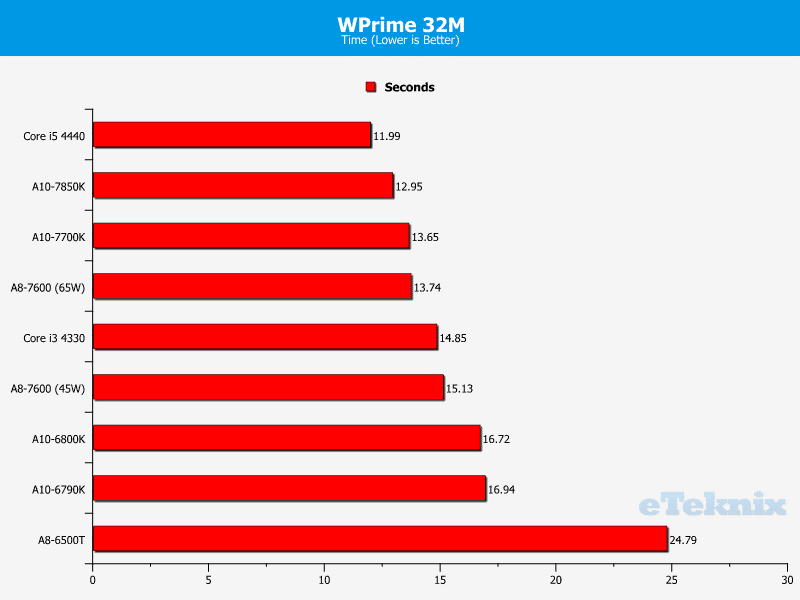
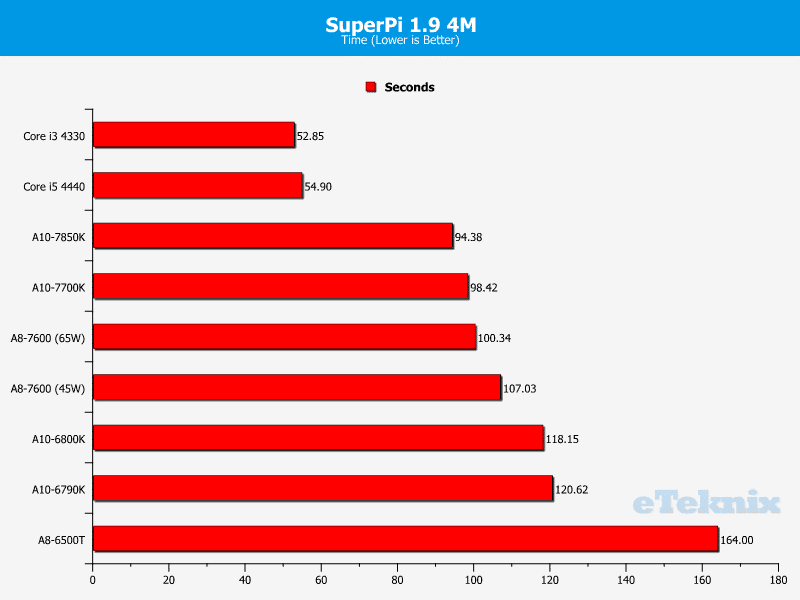
At the top end the a10-6800k pretty much ties with the a10-7850k in terms of CPU performance.

Some wins, some losses. But overall not a clear gain.
 
Wow, wPrime and SuperPi scores, how relevant. Now let's see some real benchmarks:

http://www.hardware.fr/articles/913-7/cpu-performances-applicatives.html

Almost equal MT performance to A10-6800K Richland (both apps and games). Unless BGA-only 35W Carrizo magically outperforms older 95W parts CPU-wise that essentially means AMD failed to improve the CPU performance of its fastest APU from mid 2013 till Zen's launch sometime in H2/2016.
At the same power consumption not tdp Kaveri wins most benches from Richland. There is an uplift it just isn't very apparent due to lower clocks versus Richland.

Carrizo should be better though I don't know how much it will bring on the cpu front.
 
At the same power consumption not tdp Kaveri wins most benches from Richland. There is an uplift it just isn't very apparent due to lower clocks versus Richland.

Carrizo should be better though I don't know how much it will bring on the cpu front.

Yes but performance has gone nowhere. Compare Kaveri to PII x4 980. No gain.
 
Yes but performance has gone nowhere. Compare Kaveri to PII x4 980. No gain.

Ah, the old "Construction cores are inferior to K10.5" trope. Tell you what.

The 980 was a Black Edition chip, meant for overclocking, though in all fairness, it was close to its realistic clockspeed wall @ stock anyway. Very little headroom except maybe if you put it on the right AM3+ board and dump volts on it, and even still, that trick worked better on Zosma/Thuban than Deneb. Even still . . . it's a BE.

edit: man half my post got lost, what gives? Anyway, I'll take my 7700k @ 4.7 over a C3 Deneb any day of the week, in nearly anything. At least Thuban can handle more threads (and hit higher clocks than Deneb).
 
Last edited:
Yes but performance has gone nowhere. Compare Kaveri to PII x4 980. No gain.

The 980 has a L3 cache wich Kaveri is deprived of, in hfr link there s a phenom 955 and a L3 cacheless 840 at same frequency, you can see the influence of the cache and can normalize perfs with frequency.
 
With Carrizo being a full HSA 1.0 part, will it be able to use hUMA to utilize pointers instead of copies reducing memory bw needs? Or is that something that can't be done @ the driver level and needs to be written in software? From my understanding HSA was supposed to unify the memory pool IE; no more alloticating IGP memory.
 
but isn't perf/watt all the rage nowadays? if so there has been a tonne of improvements.

Yeah, but the competition also improved. Now AMD has a bigger performance deficit and a bigger performance/watt deficit. 980 was a better product for its time than Kaveri will ever be.
 
Yeah, but the competition also improved. Now AMD has a bigger performance deficit and a bigger performance/watt deficit. 980 was a better product for its time than Kaveri will ever be.

Oranges to Apples, Kaveri is an APU, it has a CPU + iGPU. Phenom II 980 was a CPU.

Also, 980 was replaced by 1090T and that was replaced by FX8350. All of them are CPUs at 125W TDP.

Edit: It is like comparing Core i5 760 to Core i3 Haswell, oranges to apples 😉
 
Last edited:
Back
Top