• We’re currently investigating an issue related to the forum theme and styling that is impacting page layout and visual formatting. The problem has been identified, and we are actively working on a resolution. There is no impact to user data or functionality, this is strictly a front-end display issue. We’ll post an update once the fix has been deployed. Thanks for your patience while we get this sorted.

AMD Bristol/Stoney Ridge Thread

Page 4 - Seeking answers? Join the AnandTech community: where nearly half-a-million members share solutions and discuss the latest tech.
Was Bristol Ridge updated with the new UVD block to support both profiles? IMO, it would be a bit dishonest to talk up HEVC support to such an extent if it omits the profile needed for most real-world applications.

There are no physical differences between BR and CZ. Stoney Ridge is the only design which support 10-bit HEVC. It has newer UVD and security processor than CZ or BR.
 
A full Carrizo die PS has never been published (AFAIK), but with AMD released on on Bristol Ridge.

I thought that Carrizo shot was of the full die, and the Bristol Ridge shot was actually ~1.2 dice? The "new" parts are duplicates of existing structures on the opposite side of the picture, i.e. they included parts of the neighbouring dice.
 
Carrizo and Bristol Ridge are both the same, full die. AMD just never released an uncropped poly shot (image of the die) for Carrizo. For "Bristol Ridge" they did, with altered coloring (file name "recolor").
 
Carrizo and Bristol Ridge are both the same, full die. AMD just never released an uncropped poly shot (image of the die) for Carrizo. For "Bristol Ridge" they did, with altered coloring (file name "recolor").

Oh I agree that they're certainly the same die 🙂 I just think that Carrizo was the uncropped shot, and the Bristol Ridge shot is "overscanned".
 
Oh I agree that they're certainly the same die 🙂 I just think that Carrizo was the uncropped shot, and the Bristol Ridge shot is "overscanned".

Actually you're right 😀
Carrizo shot isn't cropped but Bristol Ridge is captured on a uncut wafer.
 
How low in tdp could stoney scale ?

Would it be feaseble for it to run at something like 5-7W tdp ?
 
I believe i show somewhere 6W TDP, could be mistaken though.

If this will be cheap enough and would scale down, it would be a great replacement for atom chips, that intel is killing off.
There is still no x86 based tv box, that would support vp9, hevc hi10 in hardware.
 
10W is the minimum cTDP configuration value for models released so far. 9410 is the only model which supports cTDP > TDP configuration.
 
Very happy to see Stoney Ridge equipped with HDMI 2.0, 10 bit H265, VP9, etc.

Next step (assuming an inexpensive Mini-ITX board gets released that I can acquire for testing) is too see how it can game with simple (yet popular) titles like Team Fortress 2. My Athlon 5350 definitely had enough GPU, but not enough CPU:

http://forums.anandtech.com/showpost.php?p=36794469&postcount=287

I'm done with the first phase of multiplayer testing for Athlon 5350 on Team Fortress 2.

(This phase involved changing resolution with the lowest detail settings being used as a constant.)

Some basic observations:

1. The game appears to spread the load out primarily to three cpu cores. (Activity does exist on core four, but it is extremely light)

2. Some player character classes appear to stress the game more than others. For example, I seem to get the lowest frame rates while playing the Scout.

3. According to FRAPS minimum frame rates have dropped to as low as 16 on multiple logs. I have tested this on resolutions as low as 800 x 600 with lowest settings and it still happens.

4. Determining average frame rate is extremely difficult because once my player dies (and I am waiting to respawn) the frame rate shoots up much higher than what it was in game. With that mentioned, average frame rate appears to be > 30 FPS up to 1920 x 1080 (lowest settings). Some variation in average FPS appears to be dependent on map and number of players.

Overall, I will give the Athlon 5350 a pass (for casual gamers) on Team Fortress 2 up to 1920 x 1080 (lowest settings). However, the minimum frame rates reported by FRAPs can be alarmingly low. As I have mentioned, lowering resolution does not help the reported minimums. Ideally I would like to see AM1 with a higher clock on the CPU in order to help the minimum FPS.

 
Last edited:
If this will be cheap enough and would scale down, it would be a great replacement for atom chips, that intel is killing off.
There is still no x86 based tv box, that would support vp9, hevc hi10 in hardware.

Besides the TV box, maybe a PC TV? This way the power consumption of the Stoney Ridge chip can be greater than 6W.

If Smart TVs have ARM, Android, TV tuner behind one screen I figure why not have x86, Windows and TV tuner behind one screen.

And maybe with TV tuners being mated to x86 hardware out of the box (instead of being relatively esoteric hardware) Microsoft will bring back Windows Media center to Windows 10?

EDIT: With a M.2 SSD the PC/TV/All-in-one should boot very quickly and with the configuration set to "boot directly into Media Center" it could have a very TV like feel for people that want that.

Side Note: At one time ATI (now owned by AMD) was involved with TV tuners. They even had All in Wonder video cards which combined GPU and TV tuner in one AIB.

cd732b03cbb320cfcaff1c3064807386.jpg


So maybe even some Stoney Ridge "All in Wonder" thin mini-itx boards?
 
Last edited:
Isn't video decoding a separate block, that has nothing to do with the actual GCN architecture ?
Eg you could have GCN1.0 and full HEVC+VP9 decoding.
 
Very happy to see Stoney Ridge equipped with HDMI 2.0, 10 bit H265, VP9, etc.

Next step (assuming an inexpensive Mini-ITX board gets released that I can acquire for testing) is too see how it can game with simple (yet popular) titles like Team Fortress 2. My Athlon 5350 definitely had enough GPU, but not enough CPU:

http://forums.anandtech.com/showpost.php?p=36794469&postcount=287

You can still OC the chip up to 2.5 Ghz on air.

And still the bottleneck becames the RAM
 
You can still OC the chip up to 2.5 Ghz on air.

And still the bottleneck becames the RAM

My board (MSI AM1l) doesn't have overclock options.

Also when I compared Athlon 5350 with A6-5400K the difference in performance was like night and day (even with the A6-5400K using single channel...although it was 1866 speed compared to the 5350's 1600).

From my vantage point the major problem appeared to be lack of single thread.
 
Isn't video decoding a separate block, that has nothing to do with the actual GCN architecture ?
Eg you could have GCN1.0 and full HEVC+VP9 decoding.

Yes.
Both UVD and VCE are separate blocks.
Carrizo and Bristol support decoding H.264 & HEVC (8-bit) up to >= 4K and 4K H.264 encoding. There is no support what so ever for 10-bit HEVC or VP9. Stoney Ridge has 10-bit HEVC decode capability, but still lacks VP9 decode and HEVC encode capability completely.

It is possible to accelerate decoding of the unsupported codes through OpenCL (3rd party codecs), however there are major issues such as artifacting and stuttering. Also now days pure software decoding through open source LibAV provides significantly better performance than the hybrid OpenCL solution, for both of the unsupported codecs.
 
With Stoney Ridge supporting PCIe 3.0 is there any reason to expect it would not support M.2 (PCIe 3.0 x 4).

(AM1 boards typically came with PCIe 2.0 x 4 slots)
 
There are eight GPP PCI-E links on Stoney, so M.2 support is just a matter of ODMs preferences. AMD FP4 CRBs also have M.2 slot on them.
 
The AT article contains some slides, incl. this one:
Bristol%20Ridge%20Tech_FINAL-page-009_575px.jpg

http://www.anandtech.com/show/10362/amd-7th-generation-apu-bristol-ridge-stoney-ridge-for-notebooks

What I had in mind was this:
[CTI images removed]

Further information:
Joe Macri said:
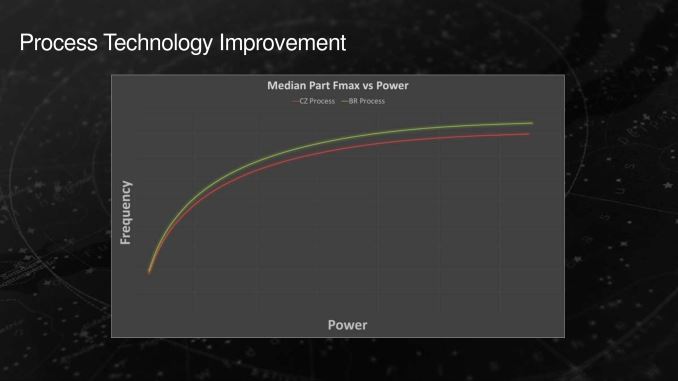
"We didn't change the shape of the transistor, but we changed transistor implant and gave the transistor much more mobility," explained Macri to Ars. "At any given voltage, we get more current out. It's typically what you'd call a process variant. GlobalFoundries did a great piece of work here. We basically got an extra 200MHz or so out of the core, for a nice 10 percent boost in performance, which is greater than what you typically get out of a simple process tweak. But this wouldn't have made a new product. I wouldn't be calling this a seventh generation product if all we did was get this."
http://arstechnica.com/gadgets/2016/05/amd-fx-bristol-ridge-apu-specs-performance/
 
If I was a billionaire, I would order a full analysis of "Carrizo" and "Bristol Ridge" from Chipworks :sneaky:

I wonder why didn't they implement those marvelous changes in "Carrizo" to begin with. The 28nm HPP process wasn't exactly new, nor Carrizo in the schedule by the time AMD finally managed to pop it out.
 
Serious question here: could this compete with Core m3 parts? If I were AMD right now, I would be integrating systems that looked something like this:

11.6" 1600x900 screen
Metal body
128GB mSATA SSD
4-8GB of RAM

By passing on useless gimmicks like 360-degree hinges and touchscreens, AMD could invest in build quality and SSDs and produce fairly cheap and rather reliable machines. Think something like "Eee PC on steroids" here, or a metal version of the old Thinkpad X100-series.
 
I'm confused about VP9. All the sites report the there is VP9 support, and even anandtech implies that UVD handles VP9 decode "...the upgraded video decoder and codec engine, and thus support for VP9 and HEVC decode in AMD’s lowest parts."

Why are people saying that there is no VP9 decode in the APU?
 
Back
Top