• We’re currently investigating an issue related to the forum theme and styling that is impacting page layout and visual formatting. The problem has been identified, and we are actively working on a resolution. There is no impact to user data or functionality, this is strictly a front-end display issue. We’ll post an update once the fix has been deployed. Thanks for your patience while we get this sorted.

AMD Beema/Mullins Launch Thread

Page 6 - Seeking answers? Join the AnandTech community: where nearly half-a-million members share solutions and discuss the latest tech.
One thing to look at is that beema top bin is stated as "Up to 2.4Ghz" clock, but don't turbo to this frequency the whole time.


Anyway, seems AMD made a big progress in efciency matter without an architectural change and this is awesome. Even if Mullins fails on mobile front is a big win for AMD, once is their first strike on this market.

TechReport and ExtremeTech are both reporting that the A6-6310 has a 2.4 GHz turbo and a 2.0 GHz base clock. The rest of the Beema processors don't implement turbo.

Even if Mullins is a farce, the more believable Beema parts are still a really solid update IMO.

A6-5200 -> A6-6310 (20% higher CPU [turbo], 33% higher GPU, TDP from 25W > 15W)
A4-5000 -> A4-6210 (20% higher CPU, 20% higher GPU)
E1-2500 -> E2-6110 (2x cores, 7% higher CPU, 25% higher GPU)
E1-2100 -> E1-6010 (35% higher CPU, 15% higher GPU)
 
"Likely" is neither a number nor any metric that would be a valuable argument, which render the rest of your sentence without any sense.

I'm not launching a personal attack or anything but will you please stop taking my posts so obtusely.

Why exactly did I use 'likely'? I gave a reason and a valid reason too. 22nm trigate vs. 28 nm.

"Likely" is simply my guess. As the answer is not known I am simply speculating.

Likely is a perfectly useful and valid quantifier. It is an extremely valid argumentative quantifier used to indicate a strong but not absolute bias in an event toward an outcome with a moderate acknowledgement that the desired event may not occur.

By your logic the statement: "It is likely that runner one with a 20% head start will run the race against runner two who must run the entire distance" is wrong. Or in a more extreme case: "It is likely that my lottery ticket will not win the jackpot". Or:"At a casino I am more likely to lose money than win money."

These statements shows that likely is an extremely useful quantifier. You don't know if runner one is average joe and runner two is Usain Bolt (in which case runner two would win); this does not however prove the statement false. Taking two random runners, the one with the 20% head start is likely to win but this outcome is not a given. You could have a winning ticker or be a card counter but the statements above are looking at circumstances that not extreme (ie average behaviour).

Please understand that my statement was not 'fact'. It was speculation, a guess, and I freely admitted so. Nevertheless I supplied a reason for my guess and if you would like to discuss, aiming at that reason would be great.

I have no idea how much power this chip is using (no one does at this point) but baytrail is likely ahead in terms of perf/W. 22nm trigate vs. 28 nm planar is hard to overcome.
 
TechReport and ExtremeTech are both reporting that the A6-6310 has a 2.4 GHz turbo and a 2.0 GHz base clock. The rest of the Beema processors don't implement turbo.

Even if Mullins is a farce, the more believable Beema parts are still a really solid update IMO.

A6-5200 -> A6-6310 (20% higher CPU [turbo], 33% higher GPU, TDP from 25W > 15W)
A4-5000 -> A4-6210 (20% higher CPU, 20% higher GPU)
E1-2500 -> E2-6110 (2x cores, 7% higher CPU, 25% higher GPU)
E1-2100 -> E1-6010 (35% higher CPU, 15% higher GPU)

Well, at a 15W TDP the main problem is that intel has full blown Haswell U and Y core CPUs at 11-15W TDP which are far superior in performance. It really isn't even a contest past 10W TDP, intel wins hands down with Haswell there. Although AMD will obviously market it as a lower cost, lower performance chip for lower end devices. Cuz AMD isn't going to touch Haswell past 10W TDP, isn't going to happen. Oh. Oddly enough. Those full blown Haswell core i5 CPUs with 11-15W TDP are getting 12 hours of battery life in the macbook air. I'd say it's a safe bet that AMD isn't going to touch that performance of Haswell architecture nor remotely match the efficiency/battery life.

All of that is fine on the surface, if those 15W TDP parts can deliver decent PPW and provide "decent" performance with 7+ hours of battery that could be okay. While they can't match Haswell, they can still deliver a decent product alternative. And as annoying as the lack of battery life tests are on these chips, more choice is better than less choice for competition.

Anyway... I'm more interested in the 5W tablet parts in terms of what battery life they offer at the given performance, which as mentioned, AMD has prohibited reviewers from sharing. So basically the metric that matters for mobile cannot be determined until a device actually pops up using the chip. As mentioned earlier you can take any architecture from the past year and make it dominate the benchmarks with aggressive turbo clockspeeds. The question is, at what battery life does it get those benchmarks at. 3 hours? 4 hours? If that's the case, then 3-4 hours is pathetic. Performance / turbo clockspeeds will just be crippled to get battery life to acceptable levels, in other words the 7+ hour area. Obviously AMD doesn't want us to know. And if they don't want to share it, well, i'd say not good. But like everything AMD, we'll just play the waiting game and wait for history to repeat I suppose.

That said I could see these being decent replacement chips for desktop kabini. But for mobile, AMD is not going to beat haswell past 10W TDP and I don't see the 4-5W TDP tablet parts having great performance per watt or battery life. I really wish an actual "real world consumer" device could be tested using the chip, because that would give us relevant mobile data. Right now we have no relevant mobile benchmarks, period. Everything is put in context by battery life when it comes to mobile benchmarks.

 
Last edited:
Well, at a 15W TDP the main problem is that intel has full blown Haswell core CPUs at 13-15W TDP which are far superior in performance. It really isn't even a contest at 13-15W TDP, intel wins hands down with Haswell there. Although AMD can try to mess with the low cost / low performance alternative. Cuz AMD isn't going to touch Haswell past 10W TDP, isn't going to happen.

Obviously not against i5s and i7s, but now with the 2.4 GHz turbo, 800 MHz GPU clock, and reduced TDP the A6-6310 is fairly competitive with Haswell i3s. Much more so than the A6-5200 was with the Ivy Bridge i3s, anyway.
 
This looks very nearly like a clean sweep in the benchmarks for AMD. I was pretty impressed with the 3770, but this is way more impressive not only from a pure performance standpoint but AMD did it with a 28nm process vs a 22nm Intel process.

All that said, there need to be some shipping tablets out before the holidays. If they can't get that then Intel will probably catch back up with Cherry Trail.

Although, Cherry Trail will need a solid 50%+ bump in GPU and around 30% CPU over Bay Trail just to match AMD in this segment now. And of course, this has a bunch of 4W chips overlapping into 12W - 15W laptop chip performance segments now.
 
Well, at a 15W TDP the main problem is that intel has full blown Haswell core CPUs at 11-15W TDP which are far superior in performance. It really isn't even a contest past 10W TDP, intel wins hands down with Haswell there. Although AMD can try to mess with the low cost / low performance alternative that they're so familiar with. Cuz AMD isn't going to touch Haswell past 10W TDP, isn't going to happen.

Haswell ULV ultrabooks do not sell in the same price segment as Beema thin and light notebooks. Beema needs to be priced properly to succeed. Notebooks at USD 350 - 400 and tablets at USD 250 - 300. AMD's Kaveri will go against the Core i3 and Core i5.

I'm more interested in the 5W tablet parts in terms of what battery life they offer at the given performance, which as mentioned, AMD has prohibited reviewers from sharing. So basically the metric that matters for mobile cannot be determined until a device actually pops up using the chip. As mentioned earlier you can take any architecture from the past year and make it dominate the benchmarks with aggressive turbo clockspeeds. The question is, at what battery life does it get those benchmarks at. 3 hours? 4 hours? If that's the case, then 3-4 hours is pathetic. Performance / turbo clockspeeds will just be crippled to get battery life to acceptable levels, in other words the 7+ hour area. Obviously AMD doesn't want us to know. And if they don't want to share it, well, i'd say not good. But like everything AMD, we'll just play the waiting game and wait for history to repeat I suppose.
you need to hold on for a month. If OEM designs don't show up at Computex, AMD has not achieved anything. All this performance is of no use without key OEM design wins. A review of a shipping tablet will reveal whether AMD is competitive on battery life. btw a 4.5w TDP and 2.8w SDP means AMD will be competitive in battery life. It obviously cannot have half the battery life at those TDP/SDP ratings.

Your pessimism on AMD is well known. so go ahead. don't believe anything.
 
Well, at a 15W TDP the main problem is that intel has full blown Haswell U and Y core CPUs at 11-15W TDP which are far superior in performance. It really isn't even a contest past 10W TDP, intel wins hands down with Haswell there. ....

That's not really true.

Intel's top ULV Pentium is the 2117U which has a TDP of 17W
AMDs A5-5000 is a 15W TDP part.
Intel's top ULV i3 is the 3217U also a 17W part


Passmark is 1909 for the AMD A4-5000
Passmark is 1643 for the Pentium 2217U
Passmark is 2298 for the i3-3217U


If we interpolate a 20% higher score for Beema vs the 1909 Jaguar, we get 2290. With the improved GPU, it will probably be a bit higher.

That would tie Beema with the Haswell i3 ULV chip, with similar / slightly lower TDP.

Now we can pick passmark apart etc, but the point is that this new chip will pass up ULV pentiums and land pretty solidly in i3 territory (esp given that this is Intels top ULV i3 Haswell laptop chip).

And I am comparing one down on the AMD lineup to top of the line Intel ULV Pentium / i3.

Now ULV i5, not so much. The top of the line beema looks like it might scratch the bottom of the ULV i5.


References :
http://en.wikipedia.org/wiki/Consumer_Ultra-Low_Voltage#Pentium_.2822_nm.29_2
And :
https://en.wikipedia.org/wiki/Jaguar_(microarchitecture)

http://www.cpubenchmark.net/cpu.php?cpu=Intel+Core+i3-3217U+@+1.80GHz&id=764

http://www.cpubenchmark.net/cpu.php?cpu=Intel+Pentium+2117U+@+1.80GHz&id=1872

http://www.cpubenchmark.net/cpu.php?cpu=AMD+A4-5000+APU
 
Yeah, it's just too bad AMD is intentionally hiding battery life. That would give us the answer, but with AMD hiding it, i'm sure THAT's a "valuable argument". If AMD is hiding it, that means it isn't good, period. That means real devices will have to lower turbo or do away altogether for proper battery life in mobile devices. It seems AMD prohibited reviewers from even testing the MOST VALUABLE mobile metrics of all.

Funny how you and others never mentioned anything about Intel hiding/prohibiting battery life in the BayTrail Anandtech review.

Hypocrisy in all its glory.

Thread crapping and personal attacks will NOT be tolerated. This is a tech discussion. Leave meta discussions about other posters to yourself
-ViRGE
 
Last edited by a moderator:
Funny how you and others never mentioned anything about Intel hiding/prohibiting battery life in the BayTrail Anandtech review.

Hypocrisy in all its glory.

Don't worry.
Anyone who has spent a considerable time on these Forums would be well aware of the mindset & reputation of certain people.

Thread crapping and personal attacks will NOT be tolerated. This is a tech discussion. Leave meta discussions about other posters to yourself
-ViRGE
 
Last edited by a moderator:
The A10 naming controversy is hilarious, considering that there is not a single mobile quad core i5, and there are even dual core i7s. The A10 tablet chip is the only really interesting one to me here. I was hoping for the top Beema chip to live up to AMD's projections in CPU performance, but it seems like it'll be sort of stagnant (possibly a slight improvement in power consumption, but the A6-5200 wasn't really a power hog to begin with). I think A6-5200 is sort of bare minimum in a laptop I'd recommend someone, and I was hoping Beema would bring the A6 up another level (and prop up the median performance in the 300-330 dollar laptop range, where a lot of people shop).
 
Funny how you and others never mentioned anything about Intel hiding/prohibiting battery life in the BayTrail Anandtech review.

Hypocrisy in all its glory.

It's definitely premature to make any power comments. In addition AMD or Intel letting people test power on a reference platform that will never be for sale to consumers isn't that informative. But you are quite right, don't recall anyone raging over Intel's lack of pre-launch power testing of Bay Trail.

The meta commentary may not be an attack on another poster, but it is unnecessary and serves to derail the thread. Please don't do it.
-ViRGE
 
Last edited by a moderator:
The question is, at what battery life does it get those benchmarks at. 3 hours? 4 hours? If that's the case, then 3-4 hours is pathetic.

I havent seen any BayTrail Z3770 Tablet having more than 3-4 hours Battery life at full load. So I guess BayTrail is pathetic by your standards as well.

Nice to know.
 
Last edited:
Funny how you and others never mentioned anything about Intel hiding/prohibiting battery life in the BayTrail Anandtech review.

Hypocrisy in all its glory.

Second page, in between the graphs.

"I had Intel measure SoC power at the board level while running a single threaded Cinebench 11.5 run on the Atom Z3770 and saw a range of 800mW - 1.2W."

"Once again, looking at SoC power however the Atom Z3770 pulls around 2.5W in this test."

http://www.anandtech.com/show/7314/intel-baytrail-preview-intel-atom-z3770-tested/2

But you are quite right, don't recall anyone raging over Intel's lack of pre-launch power testing of Bay Trail.

:whiste:

Don't instigate
-ViRGE
 
Last edited by a moderator:
It's definitely premature to make any power comments. In addition AMD or Intel letting people test power on a reference platform that will never be for sale to consumers isn't that informative. But you are quite right, don't recall anyone raging over Intel's lack of pre-launch power testing of Bay Trail.

Yes, everyone could say that they would wait for actual consumer product reviews and judge battery life and performance per watt etc. Actually that is what Im waiting for, real products in the market to compare against the competition.
But the fact remains that at 4.5W TDP you can have a fan-less Quad Core A10 Micro-6700T Tablet that is faster both in CPU and GPU than any Intel ATOM Tablet (BayTrail 3770 has 4W TDP).
 
@shady28 - why would cherry trail need 30% CPU perf bump over bay trail. bay trial and mullins are pretty much similar in CPU perf. i think 10-15% CPU perf bump over bay trail should be enough
GPU is a different scenario though
 
Single Thread nice, where are the Battery life tests ???

:whiste:

The second quote is multithreaded, as you would know if you read the review. You know, the one you linked as proof that Intel tried to hide Bay Trail power consumption.
 
The second quote is multithreaded, as you would know if you read the review. You know, the one you linked as proof that Intel tried to hide Bay Trail power consumption.

Again, where are the Battery life tests ???

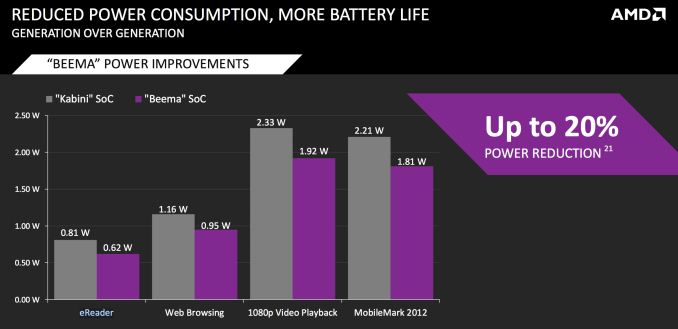
Also, AMD has shown power usage related measurements as well. So what is the problem of people here again ???

Screen-Shot-2014-04-29-at-1.06.11-AM_575px.jpg


You are this close to a vacation. Cool it, Ra. And be nice to other posters
-ViRGE
 
Last edited by a moderator:
The second quote is multithreaded, as you would know if you read the review. You know, the one you linked as proof that Intel tried to hide Bay Trail power consumption.
So you're extrapolating the battery life of the test platform using Baytrail power consumption, what happened to all the other (more) important components like the display :hmm:
 
So you're extrapolating the battery life of the test platform using Baytrail power consumption, what happened to all the other (more) important components like the display :hmm:

Display type and size isn't tied to the SoC. Measuring battery life (platform power) is a rough way to estimating SoC power because of the components you included, so knowing exactly how much the SoC draws is more valuable for the purposes of evaluating a tablet SoC. The criticism that Intel only provided SoC power and not platform power is just inane.
 
I would wait for Tablets or Notbooks to be commercially available before declaring this great or terrible product. People really need to stop defend/attack this product on power consumption area since we have very limited information related to battery life, temperatures, etc.

What I will say now is that the performance is simply amazing given that it was achieved on the somewhat ancient 28nm. Rory sure is running a very lean (mean) operation and is putting up a fight against much healthier competition. Well done.
 
Last edited:
I don't think AMD are intentionally keeping battery life data from us. The problem is that they only have a handful of these "Discovery" tablets, not enough to send out as press samples. (This was mentioned in one of the Beema reviews- I can't recall which, but I'll go dig it up if people like to.) Battery life tests are by their very nature something that takes a very long time to do, especially if you want to do it right and repeat your tests, and are only really feasible if reviewers have a device in their possession for a prolonged period of time.

Hopefully we will see some proper battery life tests when/if a Beema tablet launches. Until then we have to take these performance results with a pinch of salt, and hope that AMD haven't done a Tegra.
 
Also they dont want to send out battery life measurements, because battery life depends on the particular tablet or notebook. Some might have a bigger battery, or an SSD, or a smaller screen. Or a more efficient screen. Providing battery life figures for the Discovery Tablet, which is the only hardware AMD has at the moment, is meaningless. People would try to compare it to tablet X, Y and Z, but would really only be comparing the tablets to each other, not the chipsets used. So I think AMD doesnt want people to make premature comparisons and extrapolations.

Regarding actual power draw, they never like giving that out. I suppose its because they think that the actual power usage of the chip depends heavily on what it is being used for as well as what environment it is in.
 
I'm not launching a personal attack or anything but will you please stop taking my posts so obtusely.

Why exactly did I use 'likely'? I gave a reason and a valid reason too. 22nm trigate vs. 28 nm.

"Likely" is simply my guess. As the answer is not known I am simply speculating.

Likely is a perfectly useful and valid quantifier. It is an extremely valid argumentative quantifier used to indicate a strong but not absolute bias in an event toward an outcome with a moderate acknowledgement that the desired event may not occur.

By your logic the statement: "It is likely that runner one with a 20% head start will run the race against runner two who must run the entire distance" is wrong. Or in a more extreme case: "It is likely that my lottery ticket will not win the jackpot". Or:"At a casino I am more likely to lose money than win money."

These statements shows that likely is an extremely useful quantifier. You don't know if runner one is average joe and runner two is Usain Bolt (in which case runner two would win); this does not however prove the statement false. Taking two random runners, the one with the 20% head start is likely to win but this outcome is not a given. You could have a winning ticker or be a card counter but the statements above are looking at circumstances that not extreme (ie average behaviour).

Please understand that my statement was not 'fact'. It was speculation, a guess, and I freely admitted so. Nevertheless I supplied a reason for my guess and if you would like to discuss, aiming at that reason would be great.

Sorry if you understood it as a personnal attack but it was in no way my intention, i just wanted to point that so far we have no hard info about processes involved and not even real measurements of the competing solutions but from the said 19/40% numbers we can confidently assume that there s much more than just TDP management as you re suggesting even if, according to Hardware.fr, the 25W moniker of the previous generation was somewhat exagerated wich would render the published numbers not as flashy but neverless quite impressive given that this is still the same node size wise.

I benefit from this post to add that generaly i find all power measurements from various sites as extremely unprofessional, while benches will give about the same scores from one site to another power measurements for thoses low power solutions can vary within almost a 2 ratio but still no one seems to care that such a discretanpcy would be undoubtly questionned if it was Cinebench or Firestrike, most ironic is that if people working in that industry would perform measurements with such random methodology they would be immediatly fired for incompetence.
 
Back
Top