
-
We’re currently investigating an issue related to the forum theme and styling that is impacting page layout and visual formatting. The problem has been identified, and we are actively working on a resolution. There is no impact to user data or functionality, this is strictly a front-end display issue. We’ll post an update once the fix has been deployed. Thanks for your patience while we get this sorted.
You are using an out of date browser. It may not display this or other websites correctly.
You should upgrade or use an alternative browser.
You should upgrade or use an alternative browser.
Question Alder Lake - Official Thread
Page 17 - Seeking answers? Join the AnandTech community: where nearly half-a-million members share solutions and discuss the latest tech.
I suspect that the NEXT chip after Alder Lake will be the one to get... but it remains to be seen what AMD can do with DDR5 on board.
Agreed, gonna be a safe bet that Raptor Lake is the one to get. DDR5 5600, more E cores and improved cache for gaming ( whatever that means ) -> probably Intel is fixing some of deficiencies in memory subsystem.
itsmydamnation
Diamond Member
DDR4 vs 5 could also have an impact here ... damnit now we need 4 channel ddr4 vs 2 channel ddr4 vs 2 channel ddr5 @ fixed clock rate testing 😛Using lower clocks does not change the relative percentage difference in an almost perfectly CPU limited benchmark.
Based on Tweak PC slide showing a sweet spot for ADL-S 8+8 around the 150w mark:
Anandtech found 8 Gracemont cores consume 48w, so 12 of those should consume 72w. This could be tweaked lower with further refinements, heck, run them at 3.6GHz for further improvement in power efficiency, say 60w total. Allocate 125-130w for 12 Golden Cove Cores for a total of 185 to 190w (current 12700k MTP). 130w should enable 12 performance cores to run at 4.5, 4.6GHz. This will result in 24 cores, 36 threads. That'll clearly be more formidable than 8 p-cores and 16 e-cores. Yea, I get the area optimization headache this will cause but it should be possible with further refinements of both cores. No doubt, a lot of work has gone into the development of these chips but Intel has the resources and brains tofork heck, 'hydra' the development of these hybrid chips. Pumping watts into these chips, though they can take it, is not the best approach. The process is good now, it's on par with TSMC 7nm (Intel knows this hence the name-change), they just need to shy away from brutes to leaner designs.
Anandtech found 8 Gracemont cores consume 48w, so 12 of those should consume 72w. This could be tweaked lower with further refinements, heck, run them at 3.6GHz for further improvement in power efficiency, say 60w total. Allocate 125-130w for 12 Golden Cove Cores for a total of 185 to 190w (current 12700k MTP). 130w should enable 12 performance cores to run at 4.5, 4.6GHz. This will result in 24 cores, 36 threads. That'll clearly be more formidable than 8 p-cores and 16 e-cores. Yea, I get the area optimization headache this will cause but it should be possible with further refinements of both cores. No doubt, a lot of work has gone into the development of these chips but Intel has the resources and brains to
Anyway, they test the 12700K with 5.2 GHz P core and 4 GHz E core with both 3700CL14 Gear 1 DDR4 and 5200CL32 DDR5 with tuned subtimings. The 5900X runs at 4.9/4.7 per ccx OC and 3800CL14 with tuned subtimings as well.
Stuff of the legends right there, the only review enthusiasts need 🙂
On a 11800H, CB20 single-thread scores are:You're wrong. It changes the score/GHz. You can test it yourself.
2.8 GHz: 353 (126 points per GHz)
3.5 GHz: 439 (125 points per GHz)
4.2 GHz: 534 (127 points per GHz)
Accounting for measurement noise, CB 20 scales essentially perfectly with clock speed.
On a 11800H, CB20 single-thread scores are:
2.8 GHz: 353 (126 points per GHz)
3.5 GHz: 439 (125 points per GHz)
4.2 GHz: 534 (127 points per GHz)
Accounting for measurement noise, CB 20 scales essentially perfectly with clock speed.
Cinebench isn't terrible picky about memory, right? ~85% is more typical scaling, IIRC, and is usually down to memory appearing relatively closer/further.
Yeah, the recent Cinebenchs are pretty unaffected by memory speed and cache sizes. It's probably why a few sites picked them for IPC testing for this benchmarking round.Cinebench isn't terrible picky about memory, right? ~85% is more typical scaling, IIRC, and is usually down to memory appearing relatively closer/further.

Intel 12th Gen 'Alder Lake' - Core i9 12900K, i7 12700K en i5 12600K
Met de Core i5 12600K, Core i7 12700K en topmodel Core i9 12900K moet Intel eindelijk weer het vuur na aan de schenen van concurrent AMD kunnen leggen.
Tweaktown:


Intel Core i9-12900K "Alder Lake" CPU Review
We knew Alder Lake CPU architecture would be good, but the top-end Core i9-12900K processor easily plants Intel on top once again.
 www.tweaktown.com
nicalandia
Diamond Member
Has there been any measurements on what is Alder Lake SMT efficiency? For example at a fixed clock SMT On and SMT OFF for Multi Threaded apps like Cinebench. What is the scaling looks going beyond the P cores when the CPU is forced to use the e Cores, is there any scaling penalties from going from P-01 to e-08
Last edited:

Hulk
Diamond Member
In saying that, I'm not 100% convinced on this big.little arch for desktop. It certainly hasn't helped the power output at all which suggests those P cores must be power hungry to say the least. It will be interesting to see which ratio of P and E cores they do for mobile. Apple went 8 and 2 for their Pro and Max cpu's but I suspect if Intel goes the same it will be pretty power hungry.
I think you might be drawing this conclusion too quickly. We have been going over this, and over, and over. When any CPU is pushed to extremely high clocks power goes hyperbolic.
See below. 300MHz decrease in P-cores is produces only a 1.6% decrease in performance yet decreases power by a huge 25.8%. As I have been saying (writing), we have to be very careful and specific when talking about efficiency.
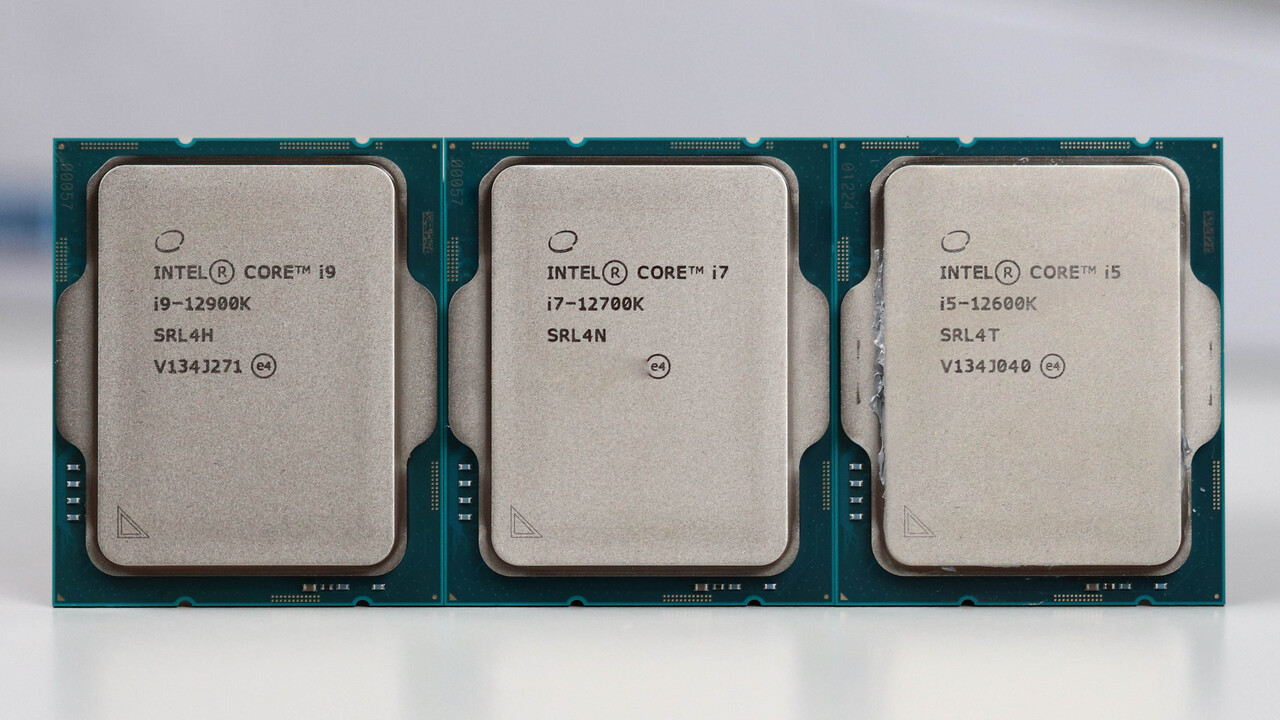
Intel Core i9-12900K, i7-12700K & i5-12600K im Test: Leistung und Effizienz P- vs. E-Core
Intel Alder Lake im Test: Leistung und Effizienz P- vs. E-Core / Wie effizient ist die Hybrid-Architektur?
�
| configuration | Tact | Package power | duration | energy | ||
|---|---|---|---|---|---|---|
| P-Cores | E-cores | P-Cores | E-cores | |||
| Performance, consumption and efficiency depending on the P-Cores | ||||||
| 2 | 8th | 5.100 MHz | 3.700 MHz | 93 watts | 123 s | 11,439 Ws |
| 2 | 8th | 4,800 MHz * | 3.700 MHz | 69 watts | 125 s | 8.625 Ws |
| * manually restricted |
This is going to get really good and complicated when power is held to specific values for mobile use, or people who just want to keep their desktop rigs in the most efficient zone. If you don't care about power/heat and just want every bit of performance, just set it wide open and use all the power it can take. But if you cut it back to 150W ADL gets quite efficient while remaining speedy.
Now here's the complex part. When you throttle back to 100W, or 50W, or 15W there are LOTS of combinations of which cores to use and at what frequencies you run them. There will be a lot of fine tuning for the Thread Director and I think we are going to see HUGE benefits in mobile as Intel gets this worked out. The more I think about this the more I think AMD better get on this, especially for mobile or they may find themselves in a pickle.
For example, with 2+8 mobile with the same power budget you can run 1P fast, 1P slow, and 8e's medium, or 2P's fast and 8e's really low, or any of the multitude of combinations to fit into a power budget to maximize efficiency and performance. In a nutshell, every microarchitecture has a frequency range in which it will operate optimally. By having two vastly different types of cores there is more availability to fine tune the CPU package for the task at hand.
Imagine numerically solving nonlinear equations. You can use a brute force method, such as an incremental search. Easy to understand, easy to program but really inefficient. Next up you can program a little intelligence into the solver and use the Newton-Raphson methods (shoot for zeros using slopes). This takes more programming and smarts but it much more efficient.
One core fits all is a brute force method, especially for mobile. The higher level programming/smarts of the Thread Director is going to take mobile next level. I didn't "see" this until I started reading through all of these reviews. This is a "deep" change in computing even though it's been going on in phones for years.
An observation from the compterbase review.
When limited to 88 W, a 5800x is 2% faster than an 8+0 12900k in multi-threaded performance.
If we then add in 8 E cores to the 12900k and compare that to adding in 4 or 8 Zen 3 cores on top of the 5800x
The advantage for Zen 3 grows to 8% for adding 4 Zen 3 cores or 16% for adding 8 Zen 3 cores. In other words, in this power limited scenario, you get a greater performance increase with an additional 4 Zen3 cores than adding an additional 8 E cores for ADL. It would be interesting to see if this comparison changes at all at even lower power levels.
When limited to 88 W, a 5800x is 2% faster than an 8+0 12900k in multi-threaded performance.
If we then add in 8 E cores to the 12900k and compare that to adding in 4 or 8 Zen 3 cores on top of the 5800x
The advantage for Zen 3 grows to 8% for adding 4 Zen 3 cores or 16% for adding 8 Zen 3 cores. In other words, in this power limited scenario, you get a greater performance increase with an additional 4 Zen3 cores than adding an additional 8 E cores for ADL. It would be interesting to see if this comparison changes at all at even lower power levels.
Last edited:
Something is up with the 12900K e-cores only Handbrake HEVC score. 93fps with all cores, P's and e's operating. 87fps for e-cores only? Doesn't make sense. That must be an error?
Yeah, I noticed that too. Something is wrong there. I'm guessing it is the number from the P cores only.
Edit: Or maybe just a wrong number completely.
itsmydamnation
Diamond Member
probably not , H.264 and H.265 have some inherent scaling limits, E cores are probably wide enough to hit the same limits , probably both memory / io limited at the same pointSomething is up with the 12900K e-cores only Handbrake HEVC score. 93fps with all cores, P's and e's operating. 87fps for e-cores only? Doesn't make sense. That must be an error?
The 10700 only scores 53fps with the same number of cores running higher clocks with HT.
nicalandia
Diamond Member
Thanks, that helps me out with HT/SMT performance and efficiency numbers I was searching forAn observation from the compterbase review.
Thanks, that helps me out with HT/SMT performance and efficiency numbers I was searching for
They have a direct HT comparison. They get 31% performance improvement from HT on P cores. Their test suite for this though is again, entirely renderer based which are typically very friendly to HT. I don't expect the average HT uplift to be this high.
nicalandia
Diamond Member
I've been measuring HT efficiency ever since P4 and from P4 all the say to the last Skylake based CPU it was always from 19-24% in Cinebench(R11 thru CB15/20 which are HT friendly), I have not been able to find any hard number on Rocket Lake but since is pretty wide I would assume that it was the first Intel Consumer CPU to reach at least 30% but I don't have the data. That 31% is mighty impressive for Alder LakeThey have a direct HT comparison. They get 31% performance improvement from HT on P cores. Their test suite for this though is again, entirely renderer based which are typically very friendly to HT. I don't expect the average HT uplift to be this high.
View attachment 52362

UsandThem
Elite Member
The performance of the 12700k and 12900k didn't surprise me much, as I suspected they'd fall where they did.
For me the biggest surprise was the sub $300 12600k.
I know overall platform costs have to be weighed for both AMD and Intel, but right now that is by far the best $/performance CPU in the last several years.
If Intel can supply enough of those to the retail market, AMD will need to really lower the prices of the 5600X and 5800X. Intel already stated they would be severely supply constrained well into 2022, so I guess we'll see how it plays out.
When I upgraded my son's PC roughly a month ago, I was going to to with an 11600k and more budget friendly Z590 motherboard, but all the major retailers were out of stock (and Amazon estimating about a 30 - 45 day wait for inventory).
[Edited for correct Intel model numbers as pointed out by nicalandia]
For me the biggest surprise was the sub $300 12600k.
I know overall platform costs have to be weighed for both AMD and Intel, but right now that is by far the best $/performance CPU in the last several years.
If Intel can supply enough of those to the retail market, AMD will need to really lower the prices of the 5600X and 5800X. Intel already stated they would be severely supply constrained well into 2022, so I guess we'll see how it plays out.
When I upgraded my son's PC roughly a month ago, I was going to to with an 11600k and more budget friendly Z590 motherboard, but all the major retailers were out of stock (and Amazon estimating about a 30 - 45 day wait for inventory).
[Edited for correct Intel model numbers as pointed out by nicalandia]
Last edited:
nicalandia
Diamond Member
Fixed..The performance of the 12700k and 12900k didn't surprise me much, as I suspected they'd fall where they did.
For me the biggest surprise was the sub $300 12600k.
UsandThem
Elite Member
Oops, my bad.Fixed..
That's what I get for typing on my Fire tablet (which is a PIA on sites like Anandtech) while taking a manly Epsom salt bath for the bad back 😛).
However, I assure no pain medication or muscle relaxers caused the slip). However, I might be on Ambien so let me Tweet about a political figure and see well that goes......
😉😎
For posterity:
As usual it is this Russian channel that does the OC testing properly. They tested the 12700K, which seems to have not many reviews.
Anyway, they test the 12700K with 5.2 GHz P core and 4 GHz E core with both 3700CL14 Gear 1 DDR4 and 5200CL32 DDR5 with tuned subtimings. The 5900X runs at 4.9/4.7 per ccx OC and 3800CL14 with tuned subtimings as well.
What's interesting about their test is that some games like the low latency that DDR4 offers while other games like the higher bandwidth of DDR5. There is no clear answer as to what memory you should choose. The 12700K wins but by a narrow margin over the 5900X. Funny thing is, Intel can't touch AMD in StarCraft II with DDR5. 64MB of L3 does wonders for the 5900X in that game.
1.4V core/cache, 1.2V L2, 1.2V SA, for 5.2/4.0 GHz core, 4.4 GHz ring.
Kingston Fury Beast DDR5 featuring Micron: 1.4 VDDQ, 1.3 VDD, for 5200 MT/s (no change), 32-38-32-78-2T
Hulk
Diamond Member
probably not , H.264 and H.265 have some inherent scaling limits, E cores are probably wide enough to hit the same limits , probably both memory / io limited at the same point
Funny as that was my initial thought as well so I checked 5800X vs 5950X results in this bench to see if Handbrake was "topping out" at 8 cores. While gains are less than linear scaling from 5800X to 5950X is from 68fps to 96fps so there are gains to be had beyond 8 cores in this particular test. And there is no way those e's at 3,9GHz are beating higher clocked Zen 3 cores. It's a mistake.

nicalandia
Diamond Member
Has intel mentioned why they did not allow HyperThreading on the e cores? it would have boosted their performance at least 20% more and made their Top CPU be 16C/32T instead of 24 Threaded CPU, I guess power constrain played a part on it.
TRENDING THREADS
-
 Discussion Zen 5 Speculation (EPYC Turin and Strix Point/Granite Ridge - Ryzen 9000)
- Started by DisEnchantment
- Replies: 25K
-
Discussion Intel Meteor, Arrow, Lunar & Panther Lakes + WCL Discussion Threads
- Started by Tigerick
- Replies: 25K
-
 Discussion Intel current and future Lakes & Rapids thread
- Started by TheF34RChannel
- Replies: 24K
-

-
