• We’re currently investigating an issue related to the forum theme and styling that is impacting page layout and visual formatting. The problem has been identified, and we are actively working on a resolution. There is no impact to user data or functionality, this is strictly a front-end display issue. We’ll post an update once the fix has been deployed. Thanks for your patience while we get this sorted.

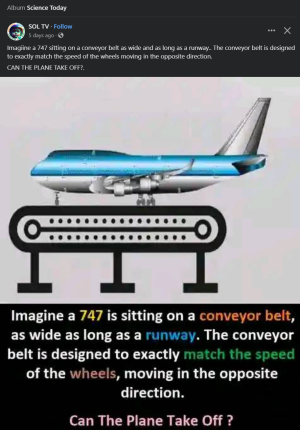
Airplane on a treadmill!

Page 6 - Seeking answers? Join the AnandTech community: where nearly half-a-million members share solutions and discuss the latest tech.
If you don't know the difference between speed and acceleration, you probably shouldn't participate in physics threads.

You even brought up a great example: the use of KERS to store energy otherwise dissipated in braking. Note that the vehicle must be accelerating or decelerating to transfer energy to and from the flywheel. At a constant speed, KERS does nothing.

We're you born this obtuse, did you have experimental surgery to make you that way?

Where did I mention speed at all? You mentioned a rotating mass creating weight and preventing a plane from taking off. I compared it to a flywheel KERS system and called you out on your bullshit.

Never go full retard like you just did.
 
can we do the monty hall problem next?

It's funny, this thread led me to write a program on Friday that simulates the Monty Hall Problem.

100 million iterations of each (switch and no switch):

Code:
            Won        Lost       Percentage Won
Stayed      33328180   66671820   33.3282%
Switched    66669617   33330383   66.6696%
 
can we do the monty hall problem next?
Is that the one like on "Deal or No Deal"? 50 cases, one has a million, you pick one. Later in the game one has $50 and the other has the million, you should switch because your case technically has a 1/50 probability while the other case has a 49/50 for the million.
 
Where did I mention speed at all? You mentioned a rotating mass creating weight and preventing a plane from taking off. I compared it to a flywheel KERS system and called you out on your bullshit.

No, I never said that at all. I talked about rotational inertia.

I said that in any "real-world" scenario, and as the problem is initially stated, the plane takes off. However, there is a method for you to prevent an airplane from taking off, given full control of a superpowered treadmill (and indestructible landing gear).

To help you understand, consider an airplane that is landing. The wheels are down, but they are NOT spinning. A heartbeat after the plane touches down, but BEFORE the brakes are applied, the wheels are spinning. Because the wheels have mass, this means that the spinning wheels now have angular momentum. Energy cannot be created or destroyed, so where did this energy come from? Why, it came from the linear momentum of the plane, meaning that the plane is now traveling just a little bit slower. Of course, now that the wheels are up to speed, they are no longer slowing the plane, and so you must apply the brakes to remove the excess linear momentum of the plane AND the angular momentum of the wheels.

But what if you are landing on this magical treadmill? Well, you could continously accelerate it backwards right after touchdown, increasing the angular momentum of the wheels and decreasing the linear momentum of the plane. Eventually this would be sufficient to stop the plane's forward movement. Of course, at that point the treadmill would be moving backwards significantly FASTER than the plane's original landing speed (because the linear momentum of the plane was its entire mass*speed, whereas the angular momentum of the wheels is their moment of inertia*angular speed. The wheels weigh much less than the plane).

I can draw a diagram or run the numbers if you like.

 
No, I never said that at all. I talked about rotational inertia.

I said that in any "real-world" scenario, and as the problem is initially stated, the plane takes off. However, there is a method for you to prevent an airplane from taking off, given full control of a superpowered treadmill (and indestructible landing gear).

To help you understand, consider an airplane that is landing. The wheels are down, but they are NOT spinning. A heartbeat after the plane touches down, but BEFORE the brakes are applied, the wheels are spinning. Because the wheels have mass, this means that the spinning wheels now have angular momentum. Energy cannot be created or destroyed, so where did this energy come from? Why, it came from the linear momentum of the plane, meaning that the plane is now traveling just a little bit slower. Of course, now that the wheels are up to speed, they are no longer slowing the plane, and so you must apply the brakes to remove the excess linear momentum of the plane AND the angular momentum of the wheels.

But what if you are landing on this magical treadmill? Well, you could continously accelerate it backwards right after touchdown, increasing the angular momentum of the wheels and decreasing the linear momentum of the plane. Eventually this would be sufficient to stop the plane's forward movement. Of course, at that point the treadmill would be moving backwards significantly FASTER than the plane's original landing speed (because the linear momentum of the plane was its entire mass*speed, whereas the angular momentum of the wheels is their moment of inertia*angular speed. The wheels weigh much less than the plane).

I can draw a diagram or run the numbers if you like.

You are right about wheel spin up at landing. But if you are accelerating the wheels with the treadmill, the work is being done by the treadmill, not the aircraft so I don't think it would slow down the aircraft after the initial spin up, assuming frictionless bearings.
 
We're talking about take off though Jagec. To slow a landing plane down with no engine input, air resistance is going to provide far more braking than any bearing surface friction.
 
This is argument is still going on? 🙁

It's like not understanding that cars overheat on dynos because they are stationary with no airflow.

If the treadmill truly sped up at exact same speed as the plane and kept it stationary the plane would not take off. If by somehow it miraculously did, even for a split second, it'd stall and be back on the ground.
 
This is argument is still going on? 🙁

It's like not understanding that cars overheat on dynos because they are stationary with no airflow.

If the treadmill truly sped up at exact same speed as the plane and kept it stationary the plane would not take off. If by somehow it miraculously did, even for a split second, it'd stall and be back on the ground.
😱
 
This is argument is still going on? 🙁

It's like not understanding that cars overheat on dynos because they are stationary with no airflow.

If the treadmill truly sped up at exact same speed as the plane and kept it stationary the plane would not take off. If by somehow it miraculously did, even for a split second, it'd stall and be back on the ground.

What makes a plane go forward? Ignore the treadmill thing entirely. What propels a plane?
 
What makes a plane go forward? Ignore the treadmill thing entirely. What propels a plane?

What propels it? Thrust.

What causes it to leave the ground? Lift.

Now I'm sure some sort of super ultra-light/STOL could be made do do this, but that's besides the point as a strong gust of wind could do the same 😀.
 
What propels it? Thrust.

What causes it to leave the ground? Lift.

Now I'm sure some sort of super ultra-light/STOL could be made do do this, but that's besides the point as a strong gust of wind could do the same 😀.

Perfect. What provides the thrust?
 
Perfect. What provides the thrust?

The engines by combustion of the fuel whether it be in the form of a propeller, jet, rocket, etc etc.

The engine/thrust is only used to overcome the drag of the plane, lift is just a byproduct of speed that the wings use as an advantage to get up into the air.
 
The engines by combustion of the fuel whether it be in the form of a propeller, jet, rocket, etc etc.

The engine/thrust is only used to overcome the drag of the plane, lift is just a byproduct of speed that the wings use as an advantage to get up into the air.

So what do the wheels do?
 
How is this thread still going? The question was answered correctly, early on in the first thread, and it was answered correctly, early in this thread.

Only for planes with wheels though. What if you changed it so the aircraft had skids instead, and the skid was semi-fastened to the treadmill with Velcro? Or how about if the plane were completely underwater, like on a treadmill inside a giant fish tank?
 
So what do the wheels do?

Just act as something of low friction for the plane to sit on until it gets enough lift to go up. You could replace them with skiis if you put the plane on snow, or replace them with floatation skiis if you place the plane on water, and it would take off.
 
You are right about wheel spin up at landing. But if you are accelerating the wheels with the treadmill, the work is being done by the treadmill, not the aircraft so I don't think it would slow down the aircraft after the initial spin up, assuming frictionless bearings.

The treadmill can only impart force to the bottom of the wheel. In order to impart torque on the wheel WITHOUT any translational component, there would have to be an equal force in the other direction somewhere in the system. If there isn't, the force imparted by a treadmill will produce both angular acceleration AND translational acceleration (in the direction that the treadmill is moving). If you add another translational force of equal magnitude (say, with the engines) you can cancel it out and the plane will stay stationary, with maddeningly accelerating wheels.

It's true that the treadmill adds energy to the system, and so the total energy stored in the wheels at the end of the procedure is higher than that imparted by the plane. That's part of why this process would never work in the REAL world!
 
This is argument is still going on? 🙁

It's like not understanding that cars overheat on dynos because they are stationary with no airflow.

If the treadmill truly sped up at exact same speed as the plane and kept it stationary the plane would not take off. If by somehow it miraculously did, even for a split second, it'd stall and be back on the ground.

That is where you fail.
 
plane.gif
 
Back
Top