• We’re currently investigating an issue related to the forum theme and styling that is impacting page layout and visual formatting. The problem has been identified, and we are actively working on a resolution. There is no impact to user data or functionality, this is strictly a front-end display issue. We’ll post an update once the fix has been deployed. Thanks for your patience while we get this sorted.

2600K @ 5GHZ, How common is it really???

Page 3 - Seeking answers? Join the AnandTech community: where nearly half-a-million members share solutions and discuss the latest tech.
Keyphrase by the person was:


They are trading, time to transaction is key. HFT (high-frequency trading), etc.

Also don't be so surprised to find out that people in professional organizations intentionally take their computers, and their computations, into harms way.

Even Via (Cyrix/Centaur) uses overclocked server farm for their work.


If it is not a matter of life and death, and merely a reduction to a matter of opportunity cost, then the elevating your risk of losing some money owing to errant computation results (no ECC, OC'ed cpu, etc) is a simple cost-benefits analysis and you will find that in certain situations you come out ahead on average by taking the gamble.

Quite. HFT is basically an arms race - the first past the post wins every time. In low latency environments people are doing ridiculously crazy things to gain an advantage beyond the demarcation points from the exchanges, and those precious nanoseconds (yes, we're even sub-microsecond now in terms of latency figures), absolutely count. Overclocked servers are just the tip of the iceberg...
 
Extremely uncommon for a STABLE (Prime95) 5.0ghz at reasonable volts and temps.

linX is BS for stability, I've had BSOD's and crashes after passing 20+ rounds of linX. However, if it will pass over an hour of Prime95 blend you are pretty much good to go.

A lot of ppl won't push past 1.4v on air and most are comfortable at 1.38v or less for 24/7 use. At lot of ppl are not comfortable with load temps near 80c either.

4.5ghz 4c8t OC requires very low volts an is easy to obtain.
4.6-4.8ghz 4c8t is the sweet spot for performance at acceptable volts and temps for the majority of owners out there.

My Clarkdale i3-540 @ 4.6ghz was noticeably faster than my golden 1.304v 4.5ghz e8500 but then again it had the extra 2 HT threads and used faster ddr3.

My 2500k and 2600k @ 4.8ghz (1.344-1.328v required) both made the Clarkdale seem like a pentium, especially when it came to video conversion.

There is nothing "magical" about the "magical" 5.0ghz.
Like said above, 95%-99% of the performance is there with 4.8ghz.

Get a Sandy plus faster ram ( 8gb ddr3 2133) and a SSD and you'll be blown away...
 
I'd pull the trigger if you use your pc for gaming. I went from a E8400 at 4Ghz to a 920 at 4ghz and noticed a massive difference in some games. If you don't game or only play COD style console port shooters on rails then stick with the 8500.
Also I know 5Ghz is the 'magic' number but I'm pretty sure you'll get over 90% (more like 99%) of the performance at 4.6-4.8ghz

NICE REPLY JackY!!!!!!!!!!!!!!!!

DITTO I agree.
 
I'm running my i5 2500K at the top multiplier (57). It runs at 5.7GHz all day at 1.55v and the temps never exceed 95 Celsius under 100% load.
 
I got 4.6 out of my watercooled 2600k with no voltage increase. I've been running it for about a 6 weeks. Smooth as silk.

If you aren't running a fixed voltage than your motherboard probably is applying a voltage increase consistent with your clock speed. This occurs when one uses the "offset" method of overclocking on many motherboards. Having +0.00v of offset doesn't mean that you aren't applying extra voltage over the voltage that is applied at stock speed. Is this the case with your setup? I only ask, because 4.6 is fairly high on "stock" voltage but seems to be right around the area where most of us have to start adding +offset voltage (IE: up to that point you can use the auto voltage applied by the motherboard for each given frequency).
 
If you aren't running a fixed voltage than your motherboard probably is applying a voltage increase consistent with your clock speed. This occurs when one uses the "offset" method of overclocking on many motherboards. Having +0.00v of offset doesn't mean that you aren't applying extra voltage over the voltage that is applied at stock speed. Is this the case with your setup? I only ask, because 4.6 is fairly high on "stock" voltage but seems to be right around the area where most of us have to start adding +offset voltage (IE: up to that point you can use the auto voltage applied by the motherboard for each given frequency).

It is possible that he's getting 4.6GHz with stock Vcc. I can/do.

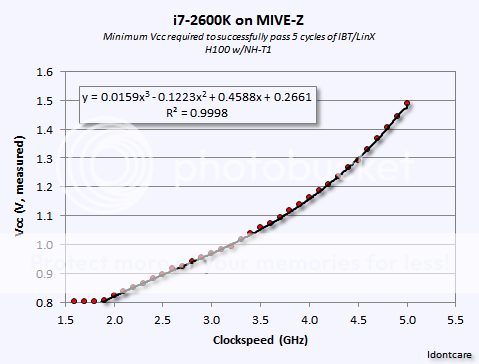
VoltageCurve.png


Stock Vcc for my 2600K is 1.35V. Disabling all the auto-Vcc aspects of my mobo (MIVE-Z), and setting voltage manually at 1.35V, I am LinX stable at 4.6 GHz.

(in fact I can undervolt it just a tad, to 1.33V, and still be LinX stable @ 4.6GHz)
 
It is possible that he's getting 4.6GHz with stock Vcc. I can/do.

VoltageCurve.png


Stock Vcc for my 2600K is 1.35V. Disabling all the auto-Vcc aspects of my mobo (MIVE-Z), and setting voltage manually at 1.35V, I am LinX stable at 4.6 GHz.

(in fact I can undervolt it just a tad, to 1.33V, and still be LinX stable @ 4.6GHz)

Nice chart!

So you mean the Vcc vs VID as seen in something like Realtemp? Kinda confusing a little bit as SB's have a dynamic Vcc/VID based on load, multiplier, features being stressed at the time.

For example I'm currently stress testing my 2700k at 4.8ghz HT on with the beta prime w/AVX support. My Vcc is hovering around 1.4v's but if viewed in Realtemp the VID is 1.4462v's
 
I dont know why you are making 5ghz a big deal honestly. A 4.5ghz 2500k or 2600k will smoke that E8600 in anything multi threaded. Hell the single threaded performance will be better also.
 
It runs at 5.7GHz all day at 1.55v and the temps never exceed 95 Celsius under 100% load.

Holy.... did it do this for more than one day? Do you smell an odor of hot resin in the vicinity of your case?

I think the OP should upgrade whenever he's ready. If I recall the benchies the 2500k is more than double the raw throughput of the 8500 at stock. It's going to be worth it.

Fwiw, I wasn't able to get my 2500k over 4.5 without busting the 1.35v ceiling I had mentally set for my o/c. I have to keep this chip for awhile, and based on what I gathered from a lot of reading I just don't feel good about anything higher than that. Right now I'm running it at stock until I get a new cooler, and anyway, it's gobs faster than my E8500.
 
Fwiw, I wasn't able to get my 2500k over 4.5 without busting the 1.35v ceiling I had mentally set for my o/c. I have to keep this chip for awhile, and based on what I gathered from a lot of reading I just don't feel good about anything higher than that. Right now I'm running it at stock until I get a new cooler, and anyway, it's gobs faster than my E8500.

Once you get your nice cooler and decide if you want to overclock or push voltages a little bit more the optional warranty might help you sleep better 🙂

http://click.intel.com/tuningplan/default.aspx

The less than 1.35v's is conservative and most likely safe for 24/7 as long as you keep the chip. I can see how/why alot of people stick to it. SB's can pump out some heat under heavy loads so I'd think it's about the voltage alot of people will start to see some pretty high temps.

My comfort zone is closer to 1.4v's but I'm under water. Gets my 2700k stable at 4.8ghz with HT on tho.
 
It is possible that he's getting 4.6GHz with stock Vcc. I can/do.

VoltageCurve.png


Stock Vcc for my 2600K is 1.35V. Disabling all the auto-Vcc aspects of my mobo (MIVE-Z), and setting voltage manually at 1.35V, I am LinX stable at 4.6 GHz.

(in fact I can undervolt it just a tad, to 1.33V, and still be LinX stable @ 4.6GHz)

Wow... nice chart! I had no clue the stock Vcc for a 2600k was in the area of 1.35V. I though stock was ~0.1V lower than that! 1.35V is what I would expect for around 4.5-4.6 on a 2500k/2600k. I just had no clue that stock Vcc was that high - my bad!
 
My stock vid is 1.271, I need to use a huge - offset to get it down to around 1.087v load without LLC.

I just started playing around with my chip at stock, first time since I got it in January the day they released. Within an hour I was at 5GHz with mine lol... I've been thinking about getting a killawatt to see if/how much reducing the vcore helps as far as power draw goes for stock.

I've been surprised at how much it will actually hit 3.6/3.7GHz in games, it's not hard to appreciate these chips even @ stock.
 
I'm at 4.6, I've tried to go higher with up to 1.5v, but my motherboard won't post at anything higher than that speed.
 
I'm at 4.6, I've tried to go higher with up to 1.5v, but my motherboard won't post at anything higher than that speed.

Have you toggled the "CPU PLL Overvoltage" to "enable" in the BIOS?

I can't go above 4.6GHz either unless I enable this.

Nice chart!

So you mean the Vcc vs VID as seen in something like Realtemp? Kinda confusing a little bit as SB's have a dynamic Vcc/VID based on load, multiplier, features being stressed at the time.

For example I'm currently stress testing my 2700k at 4.8ghz HT on with the beta prime w/AVX support. My Vcc is hovering around 1.4v's but if viewed in Realtemp the VID is 1.4462v's

My Vcc was measured with a voltmeter.

However, barring the use of a voltmeter you should be paying attention to Vcc (CPU-Z approximates this when it reports your cpu coltage) and do not pay any attention to VID (realtemp or coretemp) for the purposes we are talking about here.
 
Have you toggled the "CPU PLL Overvoltage" to
My Vcc was measured with a voltmeter.

However, barring the use of a voltmeter you should be paying attention to Vcc (CPU-Z approximates this when it reports your cpu coltage) and do not pay any attention to VID (realtemp or coretemp) for the purposes we are talking about here.

wow these links are great!more than what i was looking for.:awe:

@5ghz topic imho 5ghz is really common,got mine 1.46v ht enabled but i still prefer 4.5ghz 1.28v for the temps 88c vs 68c running linx :ninja:
 
I think a lot of chips can get there, it's how much voltage will it take and can you cool it that is the question.

I am running mine @ 5ghz now with 1.49V and some other voltages tweaked as well; VCC, VCCSA, PLL and some other settings. I know 2600/2500 chips can generally get there will less, usually. My issue now is I think my water loop is still not working properly.

I am seeing temps of 62C on the low core up to 72C on the highest core under load. Doesn't seem right for a 360 radiator that is only cooling the CPU. 😡
 
It's not common at all. I personally want to keep my chip for three years or more and at low temps, so I'm sticking with 1.28-1.29V. No way I'm going over 1.32V.
 
As long as you don't get a terrible motherboard, %99 of people just have to change multiplier and will get 4.6GHz. I can do 5ghz on my chip if i raise voltage. But thats not my thing cause 4.6ghz is fine for what i do, don't have to change anything else.

I got a asus Pro Gen 3 if you are wondering what a good motherboard to get a easy overclock without having to mess with anything else.
 
Back
Top