• We’re currently investigating an issue related to the forum theme and styling that is impacting page layout and visual formatting. The problem has been identified, and we are actively working on a resolution. There is no impact to user data or functionality, this is strictly a front-end display issue. We’ll post an update once the fix has been deployed. Thanks for your patience while we get this sorted.

Zen APUs made by GloFo, 14nm FinFET node, and packaged by Amkor

deasd

Senior member
I hope this is true. A Zen APU with HBM could finally provide competitive mid-level GPU performance in a single, low-power package. We could have AMD's equivalent of a NUC that would be as powerful as i5-2500K + GTX 960, or even better.
 
A Zen APU with HBM could finally provide competitive mid-level GPU performance in a single, low-power package. We could have AMD's equivalent of a NUC that would be as powerful as i5-2500K + GTX 960, or even better.

I don't think it would be that fast.

Reason: Power
 
For the interposer, I have been wondering if AMD has any other plans besides HBM?

Maybe some stacked NAND as well? Or perhaps some other chips to allow the laptop (or SFF BGA desktop) motherboards to be smaller....more integrated.
 
I wonder if they are even going to do an APU, they already are/have built a coherent cpu/gpu fabric for HPC. APU could be 4 core SOC + polaris 11.
 
All AMD GPUs will be the same chain. And VEGA needs HBM2.

And APU with HBM2 is economic suicide. Try again in 2020 or so.

Amkor package regular parts as well all the time.
http://www.amkor.com/go/packaging/all-packages

And AMD have been working with Amkor for the last 10 years or so. Intel have also used them for quite a while. And so have most others.
 
Last edited:
I wonder if they are even going to do an APU, they already are/have built a coherent cpu/gpu fabric for HPC. APU could be 4 core SOC + polaris 11.

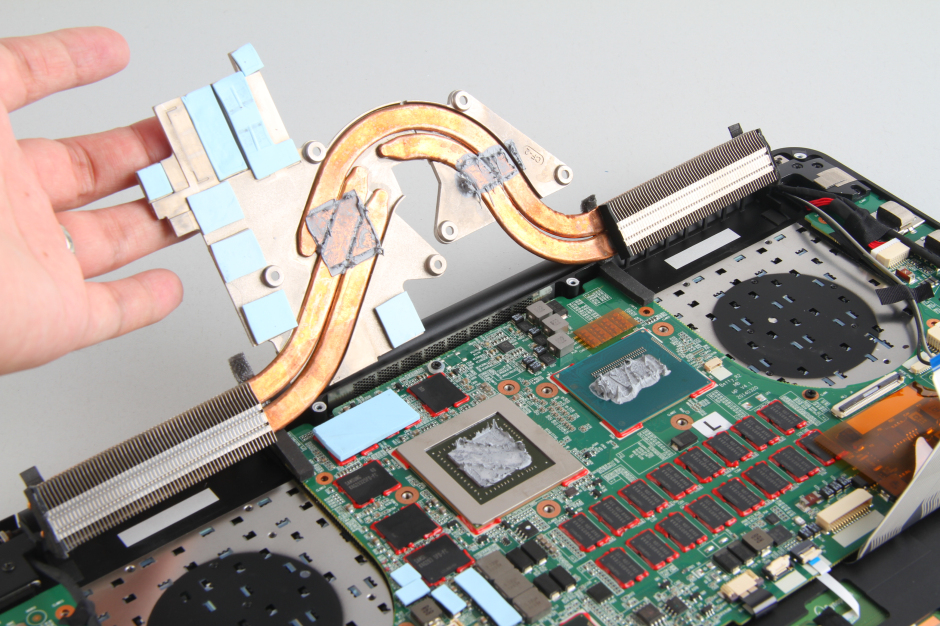
Maybe in high powered laptop something like that could replace the following:

Razer-Blade-2014-Disassembly-17.jpg


This assuming TDP of Polaris 11 is actually "reasonable enough". Isn't the Polaris 10 desktop card already 50 watts?

EDIT: I got Polaris 10 and Polaris 11 mixed up (Polaris 11 is the GPU that is used in a ~50W desktop card).
 
Last edited:
Saw it coming ages ago when HBM tech was announced.

The biggest limitations for iGPU performance is power and bandwidth.

HBM solves bandwidth and helps with power.

HBM2 will allow some very strong iGPU.
 
I will really like to see the BOM and cost of the HBM, please post here the links.

Thanks.

You should ask those that dream of HBM APUs. So, why dont you start. 🙂

AMD already said that HBM wouldn't be used on Polaris due to cost. And we already know GDDR5 cost way more than DDR4. Something the rest of us knew back when you and others started to argue that HBM didn't cost much more than GDDR5.
 
I am expecting a Zen APU with HBM; but only later in the release cycle at a significant premium.

I can see Zen APU's with DDR4 for mainstream, and a far more expensive version with HBM. Intel's Iris Pro is wicked fast, but they charge quite a bit extra for that speed. AMD will most likely do something similar.
 
I don't think it would be that fast.

Reason: Power

Uh. I'm not sure power will be the problem in this scenario.


28nm 3.5 Ghz CPU XV only needs 65W.

Now a 14nm 3.5 to 4 Ghz CPU with Zen...would need no more than 35 to 45W for the CPU bit...maybe even less (APUs are 4-Cores.)

This means at LEAST 50W of Polaris + HBM goodness(1-2 Gb?).


Of course 960 might be a little high...but I feel like it will very well reach 750 Ti minimum...which would still shrek ANYTHING Intel has to offer at this point.

Of course CPU performance would still be below Intels current and last gen...but that hardly matters...because CPU and GPU performance would actually be VERY balanced out at this point.
I mean take XV, add 40% IPC (best case), run it at 3.5 to 4 Ghz...and throw in a Geforce 750 Ti?

Holy crap you got a winner.

I mean this is just theorycrafting...but if energy efficiency is any better than my guesstimated minimum of 50W for iGPU+Hbm...then even a GTX 960 would be possible, performance wise.


To me that sounds more interesting than their big chips with 16 threads.


IF this holds true I do wonder though...would HBM act as a general L4 cache or would it be used just for the iGPU.
 
Last edited:
Uh. I'm not sure power will be the problem in this scenario.


28nm 3.5 Ghz CPU XV only needs 65W.

Now a 14nm 3.5 to 4 Ghz CPU with Zen...would need no more than 35 to 45W for the CPU bit...maybe even less (APUs are 4-Cores.)

Ehm...no. Example: 22nm 4790K 88W 4Ghz base, 14nm 6700K 91W 4Ghz base.

Also due to the IPC increase, high clocks will be much harder to hit. All construction cores have also gone down in clock over time as IPC increase.
 
Now we would only need some indication that Zen APUs will actually use HBM(2), which IMO is extremely unlikely in consumer class products at least... Otherwise this is just more made up "news".
 
And APU with HBM2 is economic suicide. Try again in 2020 or so.

Who said HBM2?
Single stack of HBM1 would be enough to feed 12-16 CU - it would work as fast buffer exactly like eDRAM in Intel's Iris Pro.

I presume that Zen based APU equipped with HBM1 could show up very late 2017 or early 2018.

Btw, it's another of your "famous" predictions?
 
HBM2 could become cheap when a major player would ask for a design with HBM2 on it. Then several manufacturers see a market and the market will be flooded with HBM2.

Sony is already requesting for a playstation 4.5.
And both microsoft and Sony have become interested in a upgradable game box. If both also become interested in the idea of providing a complete home pc solution that can also be used for normal "pc stuff". Things could go very fast. Perhaps within 2 years, HBM2 could become the next memory standard. Skipping dimms with ddr5 or gddr5x.

When staying with (x86-64) AMD and AMD GCN, backwards compatibility with current game library is a certainty. And that will increase the chance that people will upgrade to the next game box from the same manufacturer.
 
Last edited:
Yeah no. Zen HBM is strictly for the HPC APU. On package memory is the future, but that's far out. Intel is using HMC on Knights Landing, up to 16 GB which can either be used as as a giant cache or shared memory with the 6-channel DDR4. AMD is likely doing the same thing.
 
Ehm...no. Example: 22nm 4790K 88W 4Ghz base, 14nm 6700K 91W 4Ghz base.

Also due to the IPC increase, high clocks will be much harder to hit. All construction cores have also gone down in clock over time as IPC increase.

Keep in mind that the IPC is still quite a bit below the 4790K...let alone skylake. I mean we're looking at like 50%-60% less in that department. I would expect AMD to pull a 4Ghz boost 3.5/3.7 Ghz base CPU.


4790K with 15% less IPC @ 14nm? Sounds like it would run on 35-40W easily...unless the 14nm process is actually shit...which let's just assume it's not.
 
Last edited:
Yeah no. Zen HBM is strictly for the HPC APU. On package memory is the future, but that's far out. Intel is using HMC on Knights Landing, up to 16 GB which can either be used as as a giant cache or shared memory with the 6-channel DDR4. AMD is likely doing the same thing.

That would only be needed if you need massive amounts of memory. Such as HPC.
For the next gen home pc or game pc 16GB would really be enough to about 2023.


EDIT:
I wonder what the latency is for HMC in comparison to ddr4 and HBM.
 
Last edited:
Back
Top