I meant the part where it killed itselfwdym seppuku, 14900k(s) was just doing some good honest jihad with a wee little bit of suicide carbombing.

-
We’re currently investigating an issue related to the forum theme and styling that is impacting page layout and visual formatting. The problem has been identified, and we are actively working on a resolution. There is no impact to user data or functionality, this is strictly a front-end display issue. We’ll post an update once the fix has been deployed. Thanks for your patience while we get this sorted.
You are using an out of date browser. It may not display this or other websites correctly.
You should upgrade or use an alternative browser.
You should upgrade or use an alternative browser.
Question Zen 6 Speculation Thread
Page 256 - Seeking answers? Join the AnandTech community: where nearly half-a-million members share solutions and discuss the latest tech.

adroc_thurston
Diamond Member
yeah that's the key part of any good jihad.I meant the part where it killed itself
in any case, I hope no one ships bombs in DIY ever again.

gdansk
Diamond Member
Though, notably not the case for Raptor Lake. Anyway...Stop Mobo vendors than lol cause they can make bomb out of working parts.

DrMrLordX
Lifer
Will Medusa N3P mobile SoC designs be ready in early 2026? That is, out of QS and fully erratad?
adroc_thurston
Diamond Member
No, but they taped out and configs won't ever change.Will Medusa N3P mobile SoC designs be ready in early 2026?
DrMrLordX
Lifer
Hmm okay. But the point is, could they realistically release them earlier than the rest of the Zen6 consumer product stack if they wanted to, due to N3P being available now?No, but they taped out and configs won't ever change.
adroc_thurston
Diamond Member
No, because not a single Zen6 is node schedule-limited.could they realistically release them earlier than the rest of the Zen6 consumer product stack if they wanted to, due to N3P being available now?
It's Zen6 with a new (single) IOD instead of the dual-IOD of Venice.
That can't be the only change. What other updates could the new IOD bring?
I think the way the laptop market works, is that first you've got to have good enough performance. Once you have this base line set, the key to market share is giving MARGIN to the OEMs. Once you look things from this angle, you can understand why Qualcomm has been pushing expensive crap for the past many years and oems still went alone with it. On top of that, I thinks all the Snapdragon laptops are essentianlly the reference platform so they have taken away a big chunk of the platform development cost too. So even though the end product is not competitive, the oems are still more than happy to push it, with some marketing money from MS probably.
Now compare this to something like Kraken point, which is a perfect little chip for the majority of the laptop market: cheap, probably cheaper than Phoenix Point (? I can't find die size for KP), not an ounce of fancy tech (on-package dram, chiplets, etc), drops into last gen socket/platform, improvement in performance/watt. You get the idea.
Now compare this to something like Kraken point, which is a perfect little chip for the majority of the laptop market: cheap, probably cheaper than Phoenix Point (? I can't find die size for KP), not an ounce of fancy tech (on-package dram, chiplets, etc), drops into last gen socket/platform, improvement in performance/watt. You get the idea.

Josh128
Banned
Form factor and therefore heat dissipation.What is exactly stopping the CCD reuse laptop parts from having similar 1T boost clocks to desktop?
Assuming 1T power is comfortably below TDP.
adroc_thurston
Diamond Member
?Form factor and therefore heat dissipation.
Laptop parts are bare die, they have much, much, much better heat dissipation than anything AM5.
Josh128
Banned
??
Laptop parts are bare die, they have much, much, much better heat dissipation than anything AM5.
Show me a non-ultra chungus laptop that can dissipate the heat that Im currently doing on my 9900X and I'll forward you next weeks winning powerball numbers.
adroc_thurston
Diamond Member
You do understand that 80W is all Gator Range would ever need?Show me a non-ultra chungus laptop that can dissipate the heat that Im currently doing on my 9900X
Halve that for a single CCD and there you have it, mds1-hi.
Have you seen OEM doing thermal paste on laptop and power settings?You do understand that 80W is all Gator Range would ever need?
Halve that for a single CCD and there you have it, mds1-hi.
adroc_thurston
Diamond Member
will be goodnuff for that CCD either way.Have you seen OEM doing thermal paste on laptop and power settings?
DrMrLordX
Lifer
Okay, that was my estimation as well.No, because not a single Zen6 is node schedule-limited.
Josh128
Banned
My point about form factor thermal limitations is proven by the initial reviews of HX 370 not maintaining peak 1T boost due to thermal throttling. Thats a single core @5.1GHz.You do understand that 80W is all Gator Range would ever need?
Halve that for a single CCD and there you have it, mds1-hi.
To say 1T boost @ speeds approaching 6Ghz will not be affected in laptop vs desktop is delusional.
CouncilorIrissa
Senior member
Zenbook was an extreme example of a skill issue on ASUS's side, to the point where later BIOS updates decreased STAPM to like 24w. Not really the SoC's fault.My point about form factor thermal limitations is proven by the initial reviews of HX 370 not maintaining peak 1T boost due to thermal throttling. Thats a single core @5.1GHz.
I don't think that laptop SKUs will have the same boost, but this particular device isn't really evidence of that.
Last edited:
What? Nope.Zen4 was also only a single-digit IPC improvement outside of games, but still a homerun in the end because clocks.
If anything, the complete opposite. IPC is higher in productivity and scientific/server workloads:
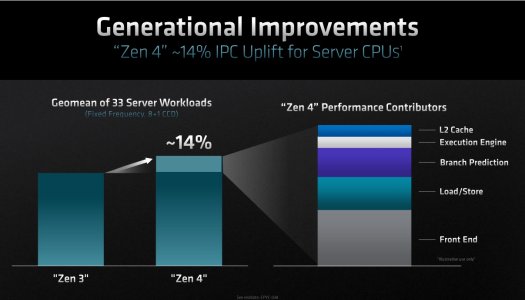
vs Client:
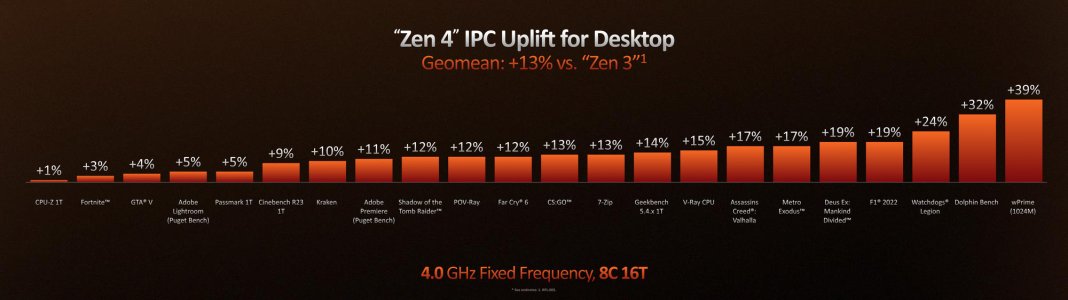
Hell, even in this "gaming" slide, the 3 highest and disproportionately big jumps vs the rest shown are not from games (depends how you count Dolphin emulator I guess).
Also not sure I agree with this either:Note that Zen3 didn't look that impressive outside of games and CCD-latency-sensitive workloads, either.
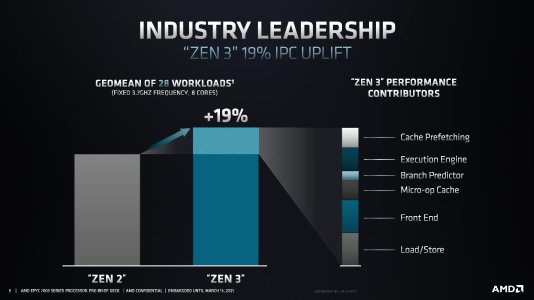
All said "28 workloads" are SPEICrate2017_int_base and SPEICrate2017_fp_base tests. Which are anything but gaming workloads and are rarely "latency sensitive".
Spec is very sensitive to L3 as wellAll said "28 workloads" are SPEICrate2017_int_base and SPEICrate2017_fp_base tests. Which are anything but gaming workloads and are rarely "latency sensitive".
Bombs will be needed to keep up with Apple in STyeah that's the key part of any good jihad.
in any case, I hope no one ships bombs in DIY ever again.
Just don't compare in both the memebenches SPEC should be closeBombs will be needed to keep up with Apple in ST

fastandfurious6
Banned
?
Show me a non-ultra chungus laptop that can dissipate the heat that Im currently doing on my 9900X and I'll forward you next weeks winning powerball numbers.
yesterday I saw an 8inch handheld device here in this forum that has higher performance than your 9900x
hope that helps
That thing can't reach it's full potential in that handheld thingy without burning your hands.yesterday I saw an 8inch handheld device here in this forum that has higher performance than your 9900x
hope that helps
TRENDING THREADS
-
 Discussion Zen 5 Speculation (EPYC Turin and Strix Point/Granite Ridge - Ryzen 9000)
- Started by DisEnchantment
- Replies: 25K
-
Discussion Intel Meteor, Arrow, Lunar & Panther Lakes + WCL Discussion Threads
- Started by Tigerick
- Replies: 24K
-
 Discussion Intel current and future Lakes & Rapids thread
- Started by TheF34RChannel
- Replies: 24K
-

-
