
DisEnchantment
Golden Member
Speculate at will
Last edited:



I m saying that SPEC Povray score difference between Zen 4 and RPL is about the same as Computerbase.
So you ll have to assume that AVX2 bring no perfs enhancement in Povray for RPL, otherwise it wouldnt be faster in SPEC (wrt to Zen 4) by the same amount than when using AVX2, that s basically what you re saying.
Or that Geekerwan numbers are flawed eventually, wich i already pointed as being a possibility.
I m saying that SPEC Povray score difference between Zen 4 and RPL is about the same as Computerbase.
So you ll have to assume that AVX2 bring no perfs enhancement in Povray for RPL, otherwise it wouldnt be faster in SPEC (wrt to Zen 4) by the same amount than when using AVX2, that s basically what you re saying.
Or that Geekerwan numbers are flawed eventually, wich i already pointed as being a possibility.
Well at least I win SOMETHING! What you gonna win? Chicken dinner?@igor_kavinski is gonna win the award for the most inaccurate guess.
(Based on the spreadsheet)

100% sure this screenshot is fake. Looks like they just messed around with the CPU ID on a Zen 4 part.Zen 5 CPU-Z single core benchmark is supposedly 910. Will share source soon.
EDIT: Sorry,, I put the twitter link below, had to get to a desktop. I wanted to link the original baidu post, but have had issues.
That is for the engineering sample of Zen 5. For reference I get around 740-750 on my stock 7950X, so about 21% higher. Not bad.
Oh and if this was already posted, apologies. Sometimes this thread moves quite quickly and it can be hard to keep up.
You can draw absolutely no conclusions about a test largely comparing scalar floating-point performance (because of having no vector intrinsics) based on performance involving vector intrinsics. Even in the "AVX2-less" builds that reviewers have used, it's still using AVX.
SPEC does not use AVX (except what the compiler can emit itself.) You cannot draw the kinds of comparisons you're talking about.
I don't find Geekerwan's result suspicious, just meaningless.
So now you re telling me that when the 7950X is deprived of AVX it lose more perf than RPL deprived of AVX, knowing that the 7950X is surely faster when both CPUs are limited to AVX, that s quite a stretched assumption given that you have no numbers to validate this point, just assumptions.
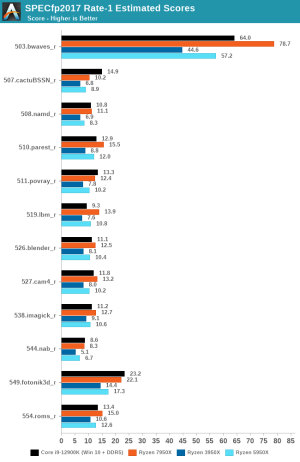
So now you re telling me that when the 7950X is deprived of AVX it lose more perf than RPL deprived of AVX, knowing that the 7950X is surely faster when both CPUs are limited to AVX, that s quite a stretched assumption given that you have no numbers to validate this point, just assumptions.
Whatever is meaningless is forcibly suspicious.
Except there are tests showing as such, namely tests within SPECfp. You have provided zero evidence to the contrary, so. . .
Wasn't the original point of contention a modified POVRAY binary used by some Intel slurpee slurping website that disabled AVX2 support for Ryzen? Where did SPEC enter into this conversation?Crap! Anandtech's in on it! The conspiracy goes deeper than we thought!
You have played Cyberpunk 2077 on Turin?Want so much to see Turin in action.
Wasn't the original point of contention a modified POVRAY binary used by some Intel slurpee slurping website that disabled AVX2 support for Ryzen? Where did SPEC enter into this conversation?
 forums.anandtech.com
You have played Cyberpunk 2077 on Turin?
I don't think you know what you are linking to. . .
Why you want to see action on Turin if you not gonna do some action with Turin?What's the point? Didn't got it.
Spec was routinely used with optimised code using AVX on official submissions, that it is cheatinng or not, and geekerwan s numbers are suspicipous in this respect when
it come to Povray.
CPU2017 Integer Rate Result: Dell Inc. PowerEdge R760 (Intel Xeon Platinum 8480+)
CINT2017 result for PowerEdge R760 (Intel Xeon Platinum 8480+); SPECrate2017_int_base: 904; SPECrate2017_int_peak: 931www.spec.org
Spec was routinely used with optimised code using AVX on official submissions, that it is cheatinng or not, and geekerwan s numbers are suspicipous in this respect when
it come to Povray.
CPU2017 Integer Rate Result: Dell Inc. PowerEdge R760 (Intel Xeon Platinum 8480+)
CINT2017 result for PowerEdge R760 (Intel Xeon Platinum 8480+); SPECrate2017_int_base: 904; SPECrate2017_int_peak: 931www.spec.org
My last link post 11544 is.See post 11478. Your comments and links aren't relevant.
Curious question: if someone compiles POVRAY with that option turned on and uses it on Intel CPU but runs the binary compiled with that option omitted on the Ryzen, will the Ryzen suffer in the performance comparison?Please stop. You clearly have never touched SPEC yourself and don't know how it works.
Curious question: if someone compiles POVRAY with that option turned on and uses it on Intel CPU but runs the binary compiled with that option omitted on the Ryzen, will the Ryzen suffer in the performance comparison?


