adroc_thurston
Diamond Member
I would rather put my ballsack straight into the woodchipper than try suing Apple.I wonder how Rosetta wasn't sued by Intel

I would rather put my ballsack straight into the woodchipper than try suing Apple.I wonder how Rosetta wasn't sued by Intel

I guess Tim Sweeney likes his ballsacks to be woodchipered.I would rather put my ballsack straight into the woodchipper than try suing Apple.
That just makes me respect Gabe Newell so much more.I would rather put my ballsack straight into the woodchipper than try suing Apple.
I wonder how Rosetta wasn't sued by Intel


I would rather put my ballsack straight into the woodchipper than try suing Apple.
My understanding is that Rosetta2 doesn't even touch x86 instructions. It lifts x86 binaries to LLVM IR, runs it through LLVM optimizers and compiles to ARM64. Not sure what basis Intel would have to sue.For what? Intel didn't sue Transmeta and their entire business model was essentially a Rosetta type strategy to directly compete with Intel - they even sued Intel themselves (something to do with low power) and Intel still didn't sue them back over the emulation.
The only argument Intel could make would have been Rosetta 2 "using" Intel's patented instructions, which was supposedly why Rosetta 2 only supported SSE 4.2 at release; since SSE* was so old it was out of patent. They later updated Rosetta 2 to support AVX 2 which was still under patent, but even if Intel had grounds for a suit it would have been pointless since Apple's transition off x86 was complete.
Do you have any links to share about this? I would like to read up further on the topic.My understanding is that Rosetta2 doesn't even touch x86 instructions. It lifts x86 binaries to LLVM IR, runs it through LLVM optimizers and compiles to ARM64. Not sure what basis Intel would have to sue.
SiliconFly and friends have assured me it can so fingers crossed!

lol, you mean the guy who rage quit these forums to the "greener" pastures of Xitter to espouse the virtues of Intel? That SiliconFly?SiliconFly and friends have assured me it can so fingers crossed!
The one and only!lol, you mean the guy who rage quit these forums to the "greener" pastures of Xitter to espouse the virtues of Intel? That SiliconFly?
I'm on Xitter, and the usual replies are from Intel sympathizers and/or investors. Ever since Intel stock doubled from their 52-week lows, a ton of people came out of the woodwork to hype up the company and hope for its success.Wow I think he may be the same guy that runs loserbenchmark. His Twitter is insane! I don't have an account so I can't read the replies to see if anyone calls him out. Some highlights include:
- Royal core is back with "super core" which is the old "reverse hyperthreading" joke.
- Mobile phone SoC's are going to use 18A
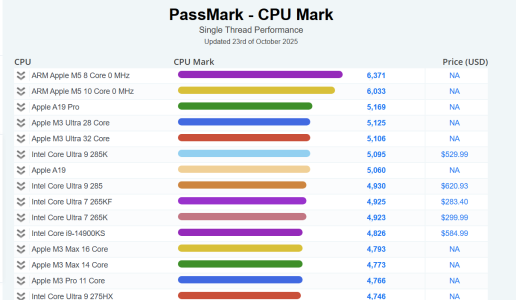
- Nova Lake should easily surprass Zen 6 and M4 in ST and match M5, while easily surpassing them both in MT.
- Nova Lake should easily match/surpass Zen 6 in gaming because of bLLC.
- Claims that no one made regarding Intel/Nvidia vs AMD only to call them out and say that it's all BS "heavily sugar coated by their excellent PR and vocal fan base".
Excellent PR? That's a good one lol.
I'm on Xitter, and the usual replies are from Intel sympathizers and/or investors. Ever since Intel stock doubled from their 52-week lows, a ton of people came out of the woodwork to hype up the company and hope for its success.
From here: https://www.notebookcheck.net/Arrow...-threaded-performance-benchmark.898105.0.html
The most radical thing that has happened to Intel is the government subsidy which should, indeed, have a long term effect on their competitiveness.
In the short run, NVL's biggest potential improvement IMO is if they can lower the latency on the ring buss. I have a feeling that NVL could post some impressive improvements if they give the cores some breathing room on the interface.
As for the ARM vs x86 debate,
From here: https://www.notebookcheck.net/Arrow...-threaded-performance-benchmark.898105.0.html
Seems like 285K is more like 5268. Still a far cry from 6371, but it makes me wonder about the other numbers.
I think it was ICL where the problems started to get bad. Maybe a result of the dual ring design. RKL was a small regression vs CML/SKL IIRC? But yes, very much agree with your point.Intel also needs to get thier L3 up to par. It's been pretty bad for a few generations now, probably since around the same time they went with a heterogeneous design. If they can't fix that the bLLC version may not live up to the hype.
About what I would expect. They've pretty much been given a blessing so not surprised about the stock. That's all I'll say about that as it's already a bit OT and certainly no need to get in to politics.
Fair point.Intel also needs to get thier L3 up to par. It's been pretty bad for a few generations now, probably since around the same time they went with a heterogeneous design. If they can't fix that the bLLC version may not live up to the hype.
This is true with all user uploaded benchmarks. You have to take the highest, non-overclocked result, and do the same with comparisons.From here: https://www.notebookcheck.net/Arrow...-threaded-performance-benchmark.898105.0.html
Seems like 285K is more like 5268. Still a far cry from 6371, but it makes me wonder about the other numbers.