• We’re currently investigating an issue related to the forum theme and styling that is impacting page layout and visual formatting. The problem has been identified, and we are actively working on a resolution. There is no impact to user data or functionality, this is strictly a front-end display issue. We’ll post an update once the fix has been deployed. Thanks for your patience while we get this sorted.

With these warm temperatures, i ask myself what is the hottest place on earth

The answer is the Lut desert in Iran. over 70 degrees celcius peak temperature , 158 degrees fahrenheit.
Hot enough to melt the glue from sneakers.
Cameras stop working, smartphones stop working because of too high internal temperatures. 😳

The lowest temperature is antartica which can reach - 89 degrees celcius , -128 degrees fahrenheit.
That is almost ideal place to use superconductors, which need to be cooled down.
Which i would not surprised if there have been some tests done in the cold regions of planet Earth , like for example in Russia near the arctic.


The more i read about it, the hotter the peak temperature ever reached gets :

Small excerpt form text :
"
Death Valley holds the record for the highest air temperature on the planet: On 10 July 1913, temperatures at the aptly named Furnace Creek area in the California desert reached a blistering 56.7°C (134.1°F). Average summer temperatures, meanwhile, often rise above 45°C (113°F).
But when it comes to surface temperature, two spots have Death Valley beat. A new analysis of high-resolution satellite data finds the Lut Desert in Iran and the Sonoran Desert along the Mexican-U.S. border have recently reached a sizzling 80.8°C (177.4°F).
"
Peak surface temperature of lut desert(Iran) and the sonoran desert(Mexico) : 80 degrees celcius , 177 degrees fahrenheit. 😳
 
Last edited:
Sadly, Iran hasn't yet significantly exploited the Lut Desert for renewable energy development, despite its extraordinary solar potential.
 
Sadly, Iran hasn't yet significantly exploited the Lut Desert for renewable energy development, despite its extraordinary solar potential.
The area called lut desert is so dangerous that it is even illegal to go there. It is mentioned in the video.

Sand storms as well.
Ambient temperatures of at least 50 degrees celcius, surface temperatures of max 80 degrees celcius ,177 degrees fahrenheit.
Filling that desert with solarpanels, is not as easy as it sounds.
But there should be enough parts of Iran with lower temperatures and the same amount of sun, where solarpanels and solar heaters would come in handy. That is , if the war with Israël and the USA does not destroy such solar plants. Bombs and drones from one side to the other, hurting and killing innocent people.
 
The more i read about it, the hotter the peak temperature ever reached gets :

Small excerpt form text :
"
Death Valley holds the record for the highest air temperature on the planet: On 10 July 1913, temperatures at the aptly named Furnace Creek area in the California desert reached a blistering 56.7°C (134.1°F). Average summer temperatures, meanwhile, often rise above 45°C (113°F).
But when it comes to surface temperature, two spots have Death Valley beat. A new analysis of high-resolution satellite data finds the Lut Desert in Iran and the Sonoran Desert along the Mexican-U.S. border have recently reached a sizzling 80.8°C (177.4°F).
"
Peak surface temperature of lut desert(Iran) and the sonoran desert(Mexico) : 80 degrees celcius , 177 degrees fahrenheit. 😳
The surface temperatures are why one should not walk their dogs in the heat of the day. The temperature experienced by the dog is much higher than what people experience. Plus burning their feet.
 
The surface temperatures are why one should not walk their dogs in the heat of the day. The temperature experienced by the dog is much higher than what people experience. Plus burning their feet.
Poor dogs and cats. Indeed.

With such extreme weather, sheep for example are better off with their thick woolen fur than shaven bald. The woolen fur actually protects.
Perhaps the surface temperature is the reason why some animals have evolved hooves.


Fun thing from the video is that small insects still live there in the lut desert and some even come out in broad daylight and can withstand the surface temperature.
 
Last edited:
The surface temperatures are why one should not walk their dogs in the heat of the day. The temperature experienced by the dog is much higher than what people experience. Plus burning their feet.
I once burned the skin on the bottom of my feet as a teenager, walking barefoot on blacktop on a hot, sunny summer day. Losing the calluses on the ball of both feet isn't a pleasant experience.
(I did not think it was going to be that hot...)
 
I can't even imagine how brutal that must be. Hottest I've felt was 39C and I was at a water park in swim suit. Having to be covered head to toe would make it even worse, but you have to so you don't get sunburned nearly instantly, so kind of a double edge sword.


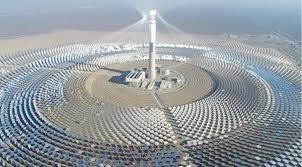
That desert would be incredible for thermal solar plants though, like those big light collecting towers with mirrors.
 
Sadly, Iran hasn't yet significantly exploited the Lut Desert for renewable energy development, despite its extraordinary solar potential.

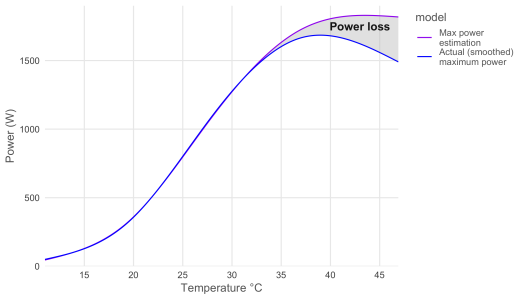
Solar hates high temperatures. This graph does not go all the way up to 70°C that is discussed here. But you can extrapolate to imagine how much power is lost at that temperature.

1751490726982.png
 
Yeah PV would maybe not do well there but I'm thinking thermal would. Or even just thermal storage, like molten salt. With high temps like that, the heat loss of the system would be slower.

Then again I cannot even imagine trying to build anything in that kind of heat. Imagine being out there mixing concrete for example. 😱
 
When I was a kid, we had an . . . let's just say, 'unusual' scoutmaster. We went to a variety of caves in PA on different trips. Not the typical tourist caves mind you. These were tight, crawl in on your belly in water and mud type caves. Today, he'd probably be convicted for child endangerment.

It turns out, that once you get to a certain depth, the temp is basically constant all year round. I just looked it up and you only have to go down between 10 and 30 feet. I'm going to guess that's roughly 3 to 9 meters.

I forget what the temps are in most caves but IIRC it's somewhere in the mid-60sF. Not exactly short sleeve weather but still, pretty amazing that you're getting those temps from the earth's internal heat.

Of course, the deeper you go, the hotter it is. I assume at some point there must be mile posts for how far it is to hell.
 
When I was a kid, we had an . . . let's just say, 'unusual' scoutmaster. We went to a variety of caves in PA on different trips. Not the typical tourist caves mind you. These were tight, crawl in on your belly in water and mud type caves. Today, he'd probably be convicted for child endangerment.

It turns out, that once you get to a certain depth, the temp is basically constant all year round. I just looked it up and you only have to go down between 10 and 30 feet. I'm going to guess that's roughly 3 to 9 meters.

I forget what the temps are in most caves but IIRC it's somewhere in the mid-60sF. Not exactly short sleeve weather but still, pretty amazing that you're getting those temps from the earth's internal heat.

Of course, the deeper you go, the hotter it is. I assume at some point there must be mile posts for how far it is to hell.
Indeed, at a mere 40k feet, the kola superdeep registered temperatures of 350F. Obviously the actual center of the earth isn't the focus here, but it put it in perspective the earth has a radius of about 21 million ft.
 
I haven't given it any thought, aside from a quick think since this thread came up, but I wonder if you could do solar heating in these ridiculous places, where you focus sun to make a furnace and generate electricity? That usually involves steam, and water's in short supply. Any other way of economically doing it?
 
Steam is a closed loop so it would be doable. Even molten salt could work then you run water through the molten salt to make steam, this way there's enough thermal mass to keep generating at night.
 
I haven't given it any thought, aside from a quick think since this thread came up, but I wonder if you could do solar heating in these ridiculous places, where you focus sun to make a furnace and generate electricity? That usually involves steam, and water's in short supply. Any other way of economically doing it?
Yes, there's various thermal plant designs that use this exact concept. Reflecting large amounts of light into a focused location that can do things like, melt salt to be used for steam power is tried and true, though there's only a few places it works well enough to be worthwhile I think.
1751563037164.jpeg
 
Yes, there's various thermal plant designs that use this exact concept. Reflecting large amounts of light into a focused location that can do things like, melt salt to be used for steam power is tried and true, though there's only a few places it works well enough to be worthwhile I think.
View attachment 126599
Molten salt towers with parabolic mirrors exist in Nothern Africa (Noor Ouarzazate Solar Power Station , 510MW) in Morocco also one in Spain and one or two in the USA.
But sand storms are a big issue. And it seems that the lut desert has a lot of rough sandstorms.

And the heat.

Then again, i saw a documentary once where it was explained that in ancient times in the hot middle east, probably Persia... Most buildings existed partially underground. with special air ducts and canals as a sort of natural functioning airconditioning.
There was always a draft of cool air coming from the lower levels beneath the ground.
I can not remember anymore what kind of documentary is was. Was on youtube.
 
Last edited:
I saw an old(18th-19th century) house around here that had slightly inset "ramps" on the top faces of the very large chimneys. My conclusion was it was to create a draught that sucked air up the chimney and cooled the house when the sun hit it. That never would've occurred to me, except I had recently read an article that described that exact thing, though not with chimneys in particular. That was the only sense I could make from the setup just by looking at it, and I thought it was pretty cool.
 
I saw an old(18th-19th century) house around here that had slightly inset "ramps" on the top faces of the very large chimneys. My conclusion was it was to create a draught that sucked air up the chimney and cooled the house when the sun hit it. That never would've occurred to me, except I had recently read an article that described that exact thing, though not with chimneys in particular. That was the only sense I could make from the setup just by looking at it, and I thought it was pretty cool.
Yeah in deed. I do not know if you mean the same thing, i had to do some hard remembering and googling but i think it is called the venturi effect. All about pressure drops and lower air pressure and higher air pressure.
(Re)Discovered in 1797 but known for thousands of years, before Christ.
 
Solar hates high temperatures. This graph does not go all the way up to 70°C that is discussed here. But you can extrapolate to imagine how much power is lost at that temperature.

View attachment 126556
These days a lot of solar panel offers come with water cooling. Well, it is not really water coolling but water heating, getting more efficiency from the (very hot because if Infrared rich) sun light. The water can easily reach temperatures of over 70 degrees celcius and thus is good enough for storage in a boiler and at the same time limit legionella bacterial infections of the water.
 
Back
Top