
-
We’re currently investigating an issue related to the forum theme and styling that is impacting page layout and visual formatting. The problem has been identified, and we are actively working on a resolution. There is no impact to user data or functionality, this is strictly a front-end display issue. We’ll post an update once the fix has been deployed. Thanks for your patience while we get this sorted.
You are using an out of date browser. It may not display this or other websites correctly.
You should upgrade or use an alternative browser.
You should upgrade or use an alternative browser.
will Intel release another CPU on 1150?
- Thread starter nyker96
- Start date

SOFTengCOMPelec
Platinum Member
In theory, Broadwell (the die shrinked Haswell) is expected to come out in Socket 1150, in about 12 .. 18 months. But if it was me, I would wait until Broadwell comes out, to give 1150 motherboards time to improve, cost reduce, and also there may be better 1150 chipsets out by then.
http://en.wikipedia.org/wiki/Broadwell_(microarchitecture)
http://en.wikipedia.org/wiki/Broadwell_(microarchitecture)
Last edited:
In theory, Broadwell (the die shrinked Haswell) is expected to come out in Socket 1150, in about 12 .. 18 months. But if it was me, I would wait until Broadwell comes out, to give 1150 motherboards time to improve, cost reduce, and also there may be better 1150 chipsets out by then.
http://en.wikipedia.org/wiki/Broadwell_(microarchitecture)
Definitely the strategy I would adopt also.
Concillian
Diamond Member
I personally think we're at the point where you have to assume new CPU = new mobo.
Just like IB, if there's a socket 1150 for the shrink, there will probably also be a chipset with more features that you'll want to go along with it. 1156 was a new socket for the shrink of Nehalem too. I just don't think we can expect current mobos to be used for anything other than current CPUs. Consider it a bonus if they do... I certainly wouldn't PLAN on keeping a mobo for the next gen CPU.
Just like IB, if there's a socket 1150 for the shrink, there will probably also be a chipset with more features that you'll want to go along with it. 1156 was a new socket for the shrink of Nehalem too. I just don't think we can expect current mobos to be used for anything other than current CPUs. Consider it a bonus if they do... I certainly wouldn't PLAN on keeping a mobo for the next gen CPU.

In theory, Broadwell (the die shrinked Haswell) is expected to come out in Socket 1150, in about 12 .. 18 months. But if it was me, I would wait until Broadwell comes out, to give 1150 motherboards time to improve, cost reduce, and also there may be better 1150 chipsets out by then.
http://en.wikipedia.org/wiki/Broadwell_(microarchitecture)
ummm you got a point, I was thinking about getting haswell for next upgrade, but this whole soso performance, less OC than Ivy kinda turned me off. but if Broadwell gonna be release on it may be there's still some hope for 1150.

SOFTengCOMPelec
Platinum Member
ummm you got a point, I was thinking about getting haswell for next upgrade, but this whole soso performance, less OC than Ivy kinda turned me off. but if Broadwell gonna be release on it may be there's still some hope for 1150.
(Wild speculation) I'm hoping that Intel will see and respond to performance (esp overclocking) enthusiasts underwhelming reaction to the Haswell series. The response I'm hoping for is something like the 2700K (follow on from 2600K), but hopefully even better, released in the next 6 months, or so.
Ideally, it would be a sort of 4770K on mega whiz wheels, with a much improved TIM solution (soldered rather than not?), hence avoiding worrying/risky de-lidding overclocks, most/all cpu options enabled on chip (such as TSX and virtualization), and even better default (higher) clock frequencies. Possibly, even more/better cache.
Back on topic, then 1150 would be a good solution for you.
Last edited:

Edrick
Golden Member
In theory, Broadwell (the die shrinked Haswell) is expected to come out in Socket 1150, in about 12 .. 18 months. But if it was me, I would wait until Broadwell comes out, to give 1150 motherboards time to improve, cost reduce, and also there may be better 1150 chipsets out by then.
http://en.wikipedia.org/wiki/Broadwell_(microarchitecture)
And then when you wait for Broadwell, in 12-18 months, people will then tell you just to wait for Skylake. It is a never ending process.
And while you wait, we will be enjoying our Haswells for 12-24 months.

crashtech
Lifer
And then when you wait for Broadwell, in 12-18 months, people will then tell you just to wait for Skylake. It is a never ending process.
And while you wait, we will be enjoying our Haswells for 12-24 months.
yeah, if I had listened to those people that say "just wait," I'd still have my 486 running Win 3.1.
SOFTengCOMPelec
Platinum Member
And then when you wait for Broadwell, in 12-18 months, people will then tell you just to wait for Skylake. It is a never ending process.
And while you wait, we will be enjoying our Haswells for 12-24 months.
yeah, if I had listened to those people that say "just wait," I'd still have my 486 running Win 3.1.
I agree. You have to decide when the time has come to act (buy computer stuff), go though what buying options are available and buy the stuff.
But, if you want the best motherboard to go with your shiny new cpu, it's best to buy the cpu and motherboard at the SAME time, which might make you decide to wait, rather than buying a motherboard in the hope of upgrading the cpu later.
Edrick
Golden Member
But, if you want the best motherboard to go with your shiny new cpu, it's best to buy the cpu and motherboard at the SAME time, which might make you decide to wait, rather than buying a motherboard in the hope of upgrading the cpu later.
On my server, I'm rocking an IB CPU on my Z68 MB from SB days. Didn't need a Z77 board.
SOFTengCOMPelec
Platinum Member
On my server, I'm rocking an IB CPU on my Z68 MB from SB days. Didn't need a Z77 board.
Sadly, it's possible that the days of being able to buy a motherboard, and then upgrading the cpu a number of times, are disappearing fast (at least on the Intel side). It also seems to depends on what you use the motherboard for (e.g. do you need the new chipset features).
We may see future motherboards have permanently soldered down cpu's only, making upgrades virtually impossible.
EDIT: I guess at the end of the day, Intel seem to be keeping their playing cards VERY close to their chest, and seem to be keeping too quiet about what is happening in the future with cpu's. E.g. In what socket formats is Broadwell coming out in, and when will we see, mainstream 6 core processors ?
This is making it harder to choose what to buy and when.
Last edited:
Concillian
Diamond Member
I don't think Intel is keeping much close to it's chest here.
They know if they make some new features that people will buy a new motherboard. People are giving them too much credit if they think Intel will not try to make a new motherboard for the Haswell refresh or Broadwell, or any other event they can. They've been doing nothing lately if not segmenting the market to cash in on people who "need" a niche product and marking that up.
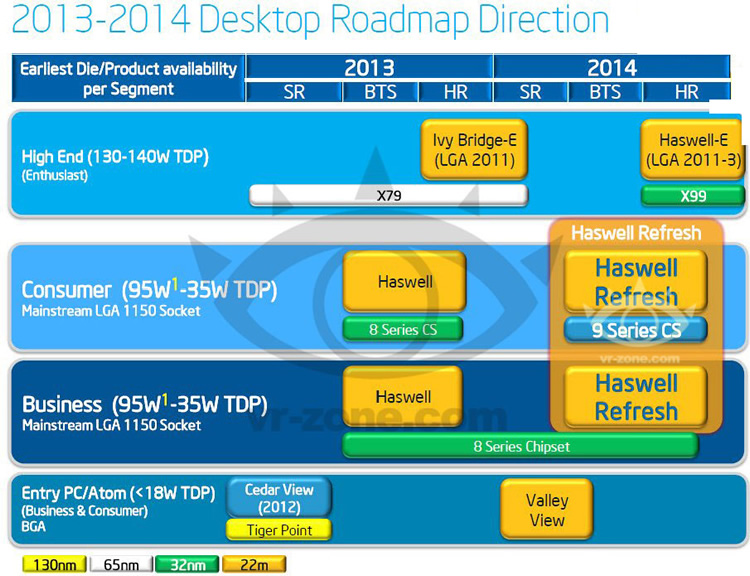
That slide up there shows a new desktop chipset on Haswell release for a reason...
Like I said, assume new CPU = new mobo. If you end up being able to upgrade CPU without a new mobo, consider it a bonus.
They know if they make some new features that people will buy a new motherboard. People are giving them too much credit if they think Intel will not try to make a new motherboard for the Haswell refresh or Broadwell, or any other event they can. They've been doing nothing lately if not segmenting the market to cash in on people who "need" a niche product and marking that up.
That slide up there shows a new desktop chipset on Haswell release for a reason...
Like I said, assume new CPU = new mobo. If you end up being able to upgrade CPU without a new mobo, consider it a bonus.
Last edited:
SOFTengCOMPelec
Platinum Member
I don't think Intel is keeping much close to it's chest here
Example, Intel seem to be keeping extremely tight lipped about the Haswell series, even though it has already been released.
Why are so many options disabled in the 4770K ?
Why does it still have a significantly worse TIM (or gap) compared to Sandy Bridge ?
Why have the maximum clock frequencies not gone up ? (lack of competition, poor 22nm yields, overheating, power consumption, or what ?) ?
Has the Haswell series experienced technical difficulties, and so is under-performing at the moment ?
If Intel are keeping people well informed, then I'm not 100% convinced. I can understand that for reasons of competition, marketing etc, may be why they are so secretive. But (for me), it seems to be getting to the point, where Intel are becoming like other companies (Microsoft comes to mind), where I end up trying to avoid their products at all costs.
EDIT: Intel cpu's are still so good (compared to the alternatives) that I still buy many Intel chips. I am just getting increasing disillusioned with their way of handling things.
Last edited:
In theory, Broadwell (the die shrinked Haswell) is expected to come out in Socket 1150, in about 12 .. 18 months. But if it was me, I would wait until Broadwell comes out, to give 1150 motherboards time to improve, cost reduce, and also there may be better 1150 chipsets out by then.
http://en.wikipedia.org/wiki/Broadwell_(microarchitecture)
Just about everything surrounding Broadwell suggests it's going to be a non desktop/BGA only part. Intel will likely release faster versions of Haswell, then move straight to Skylake for desktops.
SOFTengCOMPelec
Platinum Member
Just about everything surrounding Broadwell suggests it's going to be a non desktop/BGA only part. Intel will likely release faster versions of Haswell, then move straight to Skylake for desktops.
If so, I will be very disappointed. I was hoping that although Broadwell is not expected to be massively faster than Haswell, it should give a nice power saving advantage, for the same computing power, and have much better integrated graphics. (Much like Ivy bridges power savings over Sandy, due mainly to the die shrink).

blackened23
Diamond Member
Isn't Broadwell a "tick" using a 14nm process? The question shouldn't be broadwell, it should be the Haswell refresh which is due next year - presumably that will be using 1150. I can't see a different node using the same socket, though.
zir_blazer
Golden Member
Weren't rumors that Broadwell was going to be soldered only, or Intel say the otherwise already? Even if Broadwell is pin compatible with LGA 1150 infrastructure, if Intel sells the Processors in a BGA package that is mean to be soldered, you will need a new Motherboard that will come with it build in anyways.
Concillian
Diamond Member
Example, Intel seem to be keeping extremely tight lipped about the Haswell series, even though it has already been released.
Why are so many options disabled in the 4770K ?
Why does it still have a significantly worse TIM (or gap) compared to Sandy Bridge ?
Why have the maximum clock frequencies not gone up ? (lack of competition, poor 22nm yields, overheating, power consumption, or what ?) ?
Has the Haswell series experienced technical difficulties, and so is under-performing at the moment ?
If Intel are keeping people well informed, then I'm not 100% convinced.
My point wasn't that Intel was keeping people well informed. My point was that the writing is on the wall in traffic cone orange letters so big you have to be pretty slow not to realize what's going on.
They've never been very communicative with the enthusiast segment. Not directly anyway. Their actions over the last few years speak pretty loudly. Get your head out of the sand if you think they're planning on any favors to the enthusiast segment. It's a high margin segment that they've been squeezing for a few years. Don't expect them to stop squeezing now... there's still no real competition, so they're gonna squeeze tighter.
Last edited:
SOFTengCOMPelec
Platinum Member
My point wasn't that Intel was keeping people well informed. My point was that the writing is on the wall in traffic cone orange letters so big you have to be pretty slow not to realize what's going on.
They've never been very communicative with the enthusiast segment. Not directly anyway. Their actions over the last few years speak pretty loudly. Get your head out of the sand if you think they're planning on any favors to the enthusiast segment. It's a high margin segment that they've been squeezing for a few years. Don't expect them to stop squeezing now... there's still no real competition, so they're gonna squeeze tighter.
I guess it's taking a long time for the current situation to sink in with me, SORRY.
I've been so use to the constant stream of new cpu's which have been coming out for about the last forty years. Where, (very approximately) every two years, you could go out, and swap/upgrade your 2 year old cpu for a brand new one, which was double the execution speed. E.g. 800 MHz rather than the old ones 400 MHz etc, etc.
Things are changing on that front, and it is taking me a long time to get use to it. We need a "new law of Physics" to solve this problem.
The disappearing desktop market, has got me worried and confused.
To me, (as a computer enthusiast), it's as if cars started disappearing overnight. And for some strange reason, there were no more new cars for sale any more.
Last edited:
If so, I will be very disappointed. I was hoping that although Broadwell is not expected to be massively faster than Haswell, it should give a nice power saving advantage, for the same computing power, and have much better integrated graphics. (Much like Ivy bridges power savings over Sandy, due mainly to the die shrink).
But who cares about that on a desktop? It's plugged in and the power savings on your electric bill will be hardly anything. Haswell IGP is plenty for basic needs and the new IGP still won't be good enough for modern games at 1080p at anything higher than low to medium settings. On battery powered devices though the power savings would be substantial for run time, and in the case of ultra thin notebooks that don't have the space or thermal capacity for a dGPU, the improved IGP would be a nice benefit. To me it makes perfect sense why it would be BGA only and really doesn't upset me when you consider the above factors.
TRENDING THREADS
-
 Discussion Zen 5 Speculation (EPYC Turin and Strix Point/Granite Ridge - Ryzen 9000)
- Started by DisEnchantment
- Replies: 25K
-
Discussion Intel Meteor, Arrow, Lunar & Panther Lakes + WCL Discussion Threads
- Started by Tigerick
- Replies: 25K
-
 Discussion Intel current and future Lakes & Rapids thread
- Started by TheF34RChannel
- Replies: 24K
-

-
