

PJABBER
Diamond Member
I was amazed and intrigued as anyone with the rise of Tea Party populism.
Living in the Washington, DC area I am used to seeing the efforts of many different kinds of advocacy groups. Sometimes the flow of daily life is interrupted by marches and demonstrations, sometimes it is just the slight awareness that the crowds in the streets seem different that day. The balance between the suits and the shorts, the coloring of the outfits, the presence or lack of kids, Washington changes character daily it seems.
One weekend about a year ago I was downtown, to see a film at the National Gallery of Art as I recall, and I came across the fringes of the first large DC rally that was held by the Tea Partiers. I generally avoid being near large demonstrations, actually I avoid them like the plague, but I wanted to see the movie and it was really a pleasant day to be outside.
I stopped to talk to some of the Tea Partiers and found that everyone was friendly and relaxed in the way a lot of tourists are. I asked about the signs and how they came to travel here. When my movie was over part of the crowd was still there but dispersing. Impressively, for as huge a crowd as had gathered, there was no trash left behind, no broken windows, trashed cars, just a bucolic scene.
How much has changed in that short year? The challenges of the town halls, more rallies, the failure of elected representatives to hear the people over and over again.
No one questions the influence of the Tea Parties or their legitimacy any more, that's for sure. From a shout out by Rick Santelli at 8:11 AM the morning of February 19, 2009, on CNBC of all places, to where we are today facing the likelihood of a massive shift in political power, the Tea Parties have come of age.
Some will say America was overdue for a return to populism. Isn't that what put Obama in office? But Obama, for all of his pandering, delivered nothing but more government spending on favorites and waste, what waste, further frustrating so many Americans praying for a return to sanity.
Not a movement of Democrats or Republicans, the Tea Parties were an ordinary person's expression of frustration at the malfeasance of both Parties. With a One Party government in power, the Tea Partiers saw fewer checks and balances to restrain a massive Democrat acceleration of government spending, well beyond the war years and 9/11 reaction of the Bush Administration. The Democrats had come to town to print, borrow and spend money and no one was going to stop them.
So the tale begins with the early chapters written. The special elections - Brown in Massachusetts! - were a harbinger and a coda. This story has legs and the plot thickens and the first election which will truly reflect the mood of the country comes in just a few weeks.
The time for the Tea Parties has come.
Living in the Washington, DC area I am used to seeing the efforts of many different kinds of advocacy groups. Sometimes the flow of daily life is interrupted by marches and demonstrations, sometimes it is just the slight awareness that the crowds in the streets seem different that day. The balance between the suits and the shorts, the coloring of the outfits, the presence or lack of kids, Washington changes character daily it seems.
One weekend about a year ago I was downtown, to see a film at the National Gallery of Art as I recall, and I came across the fringes of the first large DC rally that was held by the Tea Partiers. I generally avoid being near large demonstrations, actually I avoid them like the plague, but I wanted to see the movie and it was really a pleasant day to be outside.
I stopped to talk to some of the Tea Partiers and found that everyone was friendly and relaxed in the way a lot of tourists are. I asked about the signs and how they came to travel here. When my movie was over part of the crowd was still there but dispersing. Impressively, for as huge a crowd as had gathered, there was no trash left behind, no broken windows, trashed cars, just a bucolic scene.
How much has changed in that short year? The challenges of the town halls, more rallies, the failure of elected representatives to hear the people over and over again.
No one questions the influence of the Tea Parties or their legitimacy any more, that's for sure. From a shout out by Rick Santelli at 8:11 AM the morning of February 19, 2009, on CNBC of all places, to where we are today facing the likelihood of a massive shift in political power, the Tea Parties have come of age.
Some will say America was overdue for a return to populism. Isn't that what put Obama in office? But Obama, for all of his pandering, delivered nothing but more government spending on favorites and waste, what waste, further frustrating so many Americans praying for a return to sanity.
Not a movement of Democrats or Republicans, the Tea Parties were an ordinary person's expression of frustration at the malfeasance of both Parties. With a One Party government in power, the Tea Partiers saw fewer checks and balances to restrain a massive Democrat acceleration of government spending, well beyond the war years and 9/11 reaction of the Bush Administration. The Democrats had come to town to print, borrow and spend money and no one was going to stop them.
So the tale begins with the early chapters written. The special elections - Brown in Massachusetts! - were a harbinger and a coda. This story has legs and the plot thickens and the first election which will truly reflect the mood of the country comes in just a few weeks.
The time for the Tea Parties has come.

Why It's Time for the Tea Party
The populist movement is more a critique of the GOP than a wing of it.
By PEGGY NOONAN
SEPTEMBER 17, 2010

This fact marks our political age: The pendulum is swinging faster and in shorter arcs than it ever has in our lifetimes. Few foresaw the earthquake of 2008 in 2006. No board-certified political professional predicted, on Election Day 2008, what happened in 2009-10 (New Jersey, Virginia and Massachusetts) and has been happening, and will happen, since then. It all moves so quickly now, it all turns on a dime.
But at this moment we are witnessing a shift that will likely have some enduring political impact. Another way of saying that: The past few years, a lot of people in politics have wondered about the possibility of a third party. Would it be possible to organize one? While they were wondering, a virtual third party was being born. And nobody organized it.
Here is Jonathan Rauch in National Journal on the tea party's innovative, broad-based network: "In the expansive dominion of the Tea Party Patriots, which extends to thousands of local groups and literally countless activists," there is no chain of command, no hierarchy. Individuals "move the movement." Popular issues gain traction and are emphasized, unpopular ones die. "In American politics, radical decentralization has never been tried on such a large scale." Here are pollsters Scott Rasmussen and Doug Schoen in the Washington Examiner: "The Tea Party has become one of the most powerful and extraordinary movements in American political history." "It is as popular as both the Democratic and Republican parties." "Over half of the electorate now say they favor the Tea Party movement, around 35 percent say they support the movement, 20 to 25 percent self-identify as members of the movement."
So far, the tea party is not a wing of the GOP but a critique of it. This was demonstrated in spectacular fashion when GOP operatives dismissed tea party-backed Christine O'Donnell in Delaware. The Republican establishment is "the reason we even have the Tea Party movement," shot back columnist and tea party enthusiast Andrea Tantaros in the New York Daily News. It was the Bush administration that "ran up deficits" and gave us "open borders" and "Medicare Part D and busted budgets." Everyone has an explanation for the tea party that is actually not an explanation but a description. They're "angry." They're "antiestablishment," "populist," "anti-elite." All to varying degrees true. But as a network television executive said this week, "They should be fed up. Our institutions have failed."
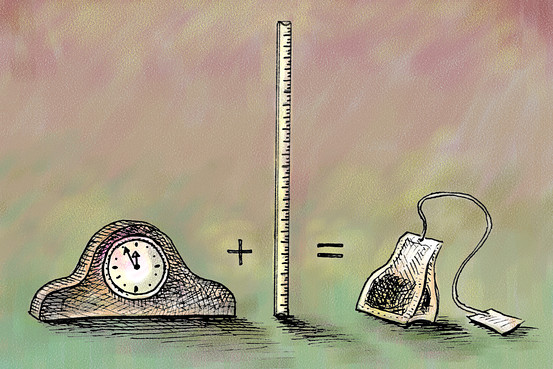
I see two central reasons for the tea party's rise. The first is the yardstick, and the second is the clock. First, the yardstick. Imagine that over at the 36-inch end you've got pure liberal thinkingmore and larger government programs, a bigger government that costs more in the many ways that cost can be calculated. Over at the other end you've got conservative thinkinga government that is growing smaller and less demanding and is less expensive. You assume that when the two major parties are negotiating bills in Washington, they sort of lay down the yardstick and begin negotiations at the 18-inch line. Each party pulls in the direction it wants, and the dominant party moves the government a few inches in their direction.
But if you look at the past half century or so you have to think: How come even when Republicans are in charge, even when they're dominant, government has always gotten larger and more expensive? It's always grown! It's as if something inexorable in our political realitywith those who think in liberal terms dominating the establishment, the media, the academyhas always tilted the starting point in negotiations away from 18 inches, and always toward liberalism, toward the 36-inch point.
Democrats on the Hill or in the White House try to pull it up to 30, Republicans try to pull it back to 25. A deal is struck at 28. Washington Republicans call it victory: "Hey, it coulda been 29!" But regular conservative-minded or Republican voters see yet another loss. They could live with 18. They'd like eight. Instead it's 28.
For conservatives on the ground, it has often felt as if Democrats (and moderate Republicans) were always saying, "We should spend a trillion dollars," and the Republican Party would respond, "No, too costly. How about $700 billion?" Conservatives on the ground are thinking, "How about nothing? How about we don't spend more money but finally start cutting."
What they want is representatives who'll begin the negotiations at 18 inches and tug the final bill toward five inches. And they believe tea party candidates will do that.
The second thing is the clock. Here is a great virtue of the tea party: They know what time it is. It's getting late. If we don't get the size and cost of government in line now, we won't be able to. We're teetering on the brink of some vast, dark new worldstates and cities on the brink of bankruptcy, the federal government too. The issue isn't "big spending" anymore. It's ruinous spending that they fear will end America as we know it, as they promised it to their children.
So there's a sense that dramatic action is needed, and a sense of profound urgency. Add drama to urgency and you get the victory of a tea party-backed candidate.
That is the context. Local tea parties seemso farnot to be falling in love with the particular talents or background of their candidates. It's more detached than that. They don't say their candidates will be reflective, skilled in negotiations, a great senator, a Paul Douglas or Pat Moynihan or a sturdy Scoop Jackson. These qualities are not what they think are urgently needed. What they want is someone who will walk in, put her foot on the conservative end of the yardstick, and make everything slip down in that direction.
Nobody knows how all this will play out, but we are seeing something bigsomething homegrown, broad-based and independent. In part it is a rising up of those who truly believe America is imperiled and truly mean to save her. The dangers, both present and potential, are obvious. A movement like this can help a nation by acting as a corrective, or it can descend into a corrosive populism that celebrates unknowingness as authenticity, that confuses showiness with seriousness and vulgarity with true conviction. Parts could become swept by a desire just to tear down, to destroy. But establishments exist for a reason. It is true that the party establishment is compromised, and by many things, but one of them is experience. They've lived through a lot, seen a lot, know the national terrain. They know how things work. They know the history. I wonder if tea party members know how fragile are the institutions that help keep the country together.
One difference so far between the tea party and the great wave of conservatives that elected Ronald Reagan in 1980 is that latter was a true coalitionnot only North and South, East and West but right-wingers, intellectuals who were former leftists, and former Democrats. When they won presidential landslides in 1980, '84 and '88, they brought the center with them. That in the end is how you win. Will the center join arms and work with the tea party? That's a great question of 2012.


