Why do liberals believe in global warming but not conservatives?

Page 2 - Seeking answers? Join the AnandTech community: where nearly half-a-million members share solutions and discuss the latest tech.

brycejones

Lifer
Oct 18, 2005
30,286
31,329
136
I was curious on what President-elect Trump thought so here it is.
http://sciencedebate.org/20answers#3

You can read his reply to them along with Stein's, Clinton' and Johnson's.

Here is Trump's response (emphasis added is mine):

"There is still much that needs to be investigated in the field of “climate change.” Perhaps the best use of our limited financial resources should be in dealing with making sure that every person in the world has clean water. Perhaps we should focus on eliminating lingering diseases around the world like malaria. Perhaps we should focus on efforts to increase food production to keep pace with an ever-growing world population. Perhaps we should be focused on developing energy sources and power production that alleviates the need for dependence on fossil fuels. We must decide on how best to proceed so that we can make lives better, safer and more prosperous."
 
Jul 9, 2009
10,759
2,086
136
Personally I favored the response by Johnson, the Libertarian candidate.
"
We accept that climate change is occurring, and that human activity is contributing to it, including through greenhouse gases like methane, nitrous oxide, and carbon dioxide.

Unfortunately for policymakers - the very activities that appear to contribute to climate change also contribute to mankind’s health and prosperity, so we view with a skeptical eye any attempts to curtail economic activity. We believe that a motivated and informed market will demand efficiency and reduced greenhouse gases, mitigating at least some of mankind’s effects. It is a virtual certainty that consumer demands and the marketplace will produce tangible benefits. It is not, however, certain that unilateral regulatory approaches by the U.S. will, in fact, produce benefits that are proportionate to costs. Nor is it certain that international treaties will produce benefits as developing nations have the most at stake to continue industrialization.

As other countries industrialize, as they have the right to do, we recognize that environmental trade-offs are inevitable.. As extreme poverty wanes in places like India and China, the poor will stop burning excrement or wood. And that will reduce certain types of pollution, while certain greenhouse gases may temporarily increase. But as countries become more developed, industrialized and automated, we believe the marketplace will facilitate the free exchange of new, efficient, carbon-friendly processes and technologies. And a Johnson-Weld administration will facilitate as much knowledge sharing as possible to speed and spread sustainable, cleaner technology as nations develop."
 
Jul 9, 2009
10,759
2,086
136
It was interesting but completely immaterial at this point since he isn't the president elect. Clinton's response is just as meaningless for the same reason.
True, but over 1/2 of the citizens that voted, voted for either Trump or Johnson. Their opinions still matter.
 

MrSquished

Lifer
Jan 14, 2013
26,556
24,748
136
It was interesting but completely immaterial at this point since he isn't the president elect. Clinton's response is just as meaningless for the same reason.

interesting policy proposal to just give up and die if your candidate/candidates side loses.

smells fishy to me. like in dead stanky fish.

I've seen more rational policy supporting proposals from drunk midgets.
 

Paratus

Lifer
Jun 4, 2004
17,754
16,092
146
Personally I favored the response by Johnson, the Libertarian candidate.
"
We accept that climate change is occurring, and that human activity is contributing to it, including through greenhouse gases like methane, nitrous oxide, and carbon dioxide.

Unfortunately for policymakers - the very activities that appear to contribute to climate change also contribute to mankind’s health and prosperity, so we view with a skeptical eye any attempts to curtail economic activity. We believe that a motivated and informed market will demand efficiency and reduced greenhouse gases, mitigating at least some of mankind’s effects. It is a virtual certainty that consumer demands and the marketplace will produce tangible benefits. It is not, however, certain that unilateral regulatory approaches by the U.S. will, in fact, produce benefits that are proportionate to costs. Nor is it certain that international treaties will produce benefits as developing nations have the most at stake to continue industrialization.

As other countries industrialize, as they have the right to do, we recognize that environmental trade-offs are inevitable.. As extreme poverty wanes in places like India and China, the poor will stop burning excrement or wood. And that will reduce certain types of pollution, while certain greenhouse gases may temporarily increase. But as countries become more developed, industrialized and automated, we believe the marketplace will facilitate the free exchange of new, efficient, carbon-friendly processes and technologies. And a Johnson-Weld administration will facilitate as much knowledge sharing as possible to speed and spread sustainable, cleaner technology as nations develop."

While I don't have much problem with the second paragraph the first has some definite issues.

They don't know if the benefit will be worth the cost of going it alone.

Here's an example of the cost:
IMG_20131018_094620.jpg


That's the city of Miami Beach that now has salt water tidal flooding during King tides due to sea level rise. They are spending about 1/2 a billion to try and shore themselves up.

That's just one city along the coast.

Second we aren't going it alone. The Paris treaty was ratified and basically the whole world is putting some effort towards mitigation.

Lastly world GDP has increased year over year and our CO2 emissions have remained constant. http://arstechnica.com/science/2016/11/global-carbon-emissions-look-steady-for-third-year-running/
Continuing to decouple the economy from fossil fuels means we can continue improving our quality of life without incurring warning.
 

mxnerd

Diamond Member
Jul 6, 2007
6,799
1,103
126
Not that conservatives don't believe it, they just won't admit it.
 

flexy

Diamond Member
Sep 28, 2001
8,464
155
106
Because (many) conservatives are establishment/government paranoid.
"Global Warming" is something assumed by "the establishment" as being true, for that reason "WE MUST" oppose it.
There is the same mindset behind as believing in "Chemtrails" or that "the government" poisons your water, or that the moon landing was a hoax. The establishment (science, and of course liberals) say it, so it CAN not be true and we don't believe it.

You are right that global warming shouldn't have anything to do with politics (but then again, EVERYTHING is politics), or at least someone shouldn't believe in GW simply because of a political association. It doesn't make too much sense.

For me personally, it is not a matter of "accepting" or even deliberately finding "the truth" now whether GW really happens, or humans make only a percentage of GW...or maybe not much at all. It is irrelevant. What's important is that pollution, greenhouse gases etc.... harm our planet in one or the other way, whether GW now "is real" or nor....for that reason I would always back those who are concerned about those things.

If someone says that GW is not happening, if a politician says this, he has an agenda, which is ultimately wanting to give industries liberties so they can pollute with less regulations. And why the fuck would I want to support this?
 

Paratus

Lifer
Jun 4, 2004
17,754
16,092
146
The Paris Treaty was not ratified. Not by the United States.

I should add this since it's obvious you actually believe the United States ratified the treaty.
https://en.wikipedia.org/wiki/Ratification
Yes you are right I used the wrong term. You may not be aware but the treaty was written in such a way that our adherence to the treaty did not require senate ratification. It will also take 4 years for us to withdraw.

Now that being said, it doesn't change my point that the US would not be going it alone in reducing greenhouse gasses.

Care to comment on that point?
 

KillerBee

Golden Member
Jul 2, 2010
1,750
82
91
I don't understand, what does global warming has to do with politics and whether you accept it or not depends on whether you're republican or democrat?

It's because Hillary = good and Trump = Bad
Vote Hillary or else you are a racist!

Yes it makes no sense as far as your original question - but that is your only choice.
 

Meghan54

Lifer
Oct 18, 2009
11,684
5,228
136
Here is Trump's response (emphasis added is mine):

"There is still much that needs to be investigated in the field of “climate change.” Perhaps the best use of our limited financial resources should be in dealing with making sure that every person in the world has clean water. Perhaps we should focus on eliminating lingering diseases around the world like malaria. Perhaps we should focus on efforts to increase food production to keep pace with an ever-growing world population. Perhaps we should be focused on developing energy sources and power production that alleviates the need for dependence on fossil fuels. We must decide on how best to proceed so that we can make lives better, safer and more prosperous."

What's really sad about Trump's answer is his assumption that we can tackle only one problem at a time, as suggested by his "perhaps we should focus on clean water or malaria or food production" instead of climate change because of limited funding.

Maybe we should try allocating just 0.5% of the defense budget to trying to solve maybe multiple problems simultaneously, like some are already do trying to do. We can research and solve problems of all types, all at the same time.

Just sounds like Trump is unable to fathom that we can do research into multiple, different areas simultaneously because we don't have enough cash around, despite his insistence we raise defense spending beyond the $700B we already spend...
 
  • Like
Reactions: Kazukian

Jaskalas

Lifer
Jun 23, 2004
36,414
10,720
136
I was 100% on board, then I talked a bit with a scientist from JPL that had recently retired, her job was sun research. I asker her about global warming, her answer was that there are a shit ton of variables and she didn't think human activity was a major factor.

That sounds like a very narrow view to a very broad subject.
Human activity clearly increases CO2 concentration.
The measured W/m² (Watt per square meter) has increased, so we cannot pretend increased CO2 is not a factor.

As to "major factor", that had largely been my contention for a while,
but Paratus largely blew that question of out the water these past several years.

Now that there is no pause, what can you possibly argue?
 

brycejones

Lifer
Oct 18, 2005
30,286
31,329
136
The Paris Treaty was not ratified. Not by the United States.

I should add this since it's obvious you actually believe the United States ratified the treaty.
https://en.wikipedia.org/wiki/Ratification

LOL, 2 things.

1. It is not a treaty. You calling it the Paris Treaty doesn't it make it so. The correct name is Paris climate accord.
2. Since it is not a treaty and does not require the US to take any actions there was no Senate vote required. The executive branch signed the accord, its a done deal.
 

greatnoob

Senior member
Jan 6, 2014
968
395
136
I was 100% on board, then I talked a bit with a scientist from JPL that had recently retired, her job was sun research. I asker her about global warming, her answer was that there are a shit ton of variables and she didn't think human activity was a major factor.

Then she or you are full of shit. ;)
I wouldn't be too quick to judge here...

Doing Environmental Economics last semester while everybody in class agrees that global warming is a thing, there are differing opinions on the major causes of it and the quantitative impact entities actually have on the ozone, these were a couple of things we thought of:

1. Livestock and meat consumption (specifically beef)
2. Aerosol in the air
3. Humans (and the effects of industrialisation)

It is safe to say there are a lot of variables when it comes to climate change.

The West and the First World will eventually see traditional non-replenishable energy source prices gradually increase as non-renewable resources run out until we hit the choke price, then it'll either be everybody adapting to renewable energy sources (since non-renewable energy source prices >= renewable energy prices), a breakthrough in extracting non-renewable resources technology or dying...

What we should worry more about are places with already large or growing economies and an increasing population size, specifically India and China..
 

Commodus

Diamond Member
Oct 9, 2004
9,215
6,821
136
The worst bit about some conservatives' resistance to climate change science (besides the damaging effect on the environment, of course): we've seen this play out before.

Remember the 'debate' over leaded gas? Clair Patterson had firm scientific evidence that environmental lead was due to gas and other industrial sources, but he had to fight against corporate lobbying and dodgy 'experts' trying to cast doubt on his findings. It took years and years before the government finally did the right thing, accepted real science and phased out lead.

We're in the same boat with climate change. There are Republicans who accept climate change, I'm sure, but there are far too many who are either paid to look the other way or have tricked themselves into thinking that pro-environment means anti-business. I suspect we'll get to our Patterson moment... I just hope it's in time.
 

trenchfoot

Lifer
Aug 5, 2000
16,125
8,714
136
The worst bit about some conservatives' resistance to climate change science (besides the damaging effect on the environment, of course): we've seen this play out before.

Remember the 'debate' over leaded gas? Clair Patterson had firm scientific evidence that environmental lead was due to gas and other industrial sources, but he had to fight against corporate lobbying and dodgy 'experts' trying to cast doubt on his findings. It took years and years before the government finally did the right thing, accepted real science and phased out lead.

We're in the same boat with climate change. There are Republicans who accept climate change, I'm sure, but there are far too many who are either paid to look the other way or have tricked themselves into thinking that pro-environment means anti-business. I suspect we'll get to our Patterson moment... I just hope it's in time.

Yep, the more you try to take something away from someone, the tighter the grip they will exert on it, until they either wring it absolutely dry of any value and let go or until they figure out a way to make more money by relaxing their grip on it.

Compelling Big Business to become good conscientious stewards of the environment is like trying to take a roll of toilet paper away from a guy with chronic diarrhea.
 

BonzaiDuck

Lifer
Jun 30, 2004
16,884
2,192
126
Let's make something clear, for Grooveriding and everyone else.

Your "democracy" has been manipulated for more than just a hundred years by concentrated economic interests. Eisenhower in 1961 forgot to mention the other half of the military industrial complex: strategic minerals. Look at some economic history: Law and Economic Policy in America
focused on the Sherman Anti-Trust Act. If this is about politics, it isn't about ideology. It's merely about money.

You can trace the money and market relationships to chemical and fertilizer companies, pharmaceuticals, plastics . . . the list goes on.

World supply is limited simply because the world is limited. Sure, oil is a renewable resource -- if you choose to wait at least 100,000 years.

Cal-Tech scientists believe the world supply will dwindle to a crisis level within the next hundred years. Conservatives who are "short-run maximizers" in vision have long been over-run by oil and defense interests. The worst of it is, even now, most of the economy runs on oil. But the most damning evidence so far to emerge in terms of the corporate dimension is Exxon-Mobil's suppression of their own acknowledged belief in climate change and concerns about how it affects their facilities near or above the Arctic Circle. Never mind that the national security apparatus: The GOP's beloved DOD and CIA, were developing scenarios and plans to cope with the demographic and political impacts due to -- global warming or climate change.

So if you want to question the fully-known atmospheric photo-chemistry, the huge accumulation of scientific statistical evidence, and the fact that you can test and prove it in a laboratory, you shouldn't be allowed to drive an automobile because it runs on a theory, tested by statistical evidence and scientific fact.

Any short-term suppression of oil consumption will result in world-wide chaos. But we're poisoning our world as a consequence: there is more CO2 in the atmosphere now than there was over the last 800,000 years.

Temple of the Holy Ghost! We're all a bunch of bacteria growing in a Petri-dish, drowning in our own shit as we over-populate, and showing the same inability to act cooperatively to solve the problem. If you want to contrive a phony argument against evolution, you could say "See?! Human progress amounts to nothing! There's been no evolution!"

Some people resent the idea that coastal residents will somehow merit a transfer of wealth for their loss from inlander-cornpones. In fact, given the history of industrial carbon energy use, we all have yet to pay the costs of generations of dead people. Whatever the "future cost" of present oil consumption may be, it has never been counted in the price at the tank, and you can track the emergence of those costs between Katrina, Sandy, the California drought, Texas wild-fires -- and the extraction risks of things like Deep Horizon.

Vehicles have been converting to natural gas since the 90s -- maybe earlier. An early start on this problem would've made any transitional pain much less. Waiting too long could result in violent turmoil and greater costs. Or just irreversible disaster.

Eat, drink and be merry! Maybe you'll be dead before the worst of it! It's OK that your grand-kids are totally f***ed. Markets solving the problem in time? Mother Nature doesn't play the market, stupid. And since the markets never accounted for future costs of what hadn't been known before, you better pray for a miracle.

 
Last edited:
  • Like
Reactions: KMFJD and greatnoob

greatnoob

Senior member
Jan 6, 2014
968
395
136
Conservatives who are "short-run maximizers" in vision have long been over-run by oil and defense interests. The worst of it is, even now, most of the economy runs on oil.

You are spot on with this. Seems like every conservative hisses at the idea of a two-period model, it's the "I want as much as I can get now, I don't want to pay higher prices, I don't care about the future. I want it NOW!" mentality that has brought so much irreversible burden on the unlucky majority of the third-world.

Any short-term suppression of oil consumption will result in world-wide chaos.
I think the 1979 oil shock could be a reason for this dependence on oil. Nobody is willing to give it up because of how cheap it is at the moment, yet it will definitely have a massive impact on the economy when it starts running out or the unlikely chances that supply is blocked once again for political reasons. The future impact of the economy can be minimised at the expense of restricting usage now and subsidising research into alternatives - say, instead of funding useless wars.

Markets solving the problem? Mother Nature doesn't play the market, stupid.
While I somewhat agree with you that a free market isn't going to solve this dilemma (unless we wait until chaos ensues) I do think government intervention could act as a catalyst in transitioning to renewable energy sources. The idea is, if a monopolist is given exclusive access to resources, they will want to act in their own best interest (higher profit) which in turn means they need to maximise consumption of that resource in 2-periods (now and future) as much as possible. They can do this by limiting quantity of resources and charging higher prices -> by acting on their own self interest they are essentially also helping speed up (or start) research on new renewable energy sources and extraction methods.

At the end, the free market is there as a last resort and sort of a safety net: prices become so ridiculously high that it's either innovate or die. I'm certain there will be government intervention when oil does start to run out - that is, if there's no new extracting technology breakthrough by then - but (hopefully) most rational people would have realised the trend of higher prices and moved to alternatives by then.
 
Jul 9, 2009
10,759
2,086
136
It IS a treaty, it was not passed in the Senate, it is not binding on the United States. I call bullshit on the idea that the Administration can lock the United States into a treaty that takes us 4 years to withdraw from without a Senate vote. I guess we'll just have to wait and see.
 

Hayabusa Rider

Admin Emeritus & Elite Member
Jan 26, 2000
50,879
4,268
126
One can ask why conservatives believe that the earth was created 10,000 years ago.


Even that doesn't work. Humanity was given the responsibility of caretaker. Clearly the Early Earth people you cite didn't bother to think about that. You don't even have to believe in GW- Look at the Pacific garbage patch. Can't pretend that's not real.
 

Paratus

Lifer
Jun 4, 2004
17,754
16,092
146
I wouldn't be too quick to judge here...

Doing Environmental Economics last semester while everybody in class agrees that global warming is a thing, there are differing opinions on the major causes of it and the quantitative impact entities actually have on the ozone, these were a couple of things we thought of:

1. Livestock and meat consumption (specifically beef)
2. Aerosol in the air
3. Humans (and the effects of industrialisation)

It is safe to say there are a lot of variables when it comes to climate change.

The West and the First World will eventually see traditional non-replenishable energy source prices gradually increase as non-renewable resources run out until we hit the choke price, then it'll either be everybody adapting to renewable energy sources (since non-renewable energy source prices >= renewable energy prices), a breakthrough in extracting non-renewable resources technology or dying...

What we should worry more about are places with already large or growing economies and an increasing population size, specifically India and China..

Why do you think I've been quick to judge?

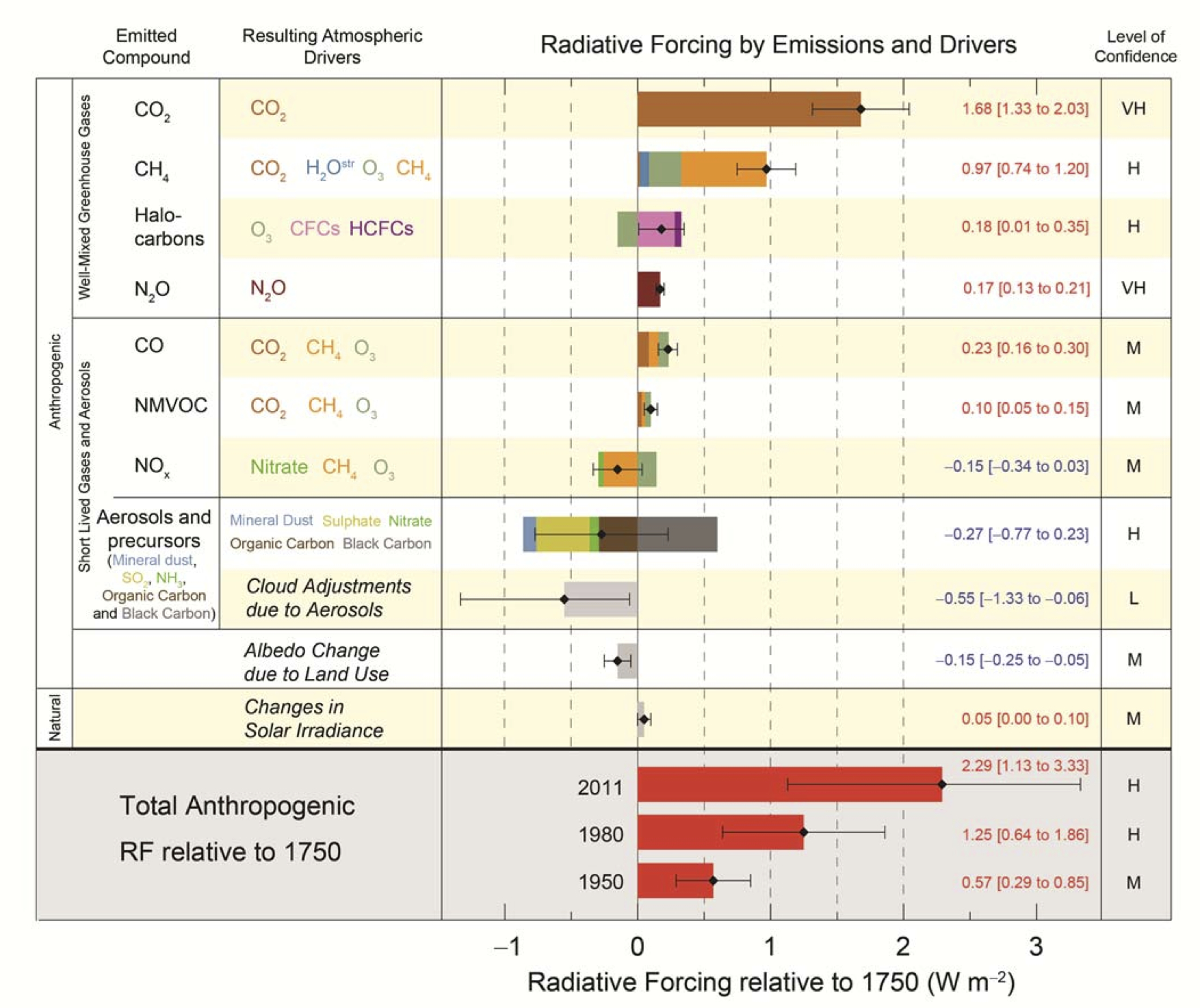
While your class may have differing opinions on the causes of global warming the absolute majority of climate scientists do not.

Natural forcings are currently roughly neutral.
Anthropogenic sources however drive the observed warming.
ipcc_rad_forc_ar5.jpg

(From the IPCC AR5)

Let's also talk about your economic analysis. While I basically agree that as fuel become scarce prices will rise which will drive adoption of new resources, did your class bother to compare that hypothesis with what's actually happening in the energy markets?

The market doesn't have to wait for scarcity before moving to new sources of energy, if those new sources make economic sense.

Natural gas, solar and wind have all seen dramatic reductions in costs making them more cost competitive than coal in the countries that are the heaviest users of coal.

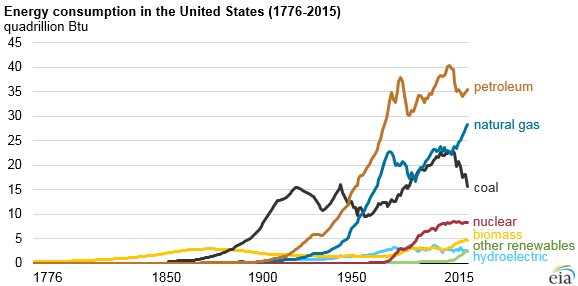
Take the US for example:
main.png

Coal and oil are down. Natural gas and renewables are all trending up.

In my area 100% renewable electric power was only $0.06-0.07 per kWh.

So I'll stand by my original assertion that one or both of them were full of it. ;)