
-
We’re currently investigating an issue related to the forum theme and styling that is impacting page layout and visual formatting. The problem has been identified, and we are actively working on a resolution. There is no impact to user data or functionality, this is strictly a front-end display issue. We’ll post an update once the fix has been deployed. Thanks for your patience while we get this sorted.
You are using an out of date browser. It may not display this or other websites correctly.
You should upgrade or use an alternative browser.
You should upgrade or use an alternative browser.
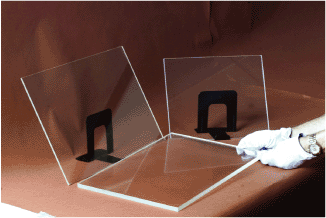
When do you think we'll see transparent aluminum products at the consumer level?
- Thread starter JEDI
- Start date



Charmonium
Lifer
They'll never do that. Then you'd be able to see all of the rat parts in your soda.Star Trek is reality:
waiting for Transparent soda cans 😀

lxskllr
No Lifer
It's not really aluminum, though. It's a ceramic that is something like 30% Al.
So it's a cut rate lead crystal?

zerocool84
Lifer
Depends what you consider consumer level. On cars, that type of stuff would only be on super cars that none of us regular people could afford.

destrekor
Lifer
It's not really aluminum, though. It's a ceramic that is something like 30% Al.
Depends which type it is: is it ALON, or heat-pressed spinel? Spinel, or MgAl2O4, is about 37% Al by mass.
But ALON (or AlON when not using the trademarked variant), Aluminum Oxynitride... well I can't find the specs.
Both are ultimately taking advantage of a similar method, creating a ceramic composed of a spinel crystal formation. I believe the heat-pressed variety is taking straight MgAl2O4 as a powder and heat-pressing it... but AlON is more of a generic description that can describe a few different molecular compositions.

twinrider1
Diamond Member
Depends what you consider consumer level. On cars, that type of stuff would only be on super cars that none of us regular people could afford.
Maybe in very limited amounts, such as the A pillar.

CZroe
Lifer
Pics in the OP are wishful thinking. Aluminum isn't being used to eliminate seams in other car body panels so why would transparent aluminum that replaces the windshield be used for that? It's a bad thing anyway. Most people think individually replaceable parts make more sense. Those people are right. Also, you can't smash the window to get out if the aluminum bends.
The reasons we don't use plastic to make that same concept car today are the same reasons we wouldn't use aluminum even if it were transparent (it scratches, it bends/isn't rigid, it doesn't shatter where you might need it to, etc). They aren't thinking this through.
The reasons we don't use plastic to make that same concept car today are the same reasons we wouldn't use aluminum even if it were transparent (it scratches, it bends/isn't rigid, it doesn't shatter where you might need it to, etc). They aren't thinking this through.
Last edited:
Depends which type it is: is it ALON, or heat-pressed spinel? Spinel, or MgAl2O4, is about 37% Al by mass.
But ALON (or AlON when not using the trademarked variant), Aluminum Oxynitride... well I can't find the specs.
Both are ultimately taking advantage of a similar method, creating a ceramic composed of a spinel crystal formation. I believe the heat-pressed variety is taking straight MgAl2O4 as a powder and heat-pressing it... but AlON is more of a generic description that can describe a few different molecular compositions.
Isn't "heat pressed" sintering?

MrPickins
Diamond Member
Depends which type it is: is it ALON, or heat-pressed spinel? Spinel, or MgAl2O4, is about 37% Al by mass.
But ALON (or AlON when not using the trademarked variant), Aluminum Oxynitride... well I can't find the specs.
Both are ultimately taking advantage of a similar method, creating a ceramic composed of a spinel crystal formation. I believe the heat-pressed variety is taking straight MgAl2O4 as a powder and heat-pressing it... but AlON is more of a generic description that can describe a few different molecular compositions.
That's what I was getting at, though. You can't call this aluminum any more than you can call a ruby or a sapphire aluminum.
Pics in the OP are wishful thinking. Aluminum isn't being used to eliminate seams in other car body panels so why would transparent aluminum that replaces the windshield be used for that? It's a bad thing anyway. Most people think individually replaceable parts make more sense. Those people are right. Also, you can't smash the window to get out if the aluminum bends.
The reasons we don't use plastic to make that same concept car today are the same reasons we wouldn't use aluminum even if it were transparent (it scratches, it bends/isn't rigid, it doesn't shatter where you might need it to, etc). They aren't thinking this through.
It's not aluminum and it doesn't have the properties of aluminum.
Last edited:

CZroe
Lifer
That's what I was getting at, though. You can't call this aluminum any more than you can call a ruby or a sapphire aluminum.
It's not aluminum and it doesn't have the properties of aluminum.
...and if it had the properties of glass or plastic we'd be using those. The fantasy is in what properties of aluminum we can retain in a transparent form.
The OP did not say what kind of transparent aluminum the pictures were depicting... a fantasy one or the one you are talking about. There is no link so I don't know why you're so sure he isn't talking about Star Trek transparent aluminum.
destrekor
Lifer
Isn't "heat pressed" sintering?
Yes - I forgot that word and just rolled with it.
destrekor
Lifer
...and if it had the properties of glass or plastic we'd be using those. The fantasy is in what properties of aluminum we can retain in a transparent form.
The OP did not say what kind of transparent aluminum the pictures were depicting... a fantasy one or the one you are talking about. There is no link so I don't know why you're so sure he isn't talking about Star Trek transparent aluminum.
I imagine all of that COULD be done... but would it be practical? For the car? Nope to the nope.
But for the kayak? Hell yes please. That would be awesome.
MrPickins
Diamond Member
...and if it had the properties of glass or plastic we'd be using those. The fantasy is in what properties of aluminum we can retain in a transparent form.
The OP did not say what kind of transparent aluminum the pictures were depicting... a fantasy one or the one you are talking about. There is no link so I don't know why you're so sure he isn't talking about Star Trek transparent aluminum.
Really I'm just venting because all the headlines I see in articles about Aluminium oxynitride describe this as a transparent form of aluminum, and people take it at face value.
CZroe
Lifer
I imagine all of that COULD be done... but would it be practical? For the car? Nope to the nope.
But for the kayak? Hell yes please. That would be awesome.
Why can't you do that with plastic? Is there any reason to think that aluminum would be better or more scratch-resistant or more able to flex?
What I'm saying is that there is no sense in imagining things that are already perfectly possible with other materials that do not require any special properties of transparent aluminum.
Last edited:
destrekor
Lifer
Why can't you do that with plastic? Is there any reason to think that aluminum would be better or more scratch-resistant or more able to flex?
What I'm saying is that there is no sense in imagining things that are already perfectly possible with other materials that do not require any special properties of transparent aluminum.
Because.


Rakehellion
Lifer
You mean sapphire? Apple tried to do that with the last iPhone but their partner wasn't able to keep up with demand.


DigDog
Lifer
It's not really aluminum, though. It's a ceramic that is something like 30% Al.
that's still pretty darn impressive.

MrPickins
Diamond Member
that's still pretty darn impressive.
I don't disagree with you.

werepossum
Elite Member
Given that aluminum oxynitride is more dense than water it would only be awesome once, until submerged. Then it would be drifting along the bottom and damned hard to find.I imagine all of that COULD be done... but would it be practical? For the car? Nope to the nope.
But for the kayak? Hell yes please. That would be awesome.
CZroe
Lifer
Metal ships float when most any shipbuilding metal is more dense than water. The entire volume of the submerged portion must be less dense, which is easy in a boat-shaped design that displaces most of that volume with air. You can make a glass boat too!Given that aluminum oxynitride is more dense than water it would only be awesome once, until submerged. Then it would be drifting along the bottom and damned hard to find.
Last edited:
TRENDING THREADS
-
 Discussion Zen 5 Speculation (EPYC Turin and Strix Point/Granite Ridge - Ryzen 9000)
- Started by DisEnchantment
- Replies: 25K
-
Discussion Intel Meteor, Arrow, Lunar & Panther Lakes + WCL Discussion Threads
- Started by Tigerick
- Replies: 25K
-
 Discussion Intel current and future Lakes & Rapids thread
- Started by TheF34RChannel
- Replies: 24K
-

-
