Whatever happened to Moore's law, amd??

Page 3 - Seeking answers? Join the AnandTech community: where nearly half-a-million members share solutions and discuss the latest tech.

frostedflakes

Diamond Member
Mar 1, 2005
7,925
1
81
As others have mentioned, Moore's law has to do with the number of transistors you can fit onto a CPU, not processor performance (although the two are usually closely related). The idea is that the number of transistors you can fit onto a CPU (for a reasonable price) will double *approximately* every 18 months. AMD has been a bit slower to transition to smaller process nodes than Intel, but they keep up pretty well. I think they've been taking about 24 months between processes, whereas Intel has kept up with 18 pretty well.
 

Hyperlite

Diamond Member
May 25, 2004
5,664
2
76
As others have mentioned, Moore's law has to do with the number of transistors you can fit onto a CPU, not processor performance (although the two are usually closely related). The idea is that the number of transistors you can fit onto a CPU (for a reasonable price) will double *approximately* every 18 months. AMD has been a bit slower to transition to smaller process nodes than Intel, but they keep up pretty well. I think they've been taking about 24 months between processes, whereas Intel has kept up with 18 pretty well.

I also consider there to be a difference between raw processor speed and parallelism in processing. Ideally, with software and architectural advances, there won't be a need for such delineation (turbo mode is a good start), but it's obviously still an issue...both from a cost perspective and a performance perspective.
 

aigomorla

CPU, Cases&Cooling Mod PC Gaming Mod Elite Member
Super Moderator
Sep 28, 2005
21,131
3,663
126
*sigh*

you guys are missing the point in why i brought out servers.

Because a 2P Amd system is always greater then a 1P AMD system.
And you really cant OC a 2P AMD system.

Well in intel language... that doesnt apply with the introduction of skullfail 2.
We can overclock a server platform, so a server platform is now in the overclocking table.

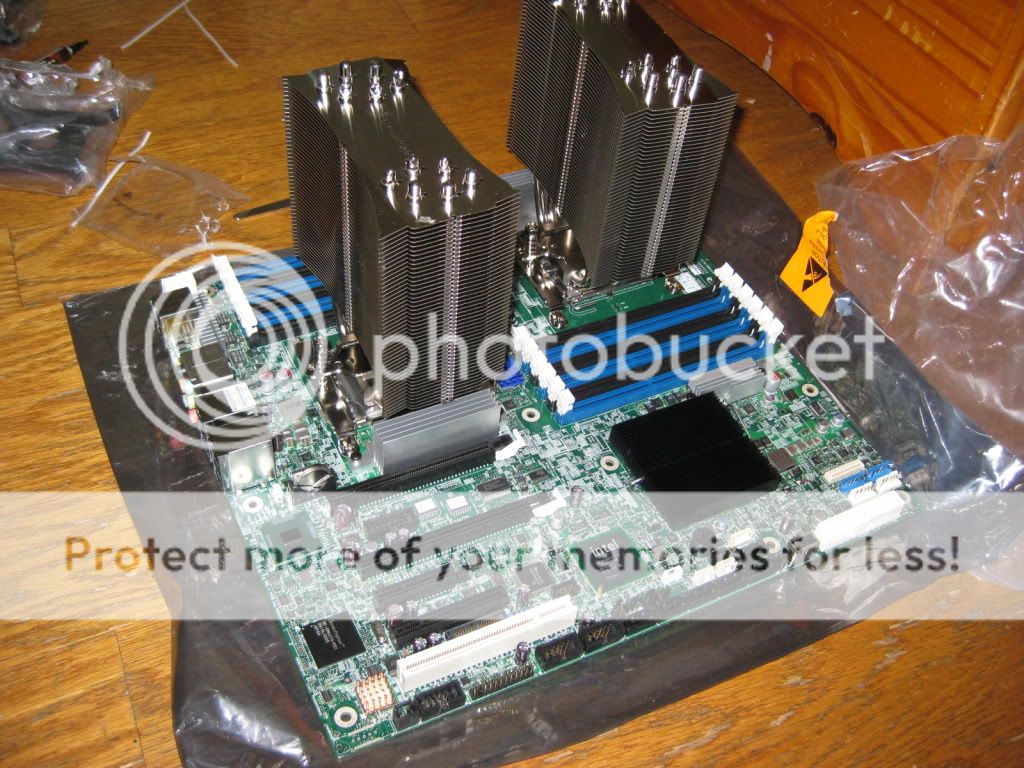
And i have a real full blown server... how many times must i spam this picture for you
IMG_1614.jpg

^ stock 8c/16t system is slower then my overclocked 6c/12t.
(FACT)

The only intel cpu i didnt touch this year is the LGA1156 + becktons + mobile.


But i was offered 4 becktons but the board would of required a 10 page NDA contract from my sponsor.

So i ultimately passed...

Also you cant overclock a beckton, or magny, like you can on a gulftown.

But Blah... i have shown countless times on WCG, and HWBOT that an overclocked Gulfy with faster ram timings, and all the bells associated with OC will give a Dual 12C/24T gulfy stock, a good run for its money.

And seems like none of you guys will believe me no matter how many times i say it.

So i'll just leave it at that...
 

deimos3428

Senior member
Mar 6, 2009
697
0
0
And i have a real full blown server... how many times must i spam this picture for you
Sorry for being Captain Obvious, but that's a server motherboard -- not a server. I assume you're using it for enthusiast purposes, because you'd be a fool to put something like that in production.

Server = stock. That's a bigger 'law' that Moore's Law will ever be.
 

RaiderJ

Diamond Member
Apr 29, 2001
7,582
1
76
AMD isn't keeping up. How does the phenom II compare to the i7? It doesn't. It barely keeps up with the C2D/Q. Thats a bad thing, it basically means that Intel doesn't have a reason to do R&D. Why create something faster then todays CPU's when nobody can compete with you?

I really hope that AMD pulls their act together, but it isn't likely that they will any time soon.

AMD is still competitive on the lower end on a price/performance ratio. The last couple years has been really tough on them, but they're starting to even make money now. If GPGPU takes off, they might really have a headstart on Intel having bought ATI. It'll be a couple years before that comes to anything.
 

cbn

Lifer
Mar 27, 2009
12,968
221
106
If GPGPU takes off, they might really have a headstart on Intel having bought ATI.

That is true, but Intel still has the process technology lead. So even if Intel's IGPs are weaker designs they can still pack almost twice as many transistors in the same die area (if they beat AMD to 22nm) to compensate.

After that...

I guess the Big question is will there be a slow down in die shrink cadences? Will 16nm and 11nm be harder to achieve than the previous nodes? If so, what will be the implications of this on chip design? Will will see faster frequencies (rather than increased xtor density) for GPUs to compensate for lack of reduction in die sizes?
 
Last edited:

frostedflakes

Diamond Member
Mar 1, 2005
7,925
1
81
Stacked/3D integrated circuits should allow Moore's law to continue for a while longer, even once we reach the limits that we can shrink the width and length of silicon transistors (which is around 10nm IIRC). I doubt there will be any slowdown, every shrink has its share of engineering challenges, yet the brilliant minds at these companies still manage to do it every 18-24 months.

Once we reach the limits of stacked silicon circuits... who knows. Graphene based transistors, maybe? :)
 

Cogman

Lifer
Sep 19, 2000
10,286
147
106
AMD doesn't have any high end products, in the consumer market. That said, we all know they are competitive at respective price points of their offerings.

Phenom II 965 = $180
i5 750 = $190

http://www.anandtech.com/bench/default.aspx?p=102&p2=109&c=1

Phenom- 24 wins
i5- 20 wins

and please, sweet jesus, do not bring up OCing. Companies don't base their processor prices around OC abilities. Even then, with the newer stepping denab's not having a problem with the 4ghz wall, it competes even better against its similarly priced intel offering. Just sayin ;)
When did I ever bring up OC other then to make fun of aigomorla for posting a benchmark comparing an overclocked CPU to a non-overclocked CPU?

Either way, the low end is not a good place to be. Intel could EASILY just drop the prices of their CPUs to a point where amd gains no money by being at the price point that they are at. Intel has complete control of the market right now, that is a bad thing. The only way for them to be "encouraged" to develop is if AMD has offerings that beat more then just their low end.

While I'm sure its a typo one way or another, just trying to keep facts strait here...

The i870 has HTT, which makes me think you were referring to the i750. The 920 has a triple channel IMC which no longer makes this a HTT vs no HTT compairison
Woops, Guess that's what I get when I make assumptions. I assumed that the i870 wasn't HT and that the i920 was. My mistake. There really isn't a good HT comparison then as none of the models offer turning off HT, and none of the none HT models really compare to the HT models. That means we pretty much have to look back at the P4 days and assume that things are being done mostly the same.
 

alyarb

Platinum Member
Jan 25, 2009
2,425
0
76
you can disable HT. there were numerous articles published when bloomfield was new, advocating that you disable it to achieve higher clocks. some games ran faster with HT off, so you got higher clocks and higher performance. content creators would prefer to leave it on.

I think the i5 750 would have to be $160 or $150 and the i3 530 would have to be $99 for intel to have "complete control."
 
Last edited:

Cogman

Lifer
Sep 19, 2000
10,286
147
106
Stacked/3D integrated circuits should allow Moore's law to continue for a while longer, even once we reach the limits that we can shrink the width and length of silicon transistors (which is around 10nm IIRC). I doubt there will be any slowdown, every shrink has its share of engineering challenges, yet the brilliant minds at these companies still manage to do it every 18-24 months.

Once we reach the limits of stacked silicon circuits... who knows. Graphene based transistors, maybe? :)
There are a couple of problems with stacked/3D circuits. For instance, it doesn't really get rid of the heat issue (transistors still give off heat). It would also add capacitance problems into the system, potentially slowing down the max speed of the circuits.

Not saying that its a bad idea, just that it has some pretty big problems that it has to overcome which non-stack circuits do see so much.

Probably that other change might be to start a new architecture. We might see the death of x86 as we know it in favor of a slimmer, non-bloated architecture. (Heck, it could keep a lot of x86 but just rid itself of worthless legacy stuff such as MMX registers)
 

Cogman

Lifer
Sep 19, 2000
10,286
147
106
you can disable HT. there were numerous articles published when bloomfield was new, advocating that you disable it to achieve higher clocks. some games ran faster with HT off, so you got higher clocks and higher performance. content creators would prefer to leave it on.

I think the i5 750 would have to be $160 or $150 and the i3 530 would have to be $99 for intel to have "complete control."
Dang it, I stand corrected again. I thought HT was hardwired on. Either way, what I was saying was correct, except for the availability of HT and the ability to enable/disable it.

deneb_vs_kentsfield_yorkfield_bloom.png


This is probably the best example of it. Especially Far cry 2. With HT performance is somewhat hurt. And, of course, x264, a highly optimized program, sees HUGE benefits from turning on HT.
 

frostedflakes

Diamond Member
Mar 1, 2005
7,925
1
81
There are a couple of problems with stacked/3D circuits. For instance, it doesn't really get rid of the heat issue (transistors still give off heat). It would also add capacitance problems into the system, potentially slowing down the max speed of the circuits.

Not saying that its a bad idea, just that it has some pretty big problems that it has to overcome which non-stack circuits do see so much.

Probably that other change might be to start a new architecture. We might see the death of x86 as we know it in favor of a slimmer, non-bloated architecture. (Heck, it could keep a lot of x86 but just rid itself of worthless legacy stuff such as MMX registers)
Stacked circuits will probably continue the trend we've seen with parallel processing. We'll move to more cores, but clocked at lower speeds to help keep heat in check. It's a more efficient way to increase performance than increasing clock speed, assuming the applications you use are threaded.

For example, I've done some tweaking with cores/voltage/frequency on my Phenom II to find the best performance per watt. These two configurations draw exactly the same amount of power (measured with a Kill-a-Watt), yet the quad core at a slightly lower per core clock will be much faster than the dual core config (again, assuming you use applications that scale well with multiple threads). The voltages are the lowest possible that the processor could run stable at:

2 cores, 3.1GHz, 1.200V
4 cores, 2.6GHz, 1.025V

Obviously there are challenges, but I'd assume it's one of the better options available, because I think Intel and AMD/IBM are all dumping a lot of R&D money into it.

As far as x86, I doubt it's going anywhere soon. It's far too ubiquitous.
 

Hyperlite

Diamond Member
May 25, 2004
5,664
2
76
When did I ever bring up OC other then to make fun of aigomorla for posting a benchmark comparing an overclocked CPU to a non-overclocked CPU?

Either way, the low end is not a good place to be. Intel could EASILY just drop the prices of their CPUs to a point where amd gains no money by being at the price point that they are at. Intel has complete control of the market right now, that is a bad thing. The only way for them to be "encouraged" to develop is if AMD has offerings that beat more then just their low end.

Oh no man that bit wasn't directed at you, sorry.


Aigo. I can't really fathom how your reading comprehension is so atrocious, but no one is arguing the speed of your system. No one is arguing that a heavily overclocked 6c/12t system is faster than a stock 8c/16t system (potentially). You don't need to prove you have money. You don't need to prove you have connections in the industry. You DO need to prove you have any factual basis for the conjecture you spout. I realize you've backed off your (ridiculous) position on Magny, and i appreciate that. Just spend a little more time examining a thread before you repeat the exact. same. thing. you say in every thread that allows you to flex your (imaginary) ego.

Now all that said, i'm extremely curious to watch the epic power consumption showdown in the coming months! So we know HT increases power consumption, we (assume) it's going to take a 25% clock increase to match Magny in performance. Both those things require considerable power draw. BUT, as we know, magny will incorporate a "hardware" hyperthreading solution, which i can only assume is going to have a larger power impact than Intel's HT. also BUT, will that implementation show greater performance increase? hmmm....
 

bobsmith1492

Diamond Member
Feb 21, 2004
3,875
3
81
Moore's law states that the number of transistors on an integrated circuit doubles roughly every 18 months.

Don't GPUs have more transistors on the die than the latest CPUs? Perhaps Moore's mantle has passed to the video processors.
 

EarthwormJim

Diamond Member
Oct 15, 2003
3,239
0
76
Moore's law states that the number of transistors on an integrated circuit doubles roughly every 18 months.

Don't GPUs have more transistors on the die than the latest CPUs? Perhaps Moore's mantle has passed to the video processors.

No it's still relevant. AMD has gone to new process sizes for essentially the same CPU, their transistor density has basically doubled (Phenom I to Phenom II).

Moore's law is transistor density, not just transistor count (and also cost, for double the density cost remains the same).
 

frostedflakes

Diamond Member
Mar 1, 2005
7,925
1
81
Yeah I guess that's a better way of looking at it. It's about how many transistors you can put in the same area/manufacture for the same price. For example at 32nm the transistors are about 71% the length and width that they are at 45nm. That corresponds to about 50% of the area at 32nm than at 45nm, meaning you can fit twice as many on the same size wafer using a 32nm process vs 45nm.
 

beginner99

Diamond Member
Jun 2, 2009
5,320
1,768
136
Does it really matter if gilftown or magny cours is faster? not really unless you know the price.
And that's where intel will win in any case, because gulftown's die is sure less than half of that of magny cours.
-> intel wins more money for each cpu sold.

And if AMD does have a surprise, intel can just lower their prices and still be better off than AMD is now.
 

taltamir

Lifer
Mar 21, 2004
13,576
6
76
moors law is really more like "moors general observation that isn't entirely accurate".
AMD hasn't been able to keep up with it. Intel has been intentionally holding back for years and actually uses moors law as a marketing target.
We are getting into a point where advancing CPU tech is very difficult.
If you look at SSD, most companies have advanced far faster then moors law, with the overall SSD speed being doubled every 3 months early on, later 6 months... and now we continue to slow the trend, but are still advancing far faster than moors law.
 

386DX

Member
Feb 11, 2010
197
0
0
AMD doesn't have any high end products, in the consumer market. That said, we all know they are competitive at respective price points of their offerings.

Phenom II 965 = $180
i5 750 = $190

http://www.anandtech.com/bench/default.aspx?p=102&p2=109&c=1

Phenom- 24 wins
i5- 20 wins

and please, sweet jesus, do not bring up OCing. Companies don't base their processor prices around OC abilities. Even then, with the newer stepping denab's not having a problem with the 4ghz wall, it competes even better against its similarly priced intel offering. Just sayin ;)

Maybe you should look at the benchmarks a bit more carefully.
I got:

i5 - 34 wins
Phenom - 9 wins
with 1 tie.

You were giving the Phenom all the wins on the benchmarks that says "Lowest is better". And the wins the Phenom did have where just marginal wins.

So yeah nice try.

-LeeBear
 

Enigmatic

Member
Oct 8, 2005
55
0
0
I was always under the impression that Intel intentionally did not hit the lower-end markets as aggressively just to keep AMD alive. Barely financially stable as a company (talking about AMD), yet existing nonetheless just so they can prevent a monopoly situation from occurring.

Considering that Intel's architecture's OCing headroom is quite a bit above AMDs I imagine they could clock many of there processors higher at equivalent price points or release cheaper quad-cores and essentially cripple AMD at each respective price point, but Intel is a profitable company... and there is no real competitive incentive to do such a thing (and risk a monopoly situation).

I really hope AMD can bust out an architecture that is as revolutionary as K8 was back when it came out. I'll keep my fingers crossed.
 

cbn

Lifer
Mar 27, 2009
12,968
221
106
I was always under the impression that Intel intentionally did not hit the lower-end markets as aggressively just to keep AMD alive. Barely financially stable as a company (talking about AMD), yet existing nonetheless just so they can prevent a monopoly situation from occurring.

Considering that Intel's architecture's OCing headroom is quite a bit above AMDs I imagine they could clock many of there processors higher at equivalent price points or release cheaper quad-cores and essentially cripple AMD at each respective price point, but Intel is a profitable company... and there is no real competitive incentive to do such a thing (and risk a monopoly situation).

I really hope AMD can bust out an architecture that is as revolutionary as K8 was back when it came out. I'll keep my fingers crossed.

Yep,

I think a lot of us are really looking forward to much higher IPC processors (not increased core counts). But with Intel in the lead by such a huge margin it doesn't look like it will happen.
 

nonameo

Diamond Member
Mar 13, 2006
5,902
2
76
I was always under the impression that Intel intentionally did not hit the lower-end markets as aggressively just to keep AMD alive. Barely financially stable as a company (talking about AMD), yet existing nonetheless just so they can prevent a monopoly situation from occurring.

Considering that Intel's architecture's OCing headroom is quite a bit above AMDs I imagine they could clock many of there processors higher at equivalent price points or release cheaper quad-cores and essentially cripple AMD at each respective price point, but Intel is a profitable company... and there is no real competitive incentive to do such a thing (and risk a monopoly situation).

I really hope AMD can bust out an architecture that is as revolutionary as K8 was back when it came out. I'll keep my fingers crossed.

The thing is, I remember that even when AMD had the lead (k8) intel processors were still not quite priced competitively. Intel doesn't really have to compete at all, their history and marketing are so good that big OEMs like dell and HP will continue to buy from them for years to come, and tbh, your average consumer really doesn't care what's in his/her computer.
 

aigomorla

CPU, Cases&Cooling Mod PC Gaming Mod Elite Member
Super Moderator
Sep 28, 2005
21,131
3,663
126
no im not going to contribute anything else to this thread.

Because it seems like NO ONE CARES on the stuff i post.
So you guys can wait and see when gulftown does Tear Magony a new one.

Because i have seen it, oh... but its all inside information that i cant really leak out.

Let me ask you guys who do know me..

HOW MANY TIMES HAVE I BEEN WRONG?
And HOW many times have i made people go OOPS
:hmm:


The guys who know me know not to go against me, unless i grossly messed up on something.

But IDC hasnt posted... neither has mark... we dont see Dmens..

Once again in a few months when things become offical, lets see who was wrong now shall we?