

What will cause a $100 core i5 to happen?

Page 4 - Seeking answers? Join the AnandTech community: where nearly half-a-million members share solutions and discuss the latest tech.

witeken

Diamond Member
Dec 25, 2013
3,899
193
106
Google is in its growth phase, so the organic growth of the business and the buzz around what it does is enough to keep the share price performing relatively well.

Once that growth phase starts slowing down, investors will complain that the stock has been underperforming (in fact, YTD, GOOG/GOOGL has been a poor performer, so what I am describing is probably not too far off), and will eye the ~$52 billion in net cash that Google has sitting on its balance sheet.

Google will probably start with a dividend first, and will pay out in dividends most of its domestic free cash flow. If that, coupled with business performance, isn't enough to satisfy investors, then expect to see Google take out debt against its foreign cash hoard and use that cash to buy-back shares.

Interesting, and what if Google doesn't start paying dividends because who cares what greedy investors, who rather wouldn't want a company innovate and just get the ROI, think a company should do? (BTW, I don't really have a strong opinion, just asking because I'm curious.)
 

witeken

Diamond Member
Dec 25, 2013
3,899
193
106
However, if Intel had not bought back shares/paid the dividends, Intel would probably still be in the exact same place because all of that profit would have just sat on the balance sheet as "cash and equivalents."

How do you know? For example, I hear Russ Fisher talking about mobile as something they were to busy for because they were conquering the data center, which is highly profitable and crucial for those devices to work. Surely Intel wouldn't have been too busy if it had tons of cash (waiting to be used for the next step step towards Moore's Law's computing ubiquity)?
 
Mar 10, 2006
11,715
2,012
126
Interesting, and what if Google doesn't start paying dividends because who cares what greedy investors, who rather wouldn't want a company innovate and just get the ROI, think a company should do? (BTW, I don't really have a strong opinion, just asking because I'm curious.)

Then Google's investors start selling their stock, the share price goes down as a result of this selling, and all of the executives whose pay is tied, at least in part, to share price performance make far less money than they would have otherwise.
 

witeken

Diamond Member
Dec 25, 2013
3,899
193
106
Intel's R&D budget has continued to increase over time, so Intel is investing at the proper levels.

A well-managed business grows R&D/SG&A expenses alongside revenues. In particular, Intel targets 30% of revenue for R&D and MG&A spending. This means that if Intel achieves its goal, it will spend a constant percentage of revenues investing in its business, but as the business grows, the spending in absolute dollar terms grows too.

That is lower than what they are currently spending:

Intel guided to $18.9 billion (plus or minus $200 million) for R&D plus MGA expenses in 2013.
 
Mar 10, 2006
11,715
2,012
126
How do you know? For example, I hear Russ Fisher talking about mobile as something they were to busy for because they were conquering the data center, which is highly profitable and crucial for those devices to work. Surely Intel wouldn't have been too busy if it had tons of cash (waiting to be used for the next step step towards Moore's Law's computing ubiquity)?

Intel could have easily afforded the R&D needed to play in mobile if it had chosen to -- buybacks or not. The problem is that Intel's management chose not to invest there and to instead focus its R&D on PCs and the data-center.

Both of those businesses are wildly profitable -- each far more profitable than Qualcomm's entire chip business, FYI -- but given how important mobile is to the future of computing, this was a huge gaffe on Intel management's part.
 
Mar 10, 2006
11,715
2,012
126
That is lower than what they are currently spending:

Correct. That is Intel's long-term target, but since they need to invest at the level they are investing, they're coming in above.

Right now, Intel is investing a lot into mobile, but it has very little revenue to show for it, which leads to elevated R&D/MG&A as a percentage of revenue. When/if the Intel mobile revenues start flowing in a material fashion, this should raise revenue without too large of an associated growth in spending related to those efforts.

That would help Intel hit its target of 30% of revenue allocated to operating expenses.
 

witeken

Diamond Member
Dec 25, 2013
3,899
193
106
Then Google's investors start selling their stock, the share price goes down as a result of this selling, and all of the executives whose pay is tied, at least in part, to share price performance make far less money than they would have otherwise.

Then Google can simply start paying their employees with the cash that would otherwise have gone to shareholders.

But anyway, if that would happen, wouldn't the stock become underpriced for the company's size, so other investors would start investing and the stock price would go up (certainly if there is still upside potential) and you end up with the same thing as what's happening to any other company, even companies that pay lots to shareholders like Intel?
 
Mar 10, 2006
11,715
2,012
126
Then Google can simply start paying their employees with the cash that would otherwise have gone to shareholders.

But anyway, if that would happen, wouldn't the stock become underpriced for the company's size, so other investors would start investing and the stock price would go up (certainly if there is still upside potential) and you end up with the same thing as what's happening to any other company, even companies that pay lots to shareholders like Intel?

Well, I would say the biggest and most important driver of stock price is business performance and perceived future prospects. Google can afford to not bother with dividends/buybacks as long as the business itself keeps on showing strong revenue/profit growth.

It's only when the business begins to see a slowdown do buybacks/dividends play an important role for investors.

For example, you probably remember the example of Apple. For years, they didn't pay a cent to shareholders in dividends/buybacks because, wow, they were growing like crazy both in revenue and profit. However, once the share price began to perform poorly as a result of what appeared to be slowing growth and lower margins (Apple's net income in 2013 was lower than that in 2012, I believe), the buybacks and dividends came into play.
 

witeken

Diamond Member
Dec 25, 2013
3,899
193
106
Intel could have easily afforded the R&D needed to play in mobile if it had chosen to -- buybacks or not. The problem is that Intel's management chose not to invest there and to instead focus its R&D on PCs and the data-center.

Both of those businesses are wildly profitable -- each far more profitable than Qualcomm's entire chip business, FYI -- but given how important mobile is to the future of computing, this was a huge gaffe on Intel management's part.

If we go to an alternate universe where shareholder return (and the worries that come with making sure there will be) doesn't exist, and Paul Otellini is wondering what it could use the company's $40B cash for, and Apple came in and asked them for a CPU for the next big thing, wouldn't PO be far more inclined to say yes because there's no shareholder money to burn if it turns out to be an unprofitable business?
 

witeken

Diamond Member
Dec 25, 2013
3,899
193
106
That would help Intel hit its target of 30% of revenue allocated to operating expenses.

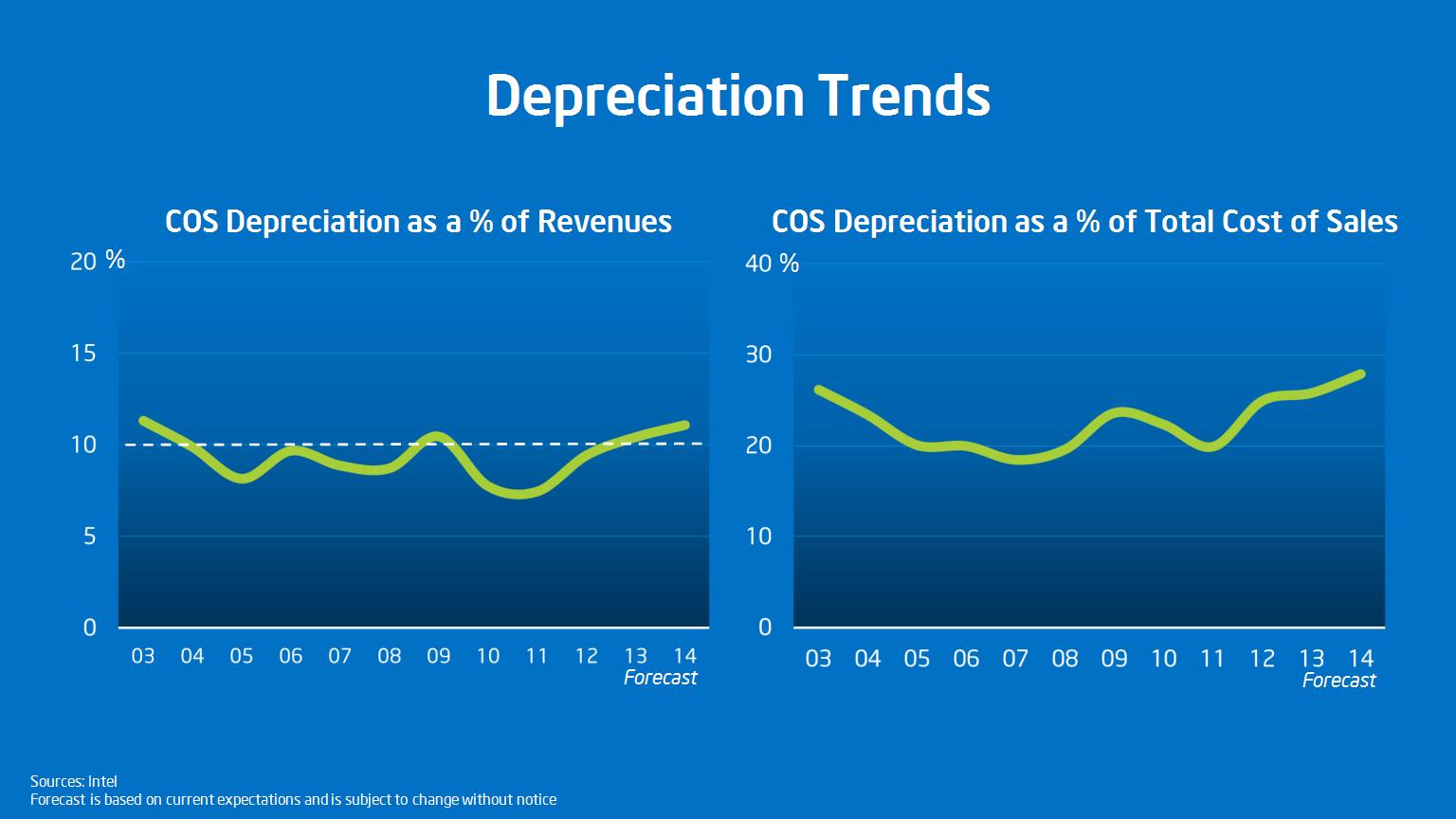
Is that this target, or is this something else:

exh99142.jpg
 
Mar 10, 2006
11,715
2,012
126
Then Google can simply start paying their employees with the cash that would otherwise have gone to shareholders.

Ah, but then you start to hurt free cash flow and you can't show the much-prettier non-GAAP operating income ;) Companies like Google basically pay employees quite a bit in stock. Then, in order to make their profitability look better than it really is, they provide "non-GAAP" operating income which excludes share based compensation.

From Google's most recent earnings report:

GAAP operating income in the third quarter of 2014 was $3.72 billion, or 23% of revenues. This compares to GAAP operating income of $3.76 billion, or 27% of revenues, in the third quarter of 2013. Non-GAAP operating income in the third quarter of 2014 was $5.36 billion, or 32% of revenues. This compares to non-GAAP operating income of $4.62 billion, or 34% of revenues, in the third quarter of 2013.

GAAP operating income was $3.72 billion because they have to actually count shares used for compensation as an operating expense. But non-GAAP, which excludes this comp (among other things, but share based comp is the biggest one), was $5.36 billion.
 
Last edited:
Mar 10, 2006
11,715
2,012
126
If we go to an alternate universe where shareholder return (and the worries that come with making sure there will be) doesn't exist, and Paul Otellini is wondering what it could use the company's $40B cash for, and Apple came in and asked them for a CPU for the next big thing, wouldn't PO be far more inclined to say yes because there's no shareholder money to burn if it turns out to be an unprofitable business?

In such a universe, companies would essentially strive to operate at break-even. However, keep in mind that in this alternate universe, competitors are also freed from the constraints of trying to earn a profit.

I can't say what would have been different in such a world, but think of it this way: companies literally exist to make investments that pay off as highly as possible.

When a company develops a CPU core, they spend $X on it and hope to earn $Y, where Y > X and Y is as large as possible. There is no point in spending $X on a project to just to breakeven...otherwise, why invest that money?

Intel investing in building a CPU core is no different from an individual stockholder investing money in shares of a company. Both are doing so with the expectation of generating a return on that invested capital, and the individual investor buying shares in a company is essentially saying, "If I had this amount of money to invest and these resources at my disposal, this is how I would invest. But since I don't, I'll just buy-in on what this company is doing and profit that way."
 
Last edited:

witeken

Diamond Member
Dec 25, 2013
3,899
193
106
Ah, but then you start to hurt free cash flow and you can't show the much-prettier non-GAAP operating income ;) Companies like Google basically pay employees quite a bit in stock. Then, in order to make their profitability look better than it really is, they provide "non-GAAP" operating income which excludes share based compensation.

I guess I could now ask why that matters (etc. ad infinitum), but I guess this is simply how capitalism works.
 

witeken

Diamond Member
Dec 25, 2013
3,899
193
106
In such a universe, companies would essentially strive to operate at break-even. However, keep in mind that in this alternate universe, competitors are also freed from the constraints of trying to earn a profit.

I can't say what would have been different in such a world, but think of it this way: companies literally exist to make investments that pay off as highly as possible.

When a company develops a CPU core, they spend $X on it and hope to earn $Y, where Y > X and Y is as large as possible. There is no point in spending $X on a project to just to breakeven...otherwise, why invest that money?

Intel investing in building a CPU core is no different from an individual stockholder investing money in shares of a company. Both are doing so with the expectation of generating a return on that invested capital, and the individual investor buying shares in a company is essentially saying, "If I had this amount of money to invest and these resources at my disposal, this is how I would invest. But since I don't, I'll just buy-in on what this company is doing and profit that way."

If that universe still consists of darwinian life, then I don't expect the company's management to be happy with breakeven, because even ignoring money you could strive for as much market share, for example, and you need money to invest to reach that goal. You'd invest because if you didn't, another company would invest and take your sales and if you don't have sales, you don't have money to sustain your life. All excess in money would be used for innovation (things that are good for humanity instead of a minority) instead of making the rich richer.

I guess this would be some sort mix between capitalism and communism.

Only 2 different people have replied on this page so far, lol
 

Ken g6

Programming Moderator, Elite Member
Moderator
Dec 11, 1999
16,828
4,812
75
I know one thing that will do it: Time. ;) Although I guess redefining i5 to be 2 cores with HT and turbo also helps. :p
